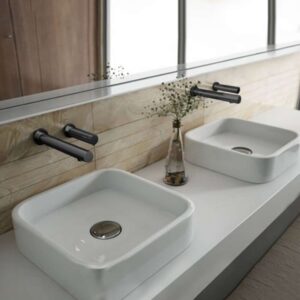
In today’s commercial spaces, functionality and design go hand in hand. Our commercial bathroom faucets are built to meet the highest standards of durability, hygiene, and style. Designed for hotels, offices, schools, and public facilities, each faucet delivers reliable performance while elevating the overall restroom experience.
Featuring touchless operation, water-saving technology, and sleek modern finishes, these faucets help maintain cleanliness and efficiency in high-traffic environments. Whether you’re upgrading an existing restroom or planning a new project, our collection offers the perfect balance of innovation and lasting quality.
Choose faucets that reflect your commitment to professionalism, sustainability, and modern design — because every detail counts when creating a clean, welcoming space.
Modern Commercial Restroom Fixtures | Touchless Faucets & Sinks
Commercial Bathroom Solutions | Professional Fixtures for Every Space
Common Failure Points in Commercial Touchless Fixtures
An AEC-oriented risk overview of the operational issues most commonly encountered in commercial touchless faucets and automatic soap dispensers.
Good restroom design is not only about what looks coordinated on opening day. It is also about minimizing false triggers, service calls, downtime, soap waste, voltage issues, user frustration, and maintenance complexity over the life of the project.
Why Failure Analysis Strengthens Specification Quality
Architects and specifiers often focus first on form, finish, and brand family alignment. Those are valid concerns, but many commercial restroom fixture failures originate from technical and operational mismatches rather than visual design. A faucet can be beautifully styled and still cause persistent complaints if its sensor bounces off a reflective sink, if its power system is poorly matched to the installation, or if its service access forces excessive labor during routine maintenance.
By reviewing failure modes before final selection, project teams can specify products more intelligently and reduce lifecycle problems. The matrix below is intended to support that kind of risk-aware decision-making.
Failure Matrix for Commercial Touchless Fixtures
Common operational challenges observed across high-traffic commercial restroom environments.
| Failure Category | Common Issue | Typical Cause | Impact on Facility | Specifier Consideration |
|---|---|---|---|---|
| Sensor Performance | False activation | Reflection from sinks or mirrors | Water waste and user frustration | Specify adjustable sensor range |
| Sensor Performance | Delayed activation | Weak IR signal or poor calibration | Negative user experience | Require fast-response sensors |
| Power System | Battery depletion | High-use environments | Fixture downtime | Consider hardwired systems |
| Power System | Voltage drop | Long wiring runs | Inconsistent performance | Verify transformer sizing |
| Water Delivery | Low perceived pressure | Restricted aerators | User dissatisfaction | Balance GPM vs pressure feel |
| Soap Dispensing | Clogging | High-viscosity soap | Maintenance calls | Match pump to soap type |
| Soap Dispensing | Over-dispensing | Poor calibration | Waste and mess | Specify dosage control |
| Installation | Improper alignment | Incorrect rough-in | Sensor misreads | Follow manufacturer specs strictly |
| Environment | Sensor interference | Ambient lighting | Erratic activation | Evaluate lighting conditions |
| Maintenance | Difficult servicing | Hidden components | Increased labor time | Specify service-access design |
How to Specify Against These Risks
A strong commercial restroom specification does not simply select a brand and finish. It defines sensor expectations, power assumptions, maintenance access, soap compatibility, and service strategy. For example, airports and campuses often justify hardwired or hybrid systems because battery replacement labor compounds quickly over time. Hospitality projects may prioritize aesthetic integration, but they still benefit from clear dosage control and service-access planning.
In healthcare and laboratory environments, durability and calibration stability usually take precedence over decorative breadth. In premium office or hospitality environments, teams may accept slightly more system complexity to achieve stronger design coordination. The right answer depends on use case, but every project benefits from addressing risk before installation.
The most effective way to reduce fixture problems is to define the operational environment early and specify accordingly: reflective surfaces, soap type, expected traffic, power availability, and maintenance staffing should all influence final product selection.
Risk Note: These conditions represent commonly observed operational challenges in commercial restroom environments. Actual performance depends on model selection, installation quality, maintenance practices, soap chemistry, water conditions, and environmental context.
Assessment Notice
This article is intended to support specification awareness and operational planning. It does not replace model-level submittal review, code-compliance evaluation, or independent laboratory performance testing.

Comments are closed