Commercial Bathroom Faucet Engineering, Sensor Control Systems, and Plumbing Fixture Integration in High-Demand Built Environments

This platform exists as a technical research publication dedicated to the engineering, performance characterization, and infrastructure integration of commercial bathroom faucet systems operating in high-traffic architectural environments. These include transportation hubs, healthcare facilities, higher education institutions, hospitality buildings, stadiums, and mixed-use commercial developments.

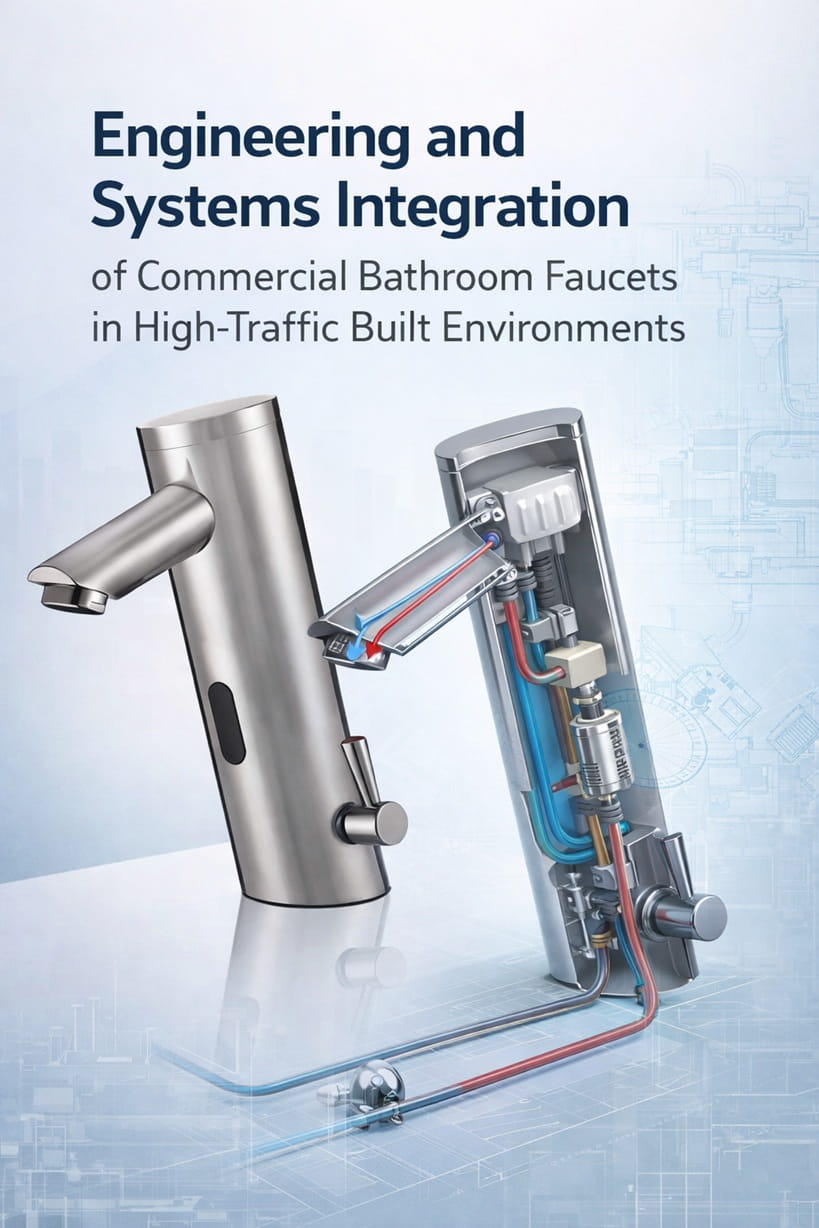
Engineering and Systems Integration of Commercial Bathroom Faucets in High-Traffic Built Environments

Hydraulic Performance, Sensor Control Architecture, Reliability Modeling, and Plumbing Infrastructure Coordination

Commercial Faucet Systems as Hydraulic Terminal Devices in Architectural Plumbing Networks

Commercial bathroom faucets represent terminal control devices within pressurized potable water distribution systems, operating as the final modulating component governing volumetric discharge, hydraulic stability, hygiene control, and user interaction. Unlike residential faucets, commercial faucets operate under significantly higher duty cycles, stochastic usage distributions, and stricter compliance constraints defined by plumbing codes, accessibility regulations, and infection control frameworks.
Premium matte black faucet designed for hotels, offices, and commercial spaces
Systems Engineering Framework

Commercial Faucet Systems Engineering Functional Role

Hydraulic, electromechanical, and architectural integration components within engineered plumbing systems
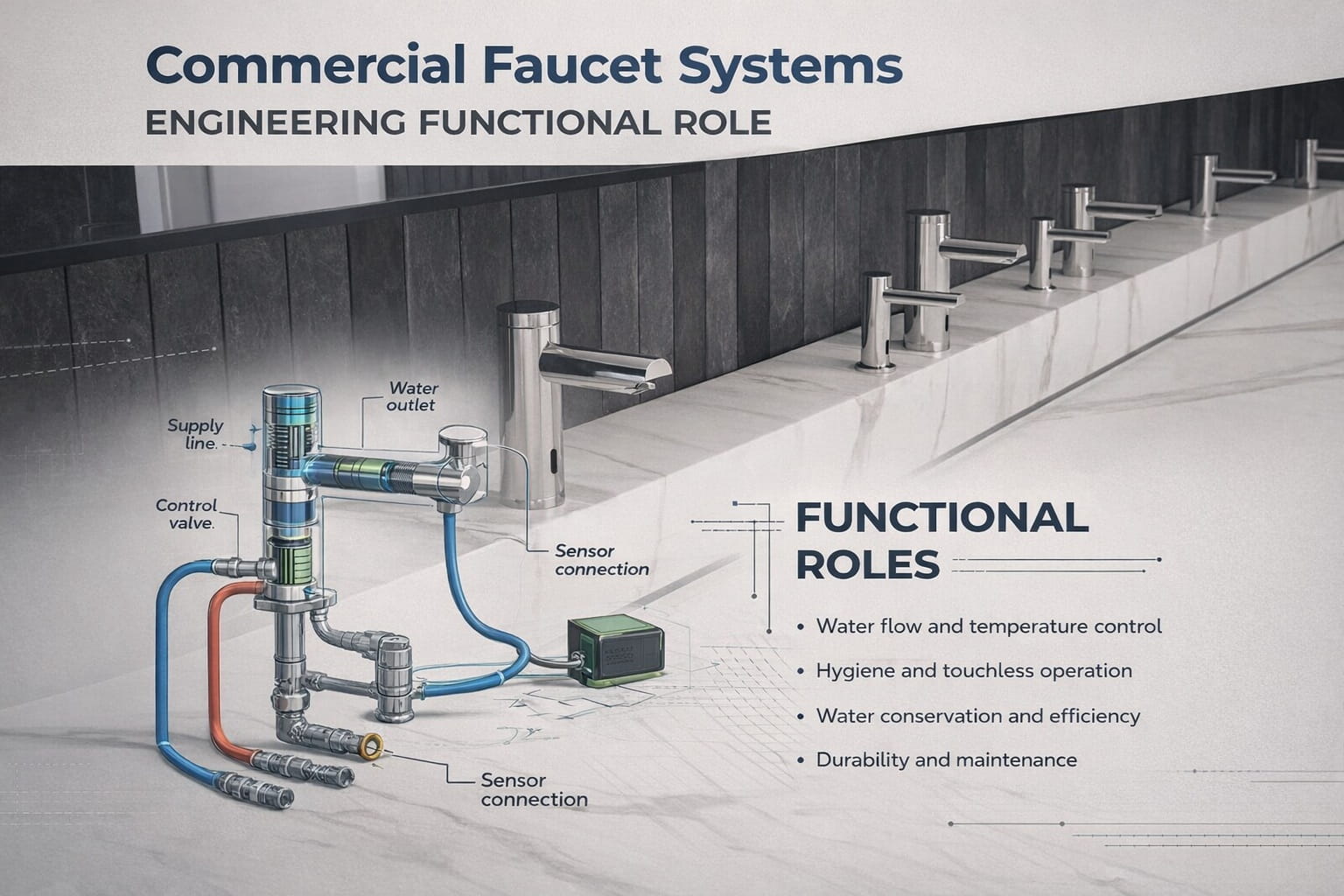
Commercial faucet integrated into engineered plumbing infrastructure showing hydraulic flow control mechanisms
Hydraulic Boundary Condition Regulators
Hydraulic boundary regulators stabilize pressure distribution and control terminal flow conditions within engineered plumbing networks.
Demand Nodes Within Probabilistic Fixture Usage Models
Demand nodes represent probabilistic flow endpoints used in hydraulic modeling to predict simultaneous fixture loading conditions.
Electromechanical Flow Control Devices
Sensor-activated systems utilize solenoid valves, sensors, and electronic controllers to regulate water discharge events.
Water Conservation Enforcement Components
Flow restrictors, aerators, and control electronics enforce water efficiency standards and consumption limits.
Cross-Disciplinary Engineering Interfaces
Fixture systems integrate architectural, plumbing, electrical, and facilities engineering disciplines into unified infrastructure networks.
From a systems engineering perspective, commercial faucets cannot be evaluated independently; their performance is inseparable from upstream piping design, pressure regimes, sensor electronics, and facility-wide water efficiency targets.
Hydraulic Engineering Analysis

Hydraulic Behavior and Fluid Mechanics of Commercial Faucet Flow Systems

Governing Equations for Faucet Flow

Commercial faucet flow rate is governed primarily by the Bernoulli equation, continuity equation, and empirical discharge coefficients.

Q = Cd × A × √(2ΔP / ρ)

Pressure-compensated faucets maintain discharge typically between 0.35 GPM and 0.5 GPM.
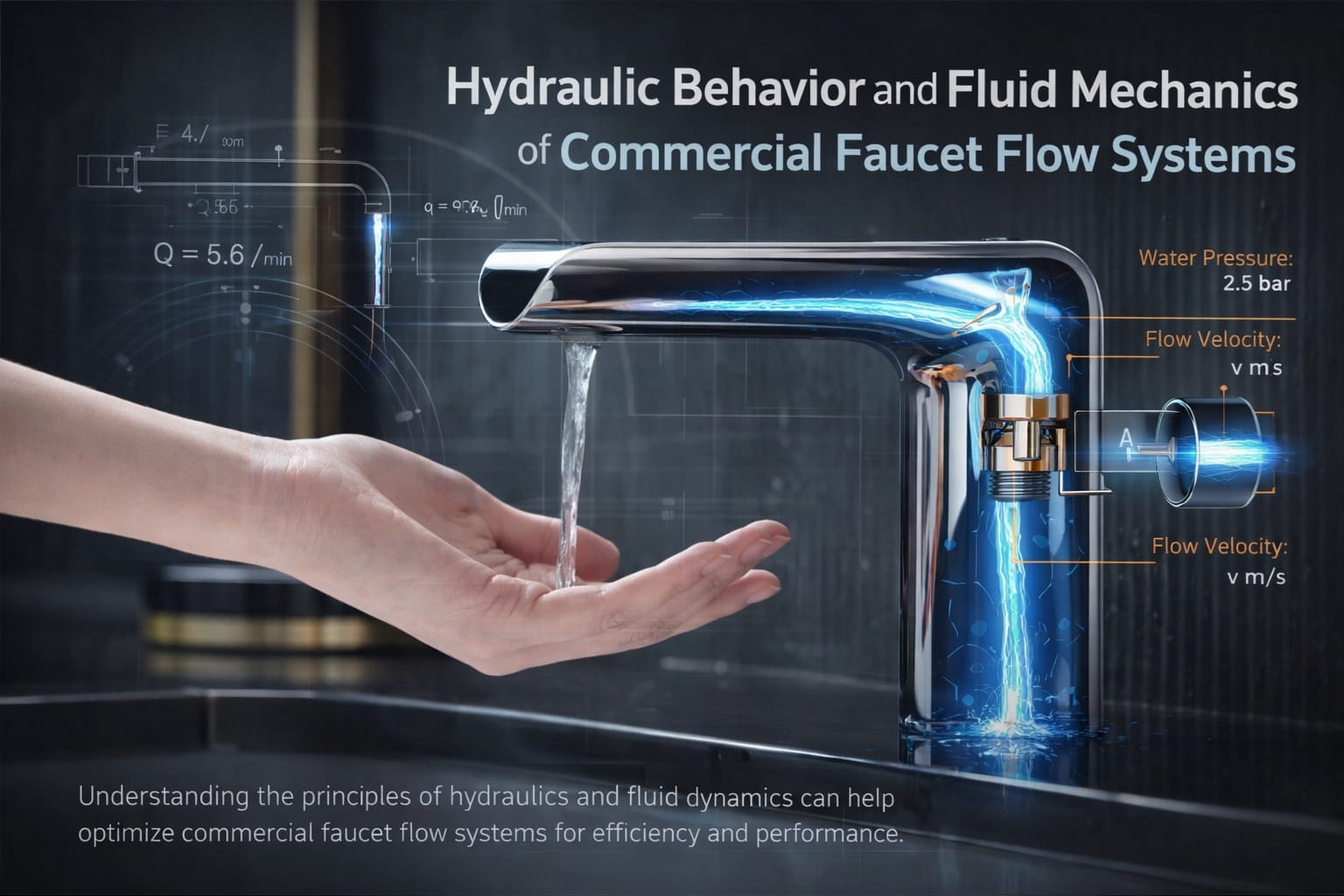
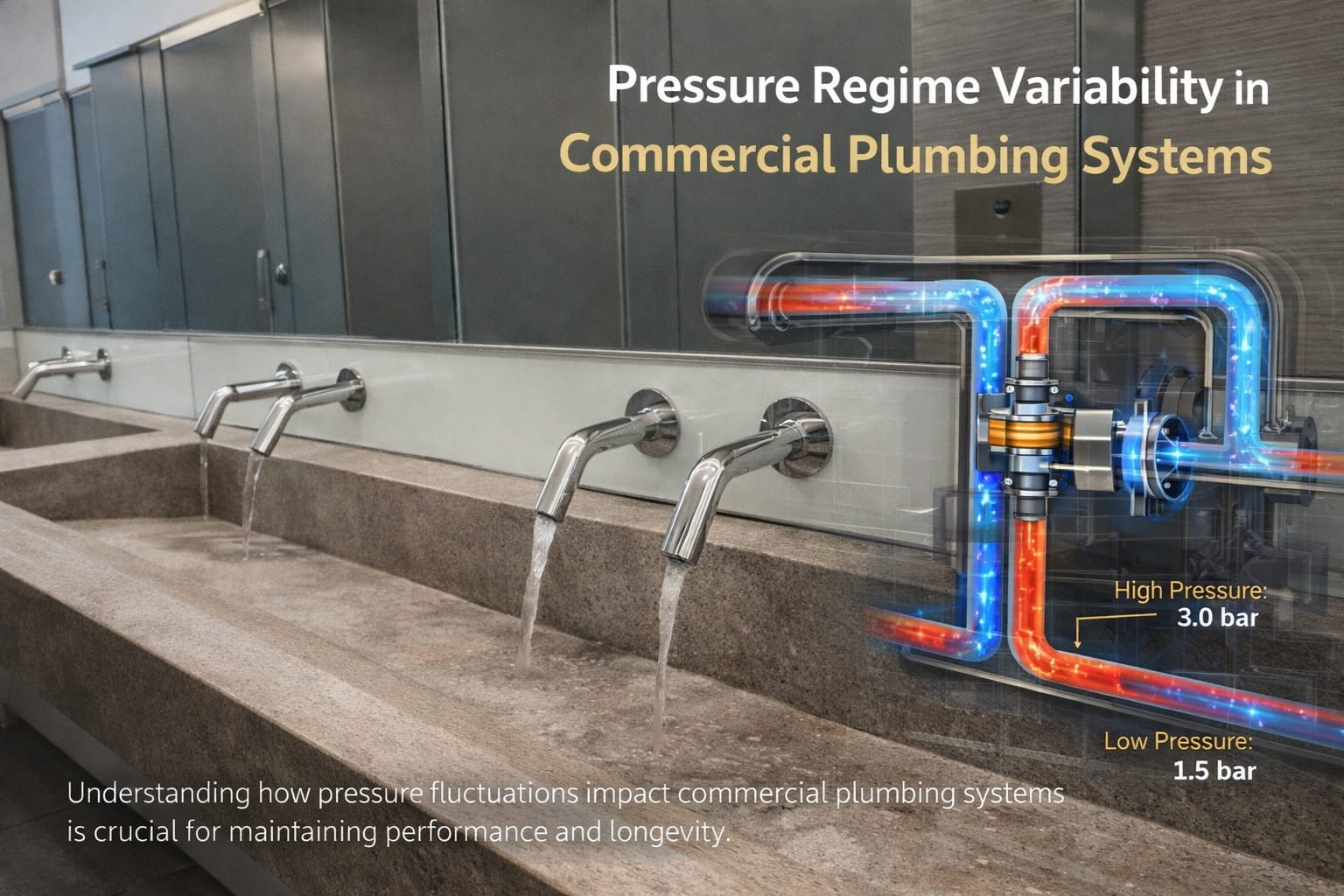
Commercial plumbing pressure regulation system with pressure reducing valve and hydraulic infrastructure
Pressure Regime Variability in Commercial Plumbing Systems
Static Pressure Head
Generated by vertical elevation differences within building plumbing systems.
Dynamic Friction Loss
Energy loss resulting from pipe wall friction and flow resistance.
Booster Pump Influence
Mechanical pressure amplification to maintain flow at upper elevations.
Pressure Reducing Valve Regulation
Controlled pressure reduction ensuring fixture safety and performance stability.
Typical Static Pressure Range
40–80 psi operational range in commercial buildings.
Typical Dynamic Pressure Range
25–60 psi under active flow conditions.
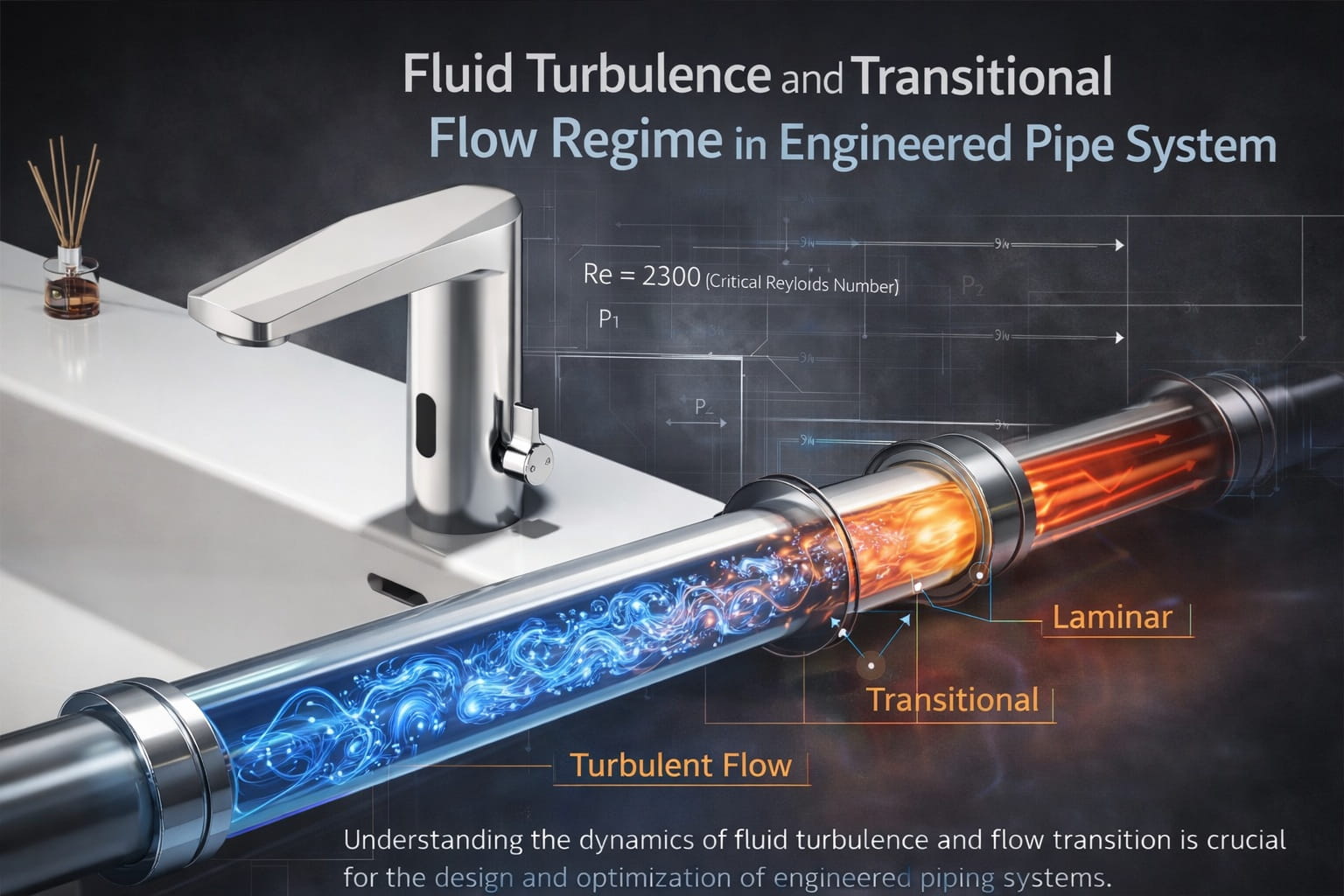
Fluid turbulence and transitional flow regime visualization in engineered pipe system
Reynolds Number and Flow Regime
Re = (ρVD) / μ
Outlet Diameter Influence
Small faucet outlet diameters increase flow velocity and turbulence probability.
Pressure Gradient Effect
Moderate pressure differentials promote transitional and turbulent flow behavior.
Aerator Flow Conditioning
Aerators alter velocity profiles and increase turbulence mixing efficiency.
Engineering Impact
Turbulent flow improves mixing performance but increases hydraulic energy dissipation.
Reference:
Munson, Young, Okiishi – Fundamentals of Fluid Mechanics
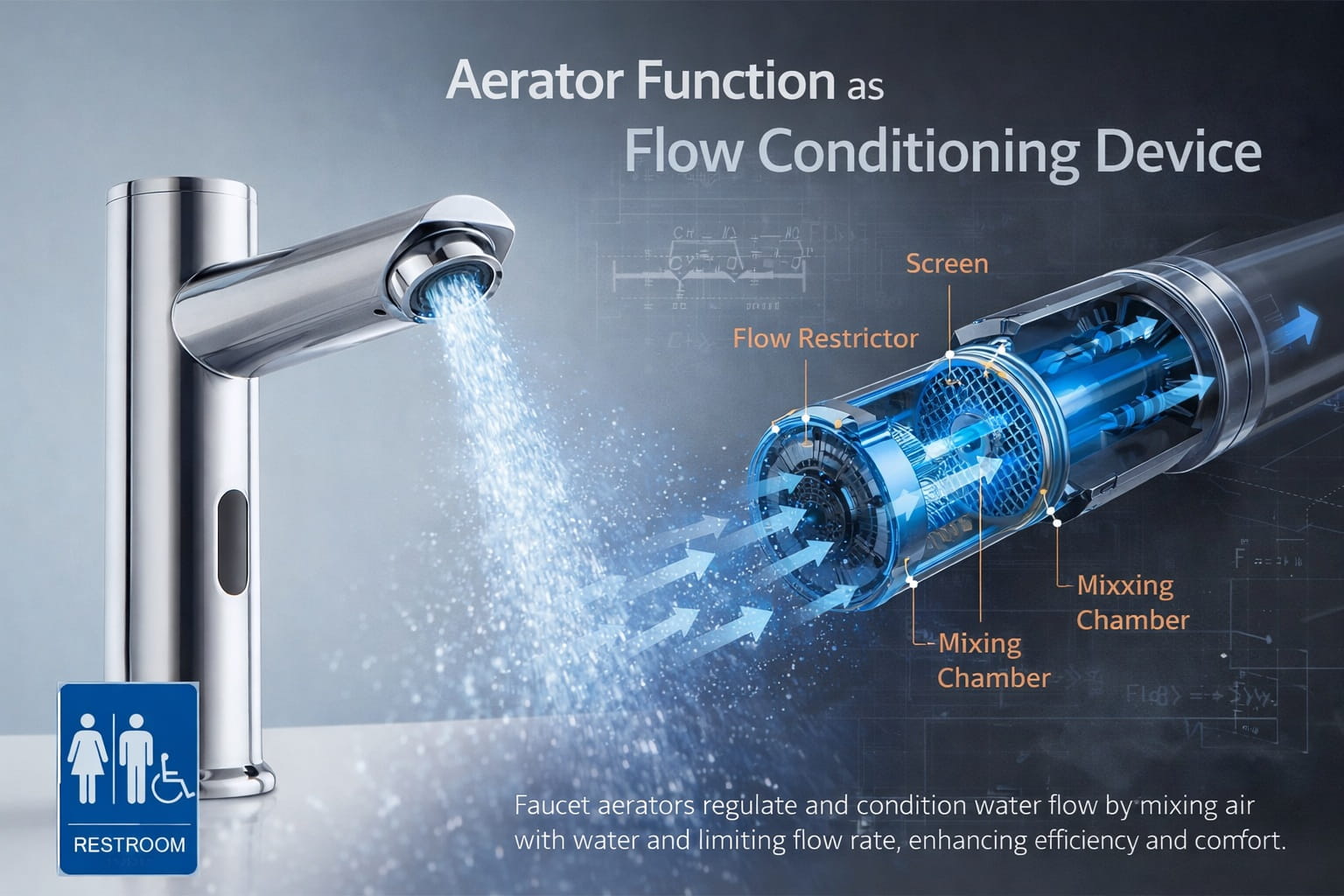
Commercial faucet aerator controlling hydraulic flow rate and discharge stabilization in engineered plumbing systems
Aerator Function as Flow Conditioning Device
Flow rate limitation through calibrated hydraulic resistance
Flow stabilization via uniform velocity distribution
Splash reduction through controlled air entrainment
Laminar flow devices eliminate air entrainment, reducing aerosolization risk and improving infection control safety.
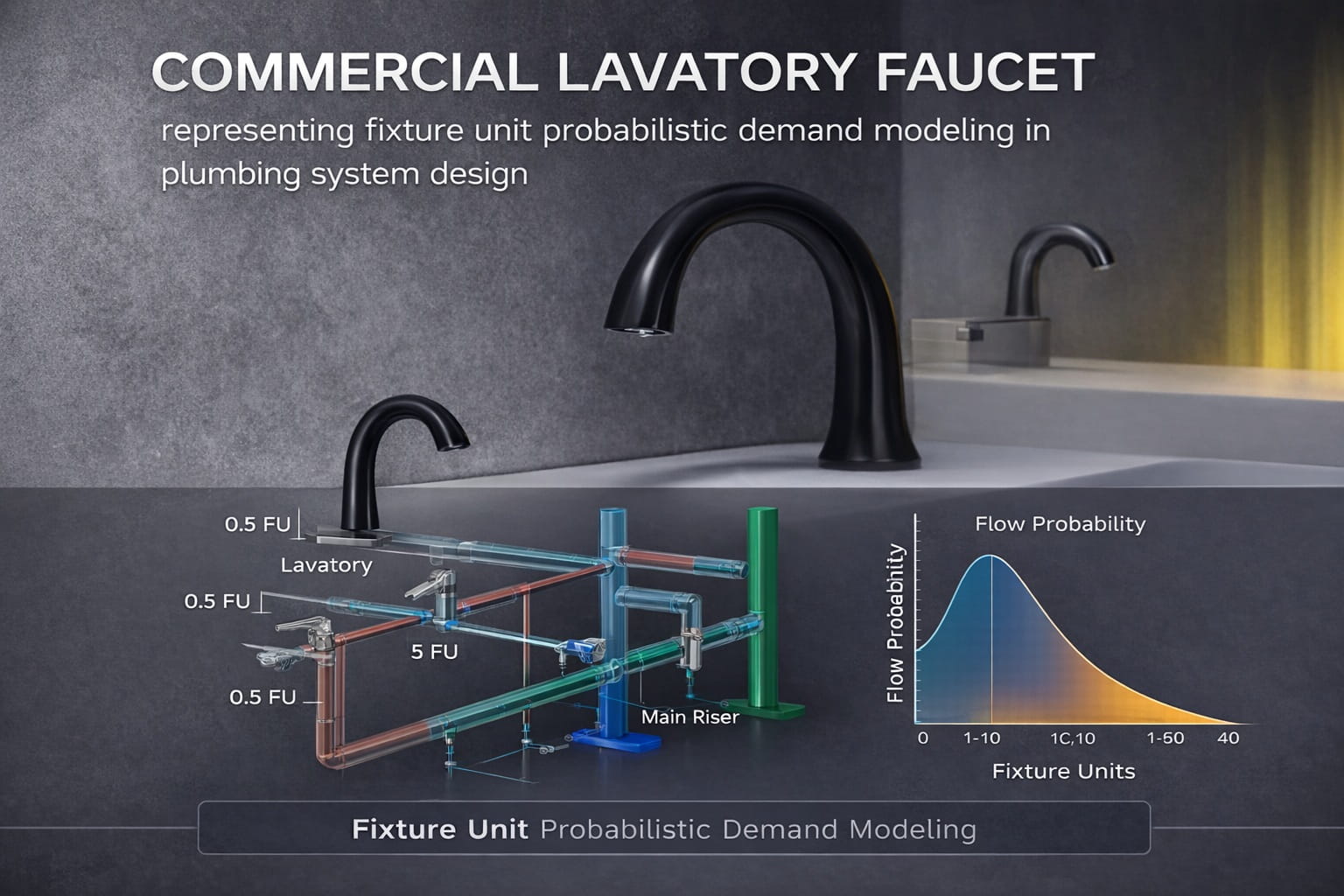
Commercial lavatory faucet representing fixture unit probabilistic demand modeling in plumbing system design
Fixture Unit Theory and Probabilistic Demand Modeling
Fixture Unit Concept
Fixture units represent probabilistic demand weighting used in hydraulic system sizing.
IPC Fixture Unit Value
Public Lavatory Faucet: 0.5 Fixture Units

What are you exploring next?

Advance your technical understanding of commercial bathroom faucet systems. Access engineering research, infrastructure analysis, and system integration insights for high-demand built environments.

Hunter’s Curve and Demand Diversity
Hunter’s method predicts peak demand based on fixture quantity and usage probability.
Q_peak ≠ ΣQ_individual
Instead:
Q_peak = f(total fixture units)
Hunter, Roy B. Methods of Estimating Loads in Plumbing Systems
National Institute of Standards and Technology
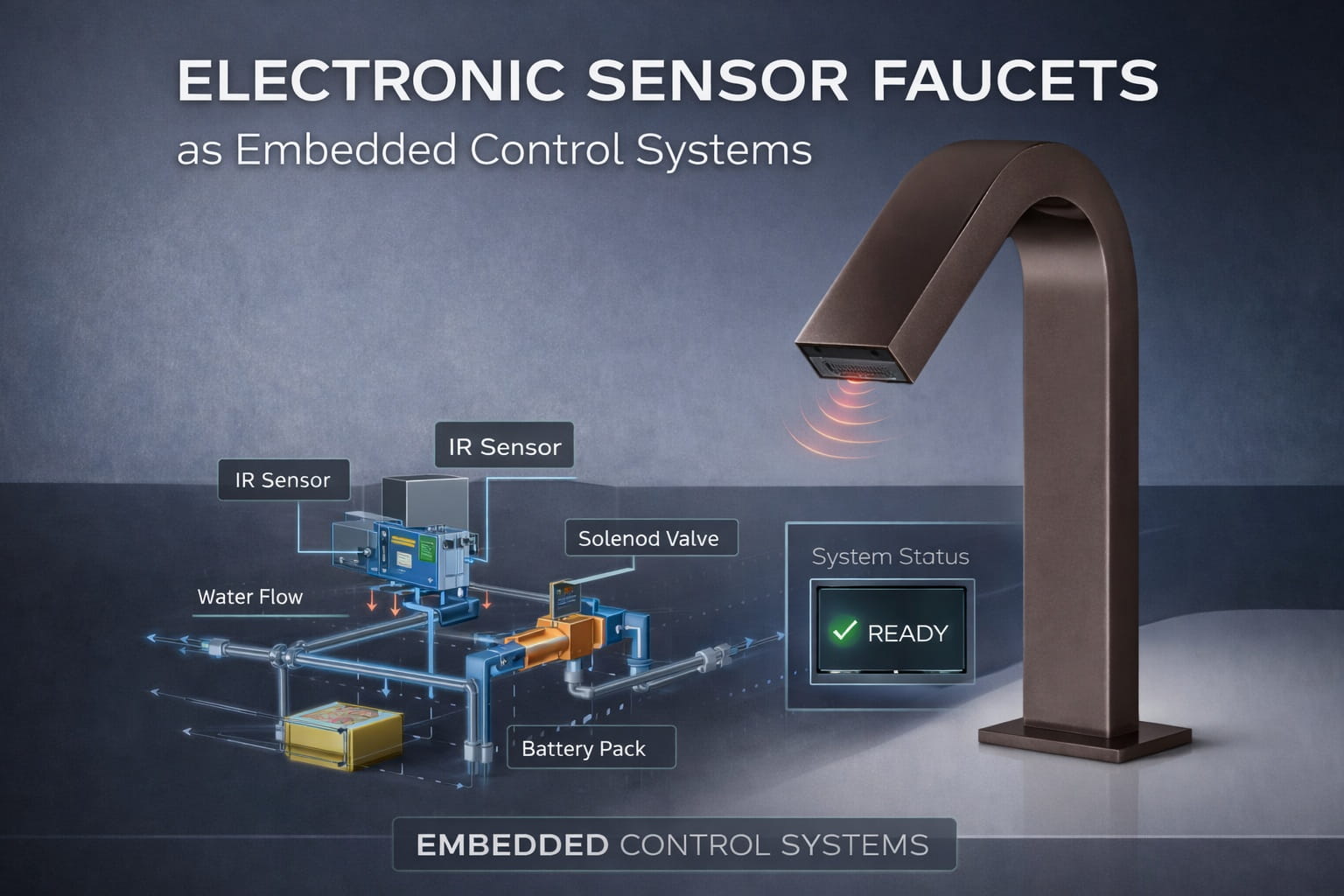
Electronic sensor faucet showing embedded infrared detection and control system
Electronic Sensor Faucets as Embedded Control Systems
Infrared sensor array
Microcontroller control unit
Solenoid valve actuator
Power system (battery or transformer)
Signal processing firmware
Infrared Detection Physics
Emitter transmits infrared signal
Object reflects signal
Receiver detects reflected signal
Microcontroller triggers solenoid valve actuation

Our team

Behind every faucet we design and deliver is a team of dedicated professionals who share one goal — excellence. From engineers and designers to customer support and installation experts, our team works together to create products that combine innovation, performance, and style. With years of experience in commercial design and technology, we’re committed to providing solutions that meet the highest standards of quality and reliability..

David Ramirez

Project Manager

Olivia Chen

Product Designer

Michael Turner

Lead Engineer
Control System Response Time Engineering
Detection latency: 50–150 ms
Valve actuation latency: 100–300 ms
Total system response: 150–450 ms
Latency optimization is critical for usability while preventing false activation events.
Solenoid Valve Electromechanical Engineering
Solenoid valves convert electrical energy into mechanical actuation force.
F = (N × I × B × A)
N = number of coil turns
I = current
B = magnetic field strength
A = plunger area
Reliability Engineering and Lifecycle Modeling
R(t) = exp(-(t/η)^β)
Characteristic life (η)
Failure mode indicator (β)
Seal degradation
Sensor failure
Solenoid fatigue
Battery depletion
MTBF: 500,000 to 2,000,000 cycles
Failure Mode and Effects Analysis (FMEA)
Sensor lens fouling
Mineral scale buildup
Valve seat erosion
Electrical contact degradation
Water Conservation Engineering Standards
EPA WaterSense maximum: 0.5 GPM at 60 psi
Lavatory faucets contribute 12–20% of total building water use
Supports LEED v4 Water Efficiency Credits
Plumbing Infrastructure Coordination
Water supply piping integration
Drainage system coordination
Electrical system interface
Architectural mounting structure integration
Mounting and Structural Engineering
Deck-mounted fixture systems
Wall-mounted structural integration
Integrated basin mounting architecture
Backflow Prevention Engineering
Compliance with ASSE 1016 and ASSE 1070 contamination prevention standards
Thermal Control and Scald Prevention
Maximum safe discharge temperature: 49°C (120°F)
Temperature mixing valve compliance with ASSE 1070
Commercial faucet integrated into plumbing, electrical, and architectural systems
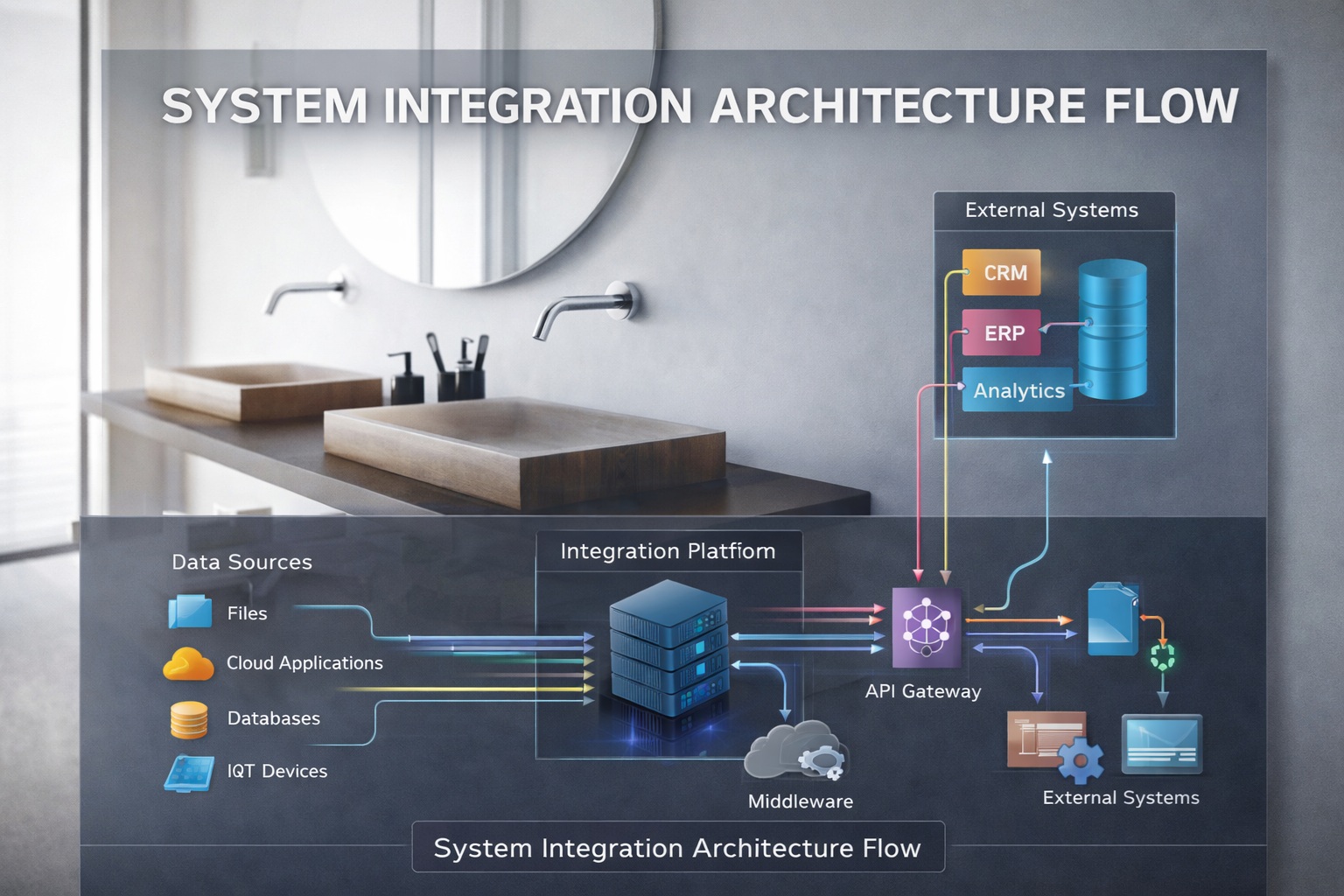
System Integration Architecture Flow
Water supply system connection
Structural mounting interface
Electrical and sensor integration
Backflow prevention protection layer
Thermal regulation and user safety control
Infection Control and Public Health Engineering
Sensor faucets reduce pathogen transmission through touchless operation.
Cross-contamination risk reduction demonstrated in healthcare engineering studies.
Architectural and Facilities Engineering Considerations
Maintenance cycle optimization
Water and energy consumption efficiency
User experience and ergonomic integration
Lifecycle cost analysis and component accessibility
Infrastructure-Scale Operational Modeling
Deployment in airports, hospitals, universities, and hotels
Peak load simulation and system demand modeling
Failure risk analysis and reliability optimization
Predictive maintenance scheduling frameworks
Future Engineering Directions in Commercial Faucet Systems
IoT-enabled faucet system integration
Usage telemetry and infrastructure analytics
Predictive maintenance engineering systems
Machine learning failure prediction modeling
Commercial Faucets as Critical Engineered Components in Building Water Systems
Commercial faucets represent integrated engineering systems combining hydraulic mechanics, electromechanical control, reliability engineering, public health protection, and architectural infrastructure coordination.
Fluid mechanics and hydraulic regulation engineering
Embedded control system and sensor engineering
Reliability engineering and lifecycle performance modeling
Public health and infection control engineering integration
Architectural and infrastructure coordination systems
Systems-level infrastructure engineering integration
Water conservation and resource efficiency optimization
Operational reliability and system lifecycle longevity
Public health safety and contamination prevention
Long-term infrastructure performance and sustainability
Commercial faucets must be evaluated, specified, and engineered as integrated infrastructure components within building water systems—not as standalone fixtures—due to their direct impact on hydraulic performance, public health safety, operational reliability, and infrastructure sustainability.

Explore Our Blog

Experience the balance of innovation, durability, and design with our commercial bathroom faucets. Engineered for high-traffic environments, each faucet combines touchless technology, water efficiency, and timeless style. Whether in hotels, offices, or public facilities, our products deliver lasting performance and elevate every space they serve.

Operations-first engineering notes for AEC + facility teams Sensor[…]