
Commercial Bathroom Faucet Temperature Control: Single Supply vs. Mixing Valve vs. Thermostatic Faucets
A commercial faucet can receive cold water, centrally tempered water, locally mixed hot and cold supplies, or point-of-use thermostatic control. Those strategies create very different plumbing, safety, commissioning and maintenance requirements. Architects and MEP engineers should therefore specify temperature architecture as deliberately as flow rate or faucet type.
Four Common Commercial Strategies
The faucet receives one cold or previously tempered supply. Simple at the fixture, but temperature control occurs elsewhere.
Hot and cold supplies enter a mixing valve. The outlet temperature may be preset or user adjustable.
A thermostatic element continually adjusts the hot/cold ratio as inlet temperature or pressure conditions change.
How the Temperature Strategies Differ
| Factor | Single / Tempered Supply | Mechanical Mixing | Thermostatic Mixing |
|---|---|---|---|
| Fixture complexity | Lowest | Moderate | Highest |
| User adjustment | Usually none | Possible | Possible or preset |
| Pressure compensation | Handled upstream | Limited unless specifically engineered | Thermostatic element continuously compensates |
| Scald protection | Depends on upstream system | Not inherent | Can provide point-of-use protection when properly certified |
| Maintenance | Simplest faucet | Mixer/cartridge service | Thermostatic cartridge + strainers + checks |
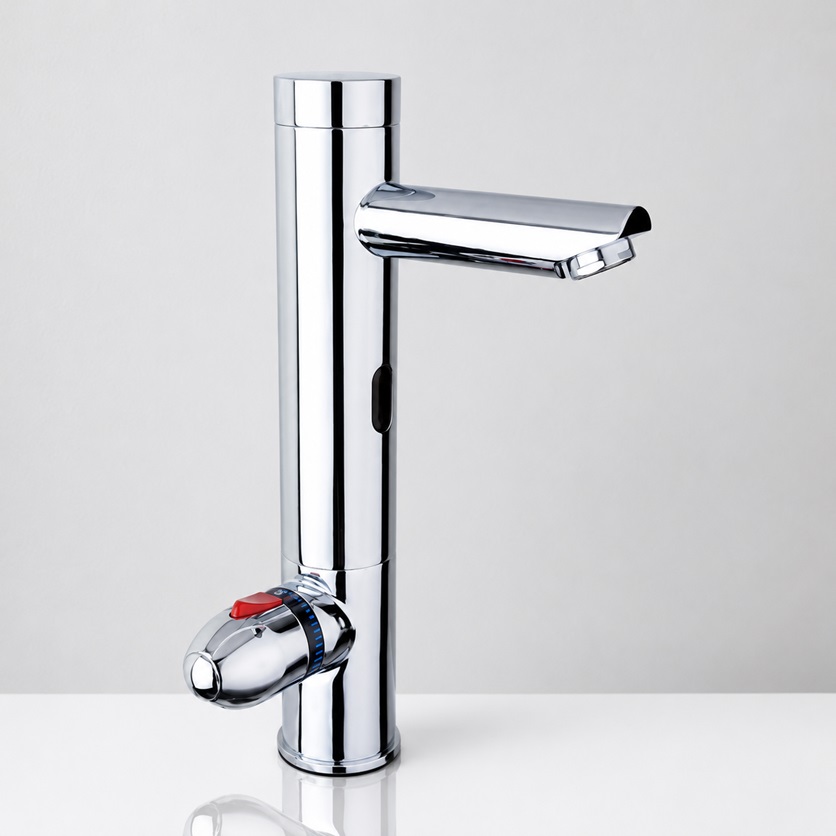
Fontana Chrome Commercial Temperature-Control Automatic Sensor Faucet with Built-In Mixing Valve
The Fontana Commercial Temperature-Control Automatic Sensor Faucet integrates temperature management directly into the commercial faucet package. Fontana publishes an above-counter mixer, adjustable sensor operation, solid-brass valve construction, and a solid-brass thermostatic mixing-valve option.
This approach can simplify project coordination because sensing, mixing and water delivery are designed around one faucet platform rather than assembled from unrelated components.
Integrated commercial package combines hands-free operation with local temperature control.
State whether the project requires conventional mixing or thermostatic mixing.
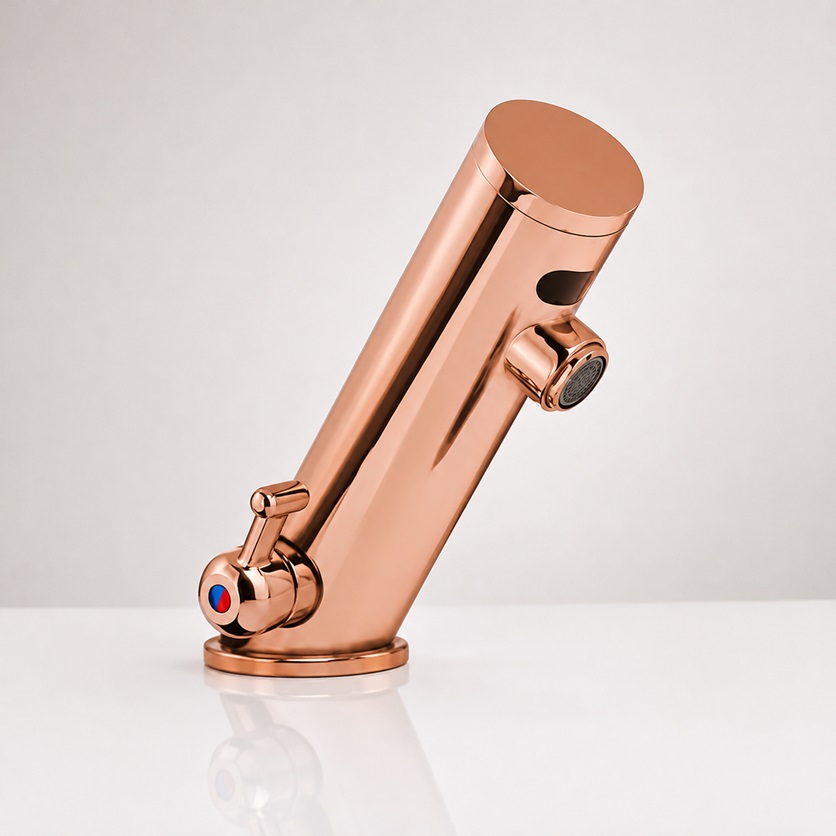
BathSelect Leo Rose Gold All-in-One Thermostatic Automatic Commercial Sensor Faucet
BathSelect’s Leo illustrates a true integrated thermostatic strategy. The thermostatic assembly continuously adjusts the hot-and-cold mixing ratio to stabilize outlet temperature as building conditions change.
The platform combines point-of-use temperature control with infrared activation, a built-in brass solenoid, AC/DC capability and commercial maintenance access.
Local thermostatic regulation reduces temperature fluctuation at the point of use.
Commission both hot and cold supplies before setting the final temperature.
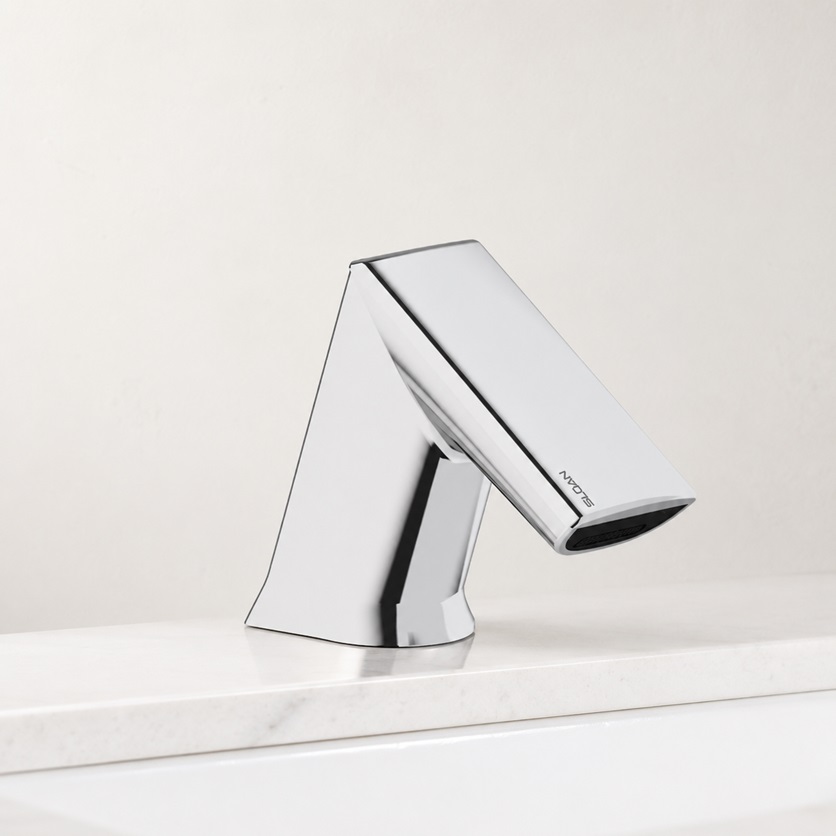
Sloan BASYS® EFX-300 with Below-Deck Thermostatic Mixing Valve
Sloan demonstrates the modular approach: the faucet remains compact above the counter while a dedicated thermostatic mixing valve is located below deck.
The selected EFX-300 configuration is specifically published with a below-deck thermostatic mixing valve and ASSE 1070 compliance, making the temperature-control requirement explicit in the product schedule.
Dedicated certified thermostatic protection can be serviced independently from the faucet body.
Provide practical below-deck access to the thermostatic valve and strainers.
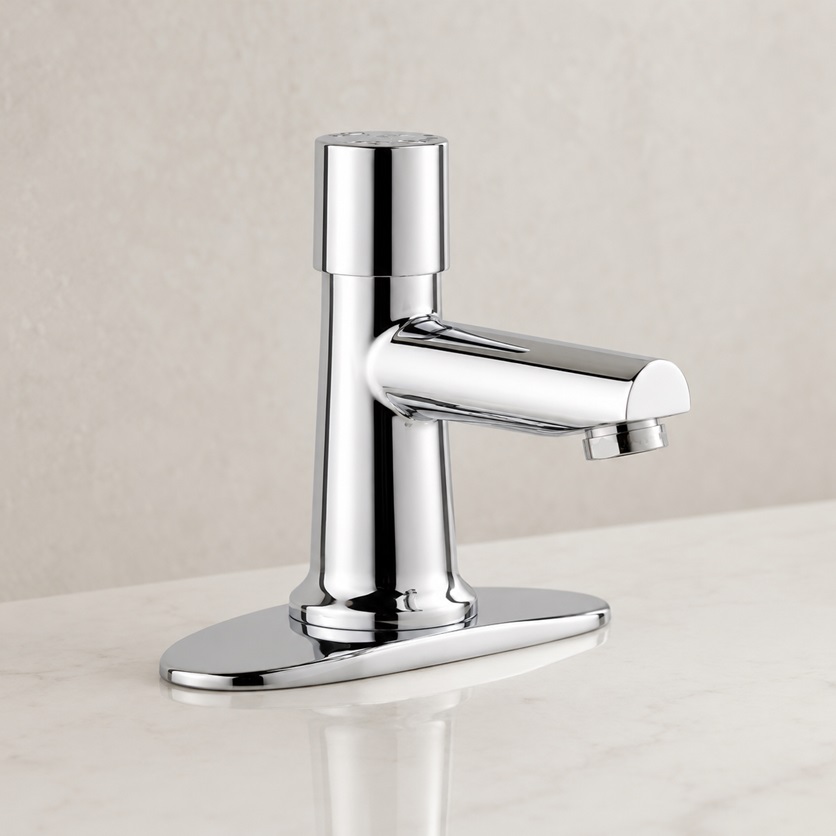
Chicago Faucets E-Tronic® 80 with Built-In ASSE 1070 Thermostatic Mixing Valve
E-Tronic 80 demonstrates another strategy: the thermostatic mixer is built into the commercial faucet package and can include user-adjustable temperature control.
Chicago Faucets specifies an integrated ASSE 1070 thermostatic mixing valve, reducing the need to assemble a separate external anti-scald package.
Integrated certified anti-scald protection plus optional user-adjustable mixing.
Determine whether users should control temperature or whether the setting should be secured.
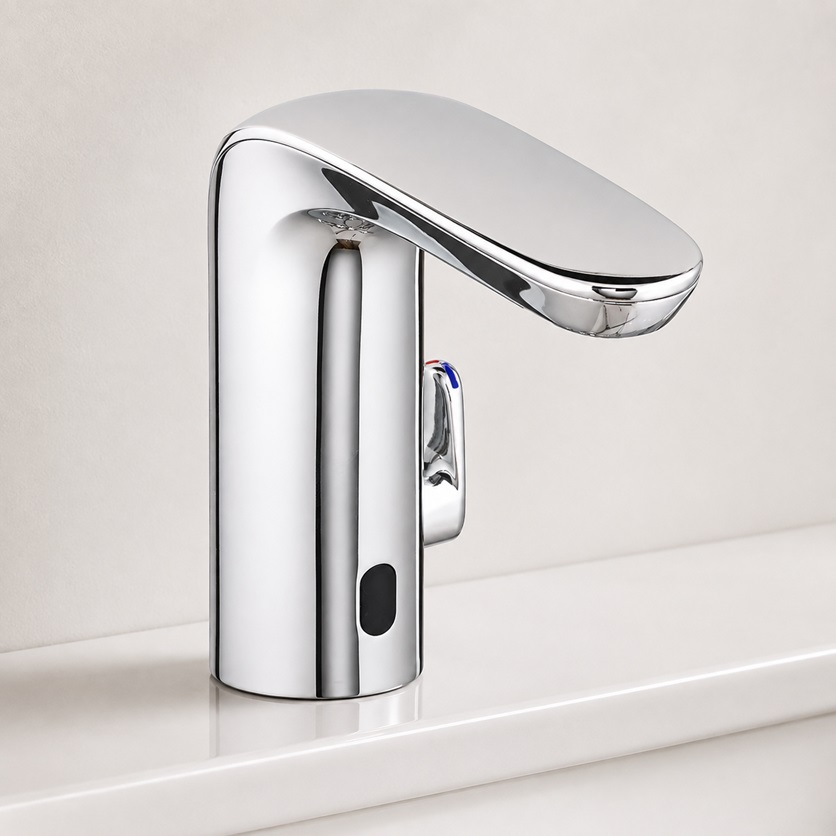
American Standard NextGen® Selectronic® with SmarTherm™ Safety Shut-Off
American Standard integrates an ASSE 1070-certified thermostatic hot-water limiter directly into the faucet through SmarTherm technology.
The system is designed to protect against a hot-water surge or interruption of the cold-water supply, while the above-deck mixing handle allows individual temperature adjustment.
Integrated thermostatic safety protection eliminates a separate TMV for ASSE 1070 protection.
Decide whether removable user adjustment should remain available after commissioning.
Why Point-of-Use Anti-Scald Protection Matters
ASSE 1070 addresses water-temperature limiting devices used at fixtures. For commercial projects where anti-scald protection is required, simply providing hot and cold mixing is not equivalent to specifying an ASSE 1070-certified temperature-limiting device.
What Happens When Cold-Water Pressure Changes?
A basic manual mixer may deliver a different hot/cold ratio when supply pressures change. A thermostatic valve continuously responds to temperature conditions and adjusts the mixture to stabilize outlet temperature within its operating range.
This becomes particularly important in office towers, hospitals, airports and hotels where simultaneous fixture use can create dynamic supply conditions.
Should Occupants Adjust the Temperature?
| Application | Temperature Strategy |
|---|---|
| High-volume public restroom | Preset tempered / thermostatic supply minimizes user adjustment. |
| Executive washroom | User-adjustable thermostatic mixing can improve comfort. |
| Healthcare | Controlled point-of-use temperature with water-management review. |
| School | Preset protected temperature reduces inappropriate adjustment. |
| Luxury hospitality | User-adjustable protected mixing balances comfort and safety. |
Five Tests Before Handover
| 1 | Confirm hot and cold supplies are connected correctly. |
| 2 | Flush and clean inlet strainers before final temperature setting. |
| 3 | Measure stabilized outlet temperature at normal operating conditions. |
| 4 | Test response to changing building supply conditions where required. |
| 5 | Record the final temperature setting and valve access location. |
Commercial Faucet Brands Related to Temperature Control
Commercial Faucet Temperature-Control FAQ
Is a mixing valve the same as a thermostatic mixing valve?
No. A basic mixer combines hot and cold water; a thermostatic valve actively regulates the mixture in response to temperature conditions.
What is ASSE 1070?
It is a performance standard for water-temperature limiting devices used at point-of-use plumbing fixtures.
Can one central mixing valve serve many faucets?
Yes in some systems, but project designers must still evaluate distribution temperature, code requirements and point-of-use safety needs.
Do touchless faucets need hot water?
No. A sensor faucet can use cold, tempered or mixed water depending on the project design.
Why do thermostatic valves have strainers?
Debris can interfere with small internal control passages and thermostatic elements, so inlet filtration helps maintain performance.
Should users be able to change faucet temperature?
It depends on facility type. Public restrooms often favor preset protected temperatures, while premium spaces may benefit from protected user adjustment.
Professional Sources
ASSE 1070 — Water Temperature Limiting Devices
Point-of-use temperature-limiting performance framework.
American Society of Plumbing Engineers
Commercial plumbing and hot-water system engineering resources.
International Code Council
Model plumbing-code requirements relevant to hot-water distribution and commercial fixtures.
ASME Codes & Standards
Commercial plumbing-fixture and valve standards resources.
CDC — Water Management Program Toolkit
Building-water management guidance relevant to temperature and stagnation planning.
Specify Temperature Architecture—not Merely “Hot & Cold”
Single tempered supplies simplify the faucet. Mechanical mixers provide user choice but do not automatically provide thermostatic protection. Point-of-use thermostatic valves add more components but can provide stable temperature and certified anti-scald performance. For commercial projects, the correct approach depends on facility risk, user control, service access and the building’s complete hot-water strategy.
Review Fontana Thermostatic Commercial Faucet →