
Commercial Faucet Comparison: Manual, Metering & Touchless
Manual, metering and touchless faucets can all be appropriate commercial solutions—but they solve different problems. Manual faucets favor simplicity, metering faucets automatically limit runtime without electronics, and touchless systems reduce handle contact while adding sensors, power and electronic water-control components. This guide compares the three architectures from an AEC and facility-management perspective.
How Commercial Faucet Types Differ
User-Controlled Valve
A lever or handle mechanically controls flow and temperature. There are no sensors, batteries or electronic controllers.
Timed Mechanical Cycle
The user presses an actuator and a metering cartridge closes automatically after a defined cycle.
Electronic Automatic Control
A sensor identifies user presence and electronically commands a solenoid, motor valve or alternative water-control mechanism.
Manual vs. Metering vs. Touchless
| Factor | Manual | Metering | Touchless |
|---|---|---|---|
| Electronics | None | None | Required |
| Automatic shutoff | No | Yes | Yes |
| Handle contact | Required | Required briefly | Not normally required |
| Power supply | None | None | Battery, AC or alternative |
| Maintenance complexity | Low | Low–moderate | Moderate |
| Runtime control | User controlled | Mechanical timing | Electronic sensing/timeout |
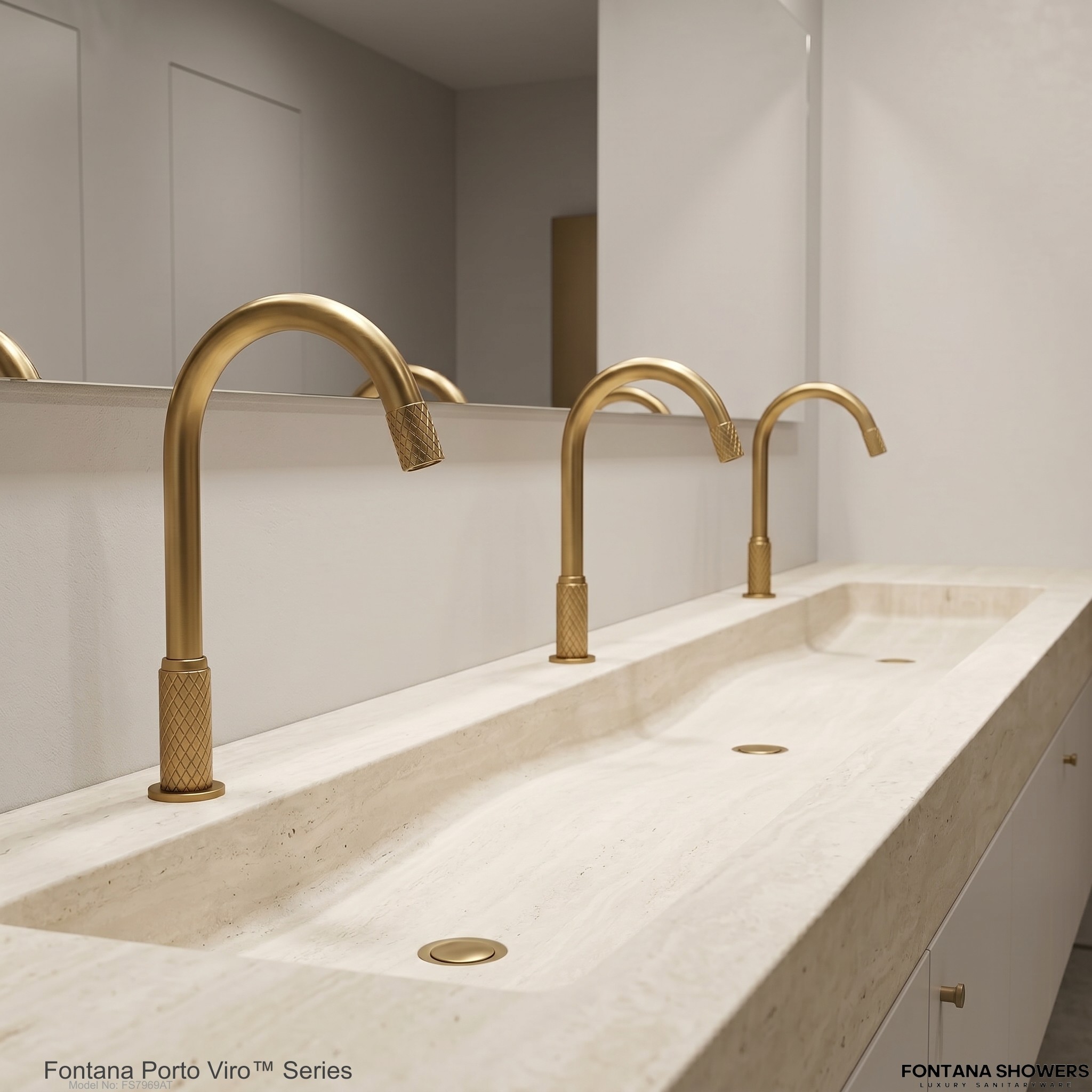
Fontana Commercial Brushed Gold Touchless Automatic Sensor Hands Free Faucet
This Fontana commercial platform represents the electronic approach: infrared activation, automatic water control and cast-brass construction combined with an architectural brushed-gold finish.
Fontana’s installation documentation specifies automatic sensing adjustment, sub-second sensor response and automatic timeout logic, making the faucet particularly useful where touch-free operation and design presentation both matter.
Hands-free operation, automatic shutoff and premium commercial presentation.
Electronics, power and valve components add service points compared with manual faucets.

BathSelect Commercial Brushed Gold Touchless Automatic Sensor Faucet
BathSelect illustrates a highly configurable touchless strategy. Published specifications include active infrared sensing, a 2–6 inch detection range, 0.6-second response, 60-second maximum runtime, AC/DC capability and a 50-mesh inlet filter.
The product can also be configured with a 0.5 GPM outlet, making it relevant to efficient public-lavatory applications.
Flexible power, adjustable sensing and controlled commercial operation.
Battery, solenoid and filter maintenance should be planned at portfolio scale.
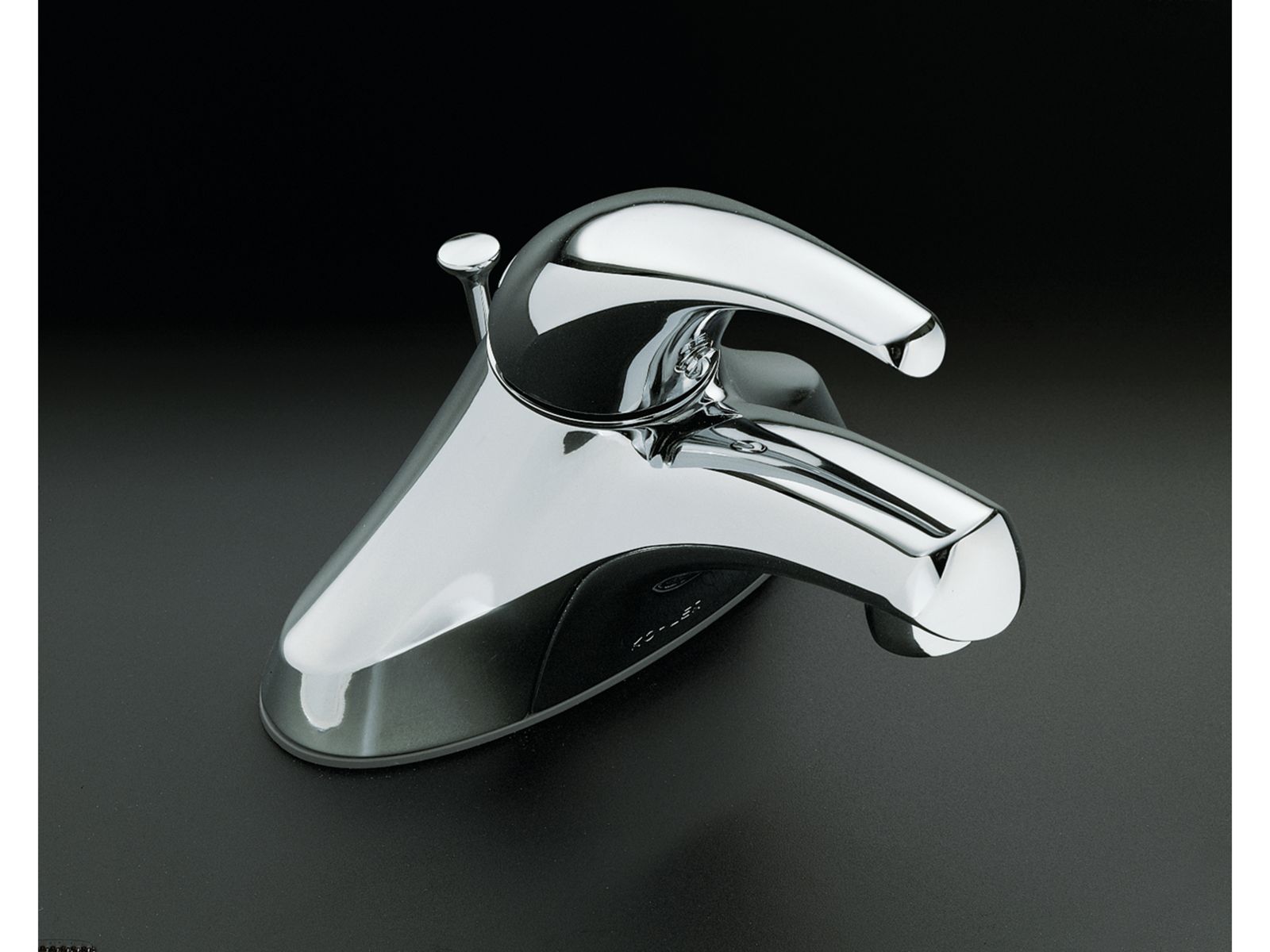
KOHLER Coralais® Commercial Manual Bathroom Faucet
Coralais demonstrates why manual faucets remain highly relevant. Its ceramic-disc valve controls both volume and temperature, while the commercial configuration includes a 0.5 GPM outlet, vandal-resistant outlet and high-temperature limit setting.
Mechanical simplicity and familiar long-term servicing.
Users control runtime, so water use depends more heavily on behavior.
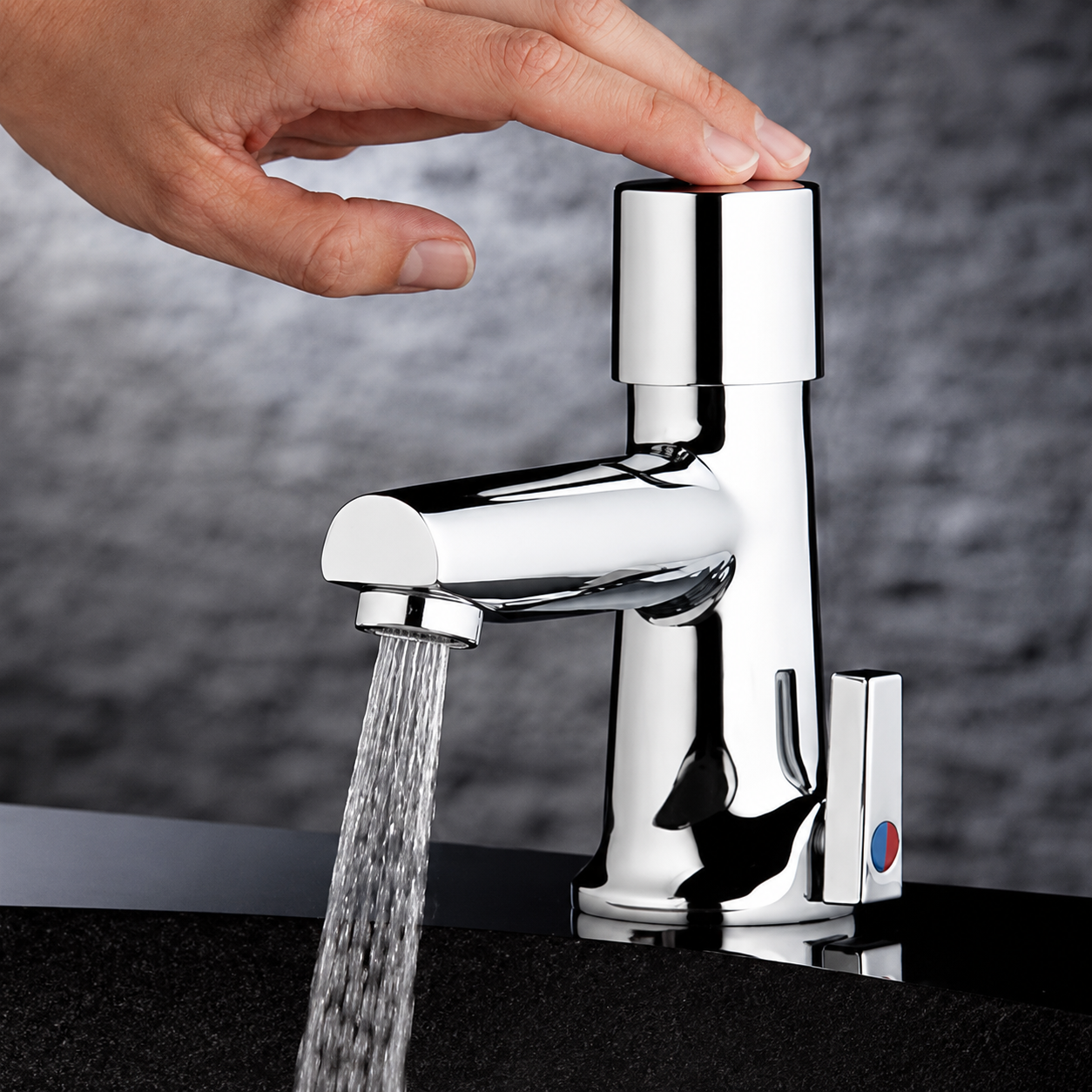
Chicago Faucets 3500 Series MVP® Metering Faucet
The 3500 Series demonstrates the mechanical middle ground. A user presses the push actuator and the MVP metering cartridge automatically closes after a timed cycle. Chicago Faucets allows the cycle time to be adjusted mechanically.
Automatic water limitation without sensors, batteries or transformers.
Metering cartridges require periodic mechanical servicing and timing adjustment.
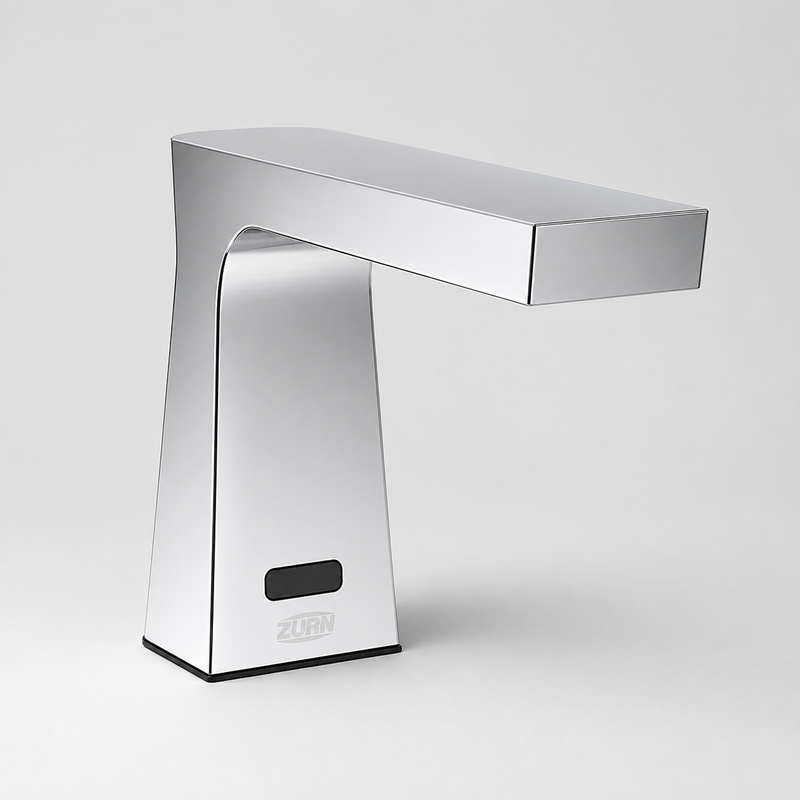
Zurn Camaya Series® ZG6953 Gear-Driven Commercial Sensor Faucet
Zurn demonstrates that “touchless” itself now includes different mechanical architectures. The ZG6953 replaces the conventional solenoid with a motor-driven ceramic cartridge and supports Bluetooth adjustment of sensing, timeout and flushing.
Programmability and alternative electronic valve architecture.
Service staff need manufacturer-specific cartridge and control knowledge.
Which Faucet Type Fits Which Building?
| Facility | Strong Starting Point | Why |
|---|---|---|
| Airport | Touchless | High traffic, automatic shutoff and reduced handle contact. |
| School | Metering / touchless | Controlled runtime and vandal-resistant commercial options. |
| Office tower | Touchless / manual | Depends on lifecycle strategy and executive-restroom design. |
| Healthcare | Touchless | Supports hands-free operation; water management still requires separate planning. |
| Low-maintenance facility | Manual | Fewest electronic service components. |
Purchase Price Is Only One Line Item
Manual faucets avoid batteries and controllers but may use more water when users leave them running. Metering faucets limit runtime mechanically but need cartridge maintenance. Touchless systems provide automatic operation and precise shutoff, but facility teams must plan for sensors, power supplies, filters and electronic water-control components.
Commercial Faucet Brands Related to This Comparison
Manual vs. Metering vs. Touchless FAQ
Which commercial faucet type requires the least maintenance?
Manual ceramic-disc faucets generally have the fewest electronic service points, although cartridges and outlets still require maintenance.
Do metering faucets need electricity?
Mechanical metering faucets do not. Their self-closing cycle is controlled by the cartridge.
Are touchless faucets always more water-efficient?
Not automatically. Flow rate and programmed runtime determine water use, although automatic shutoff helps prevent unattended flow.
What is the main advantage of metering faucets?
They combine automatic shutoff with mechanical simplicity and no battery or transformer requirement.
What is the main drawback of manual faucets?
Water continues until the user closes the valve, and users must physically operate the handle.
What should architects specify for touchless faucets?
Exact sensor, flow, power, valve, timeout, mixing and service-access requirements should all be documented.
Professional Sources
U.S. EPA — Bathroom Faucet Efficiency
Guidance for efficient lavatory faucet flow and public-restroom applications.
U.S. Department of Justice — ADA Standards
Accessibility requirements for lavatories and operable components.
American Society of Plumbing Engineers
Professional commercial plumbing-engineering and specification resources.
International Code Council
Model plumbing and building-code resources.
NSF
Potable-water fixture material and certification resources.
Choose the Control Architecture Before Choosing the Finish
Manual faucets remain excellent where simplicity dominates. Metering faucets offer an elegant mechanical solution when automatic shutoff is needed without electronics. Touchless faucets are strongest where contact reduction, automatic operation and programmable control justify the added electronic architecture. The right decision depends on the facility—not on which technology is newest.
Review Fontana Commercial Touchless Faucet →