
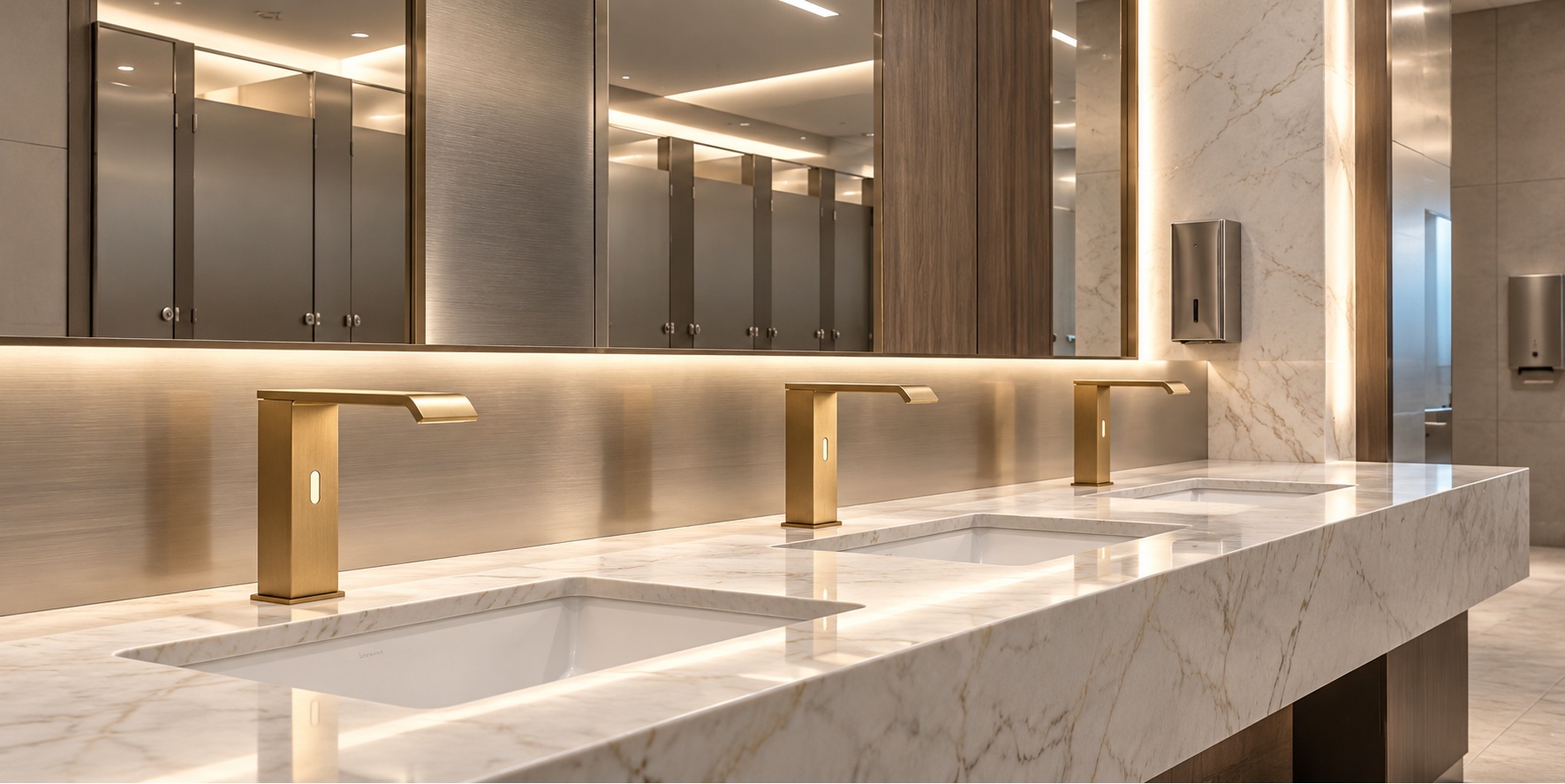
Aesthetic, Materials & Maintenance — Touchless Faucets for Commercial Office Restrooms
A specification-oriented framework for architects, MEP engineers, and facility teams evaluating sensor faucets for office restroom cores, executive washrooms, and amenity floors — covering finish harmony, PVD/coating longevity, minimalist design language, custom branding, and long-term maintenance planning.
Touchless faucets for commercial office restrooms reduce hand contact while helping architects, MEP engineers, and facility teams coordinate water efficiency, power requirements, finish selection, durability, maintenance access, and long-term serviceability. This guide explains how to specify sensor faucets for office restroom cores, executive washrooms, amenity floors, and other high-use workplace environments.
Touchless Faucets for Commercial Office Restrooms: Reference Brands
Use these manufacturer hubs when assembling finish schedules, basis-of-design documents, and approved-equal lists. Each link points directly to the brand’s official commercial touchless faucet product category.
| Brand | Touchless Faucet Hub | Related Systems | Why Reference It |
|---|---|---|---|
| FontanaShowers® | Touchless Sensor Faucets | Soap Dispensers · Multifeed Kit | Broad finishes and coordinated faucet/soap sets for office cores and amenity floors. |
| BathSelect® | Touchless Faucets | Hospitality/Commercial Portfolio | Manufacturer with in-house designs; commercial finishes and ADA-oriented selections. |
| Kohler® (Commercial) | Commercial Faucets | Kinesis™ Touchless · Commercial Products | Established spec presence; documented finishes (Chrome, Vibrant® Stainless, Matte Black, Brushed Brass). |
| Chicago Faucets® | Touchless Faucets | HyTronic® Series | Heavy-duty electronic lines; BLE configuration and broad commercial spec collateral. |
| Sloan® | Sensor Faucets | Touch-Free Solutions | Coordinated soap/faucet ecosystems; integrated sink platforms for seamless UX. |
| Zurn® | Sensor Faucets | Soap Dispensers | Smart/connected options and multiple flow/power kits for office cores. |
| Bradley® | Commercial Faucets | Coordinated Faucet & Soap | Verge® sets and multi-feed/maintenance-friendly approaches for large vanities. |
Aesthetic & Material Selection
Harmonizing Fixture Finishes Across the Restroom Environment
Finish harmony reduces visual noise and supports a consistent brand experience across elevator lobbies, amenity floors, and tenant cores. Coordinate faucet finishes with door hardware, accessories, mirror frames, and partitions. Manufacturer finish libraries help standardize palettes across programs; see the commercial hubs from Kohler, Sloan, Chicago Faucets, and Zurn for finish availability and model families appropriate to office usage.
PVD Coatings and Corrosion Resistance for Longevity
Physical Vapor Deposition (PVD) coatings deliver hard, corrosion-resistant layers that outperform conventional plating in abrasion and chemical-cleaner exposure—critical for high-frequency cleaning protocols. When specifying matte black, brushed brass/gold, or stainless tones, request PVD (or equivalent) finishes for long-term color stability and reduced tarnish in commercial cores. Manufacturers document PVD offerings in catalogs and finish guides (e.g., Kohler finish programs); include PVD requirement in Division 22 finish schedule.
Specification Decision — PVD vs. Conventional Plating
For any commercial office restroom with daily chemical-cleaner exposure, specify PVD (or equivalent) finishes for matte black, brushed brass/gold, and stainless tones. Document the PVD requirement in the Division 22 finish schedule. Conventional plating is acceptable only for chrome in low-traffic or legacy-match conditions.
Minimalist Design Trends in Corporate Restroom Spaces
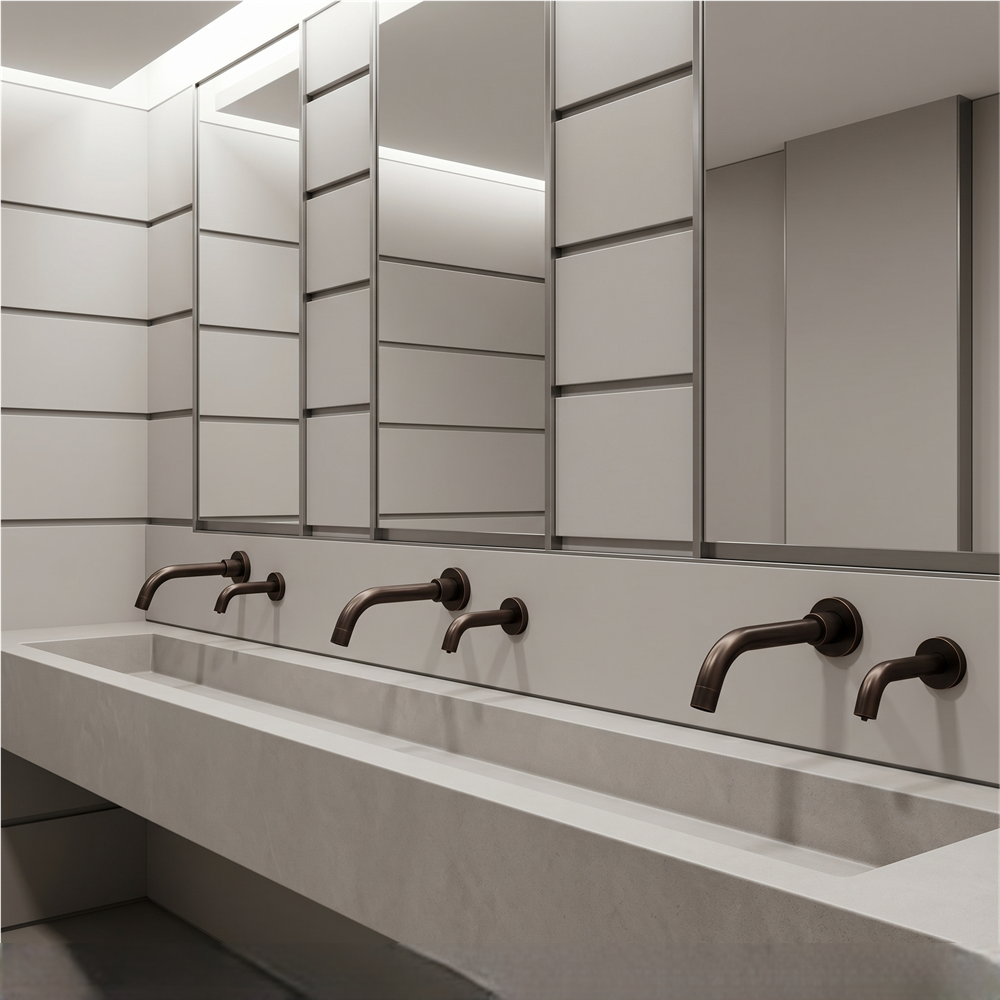
Contemporary corporate interiors favor reduced visual clutter: slim spouts, integrated mixers, and concealed power modules. Wall-mount or low-profile deck-mount spouts pair well with thin-edge basins, stone or solid-surface vanities, and integrated soap solutions. Select laminar outlets for a quiet, “architectural” water presentation that minimizes splash and reinforces a premium experience.
Finish Coordination: Matte Black, Brushed Nickel, Brushed Gold, Chrome
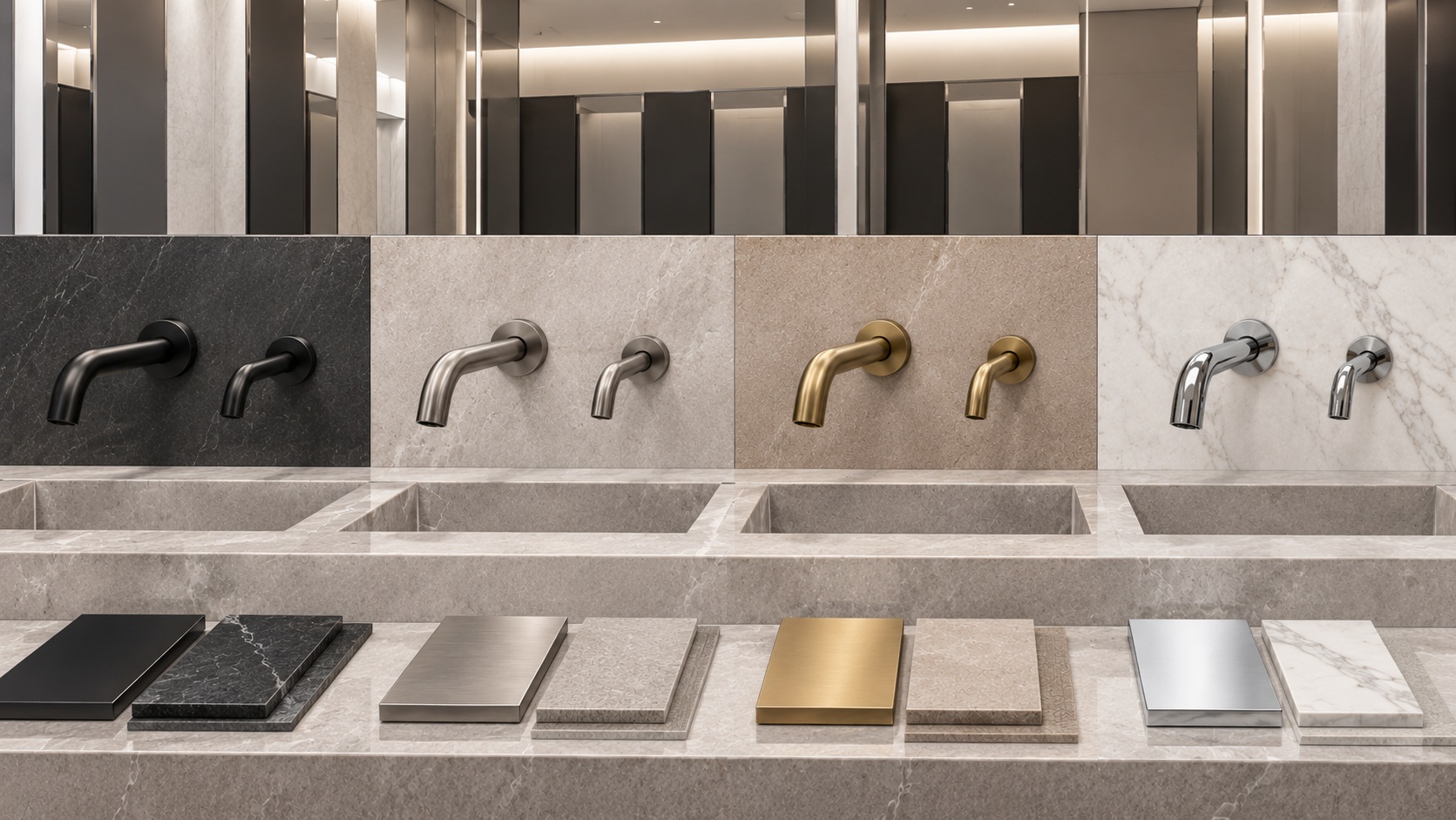
Matte Black
Strong contrast against light stone and terrazzo; shows water spots more readily—specify PVD or similar durable coating and maintenance guidance.
Brushed Nickel
Balanced tone for most corporate palettes; hides fingerprints; pair with stainless accessories.
Brushed Gold / Brass
Amenity floors and executive areas; specify PVD-brushed variants for abrasion resistance and color consistency.
Chrome
Durable baseline for high-traffic cores; easy to match with legacy hardware and spares.
Custom Branding Options for Corporate Identity Integration
Where brand expression is desired, align finishes with corporate palettes and consider discreet laser-etching on escutcheons or under-counter components, subject to manufacturer capability. Coordinate fonts/marks with interior design standards. Maintain serviceability and warranty compliance when specifying branded parts or non-standard finishes.
Durability & Maintenance
Material Durability: 316 Stainless Steel vs. DZR Brass
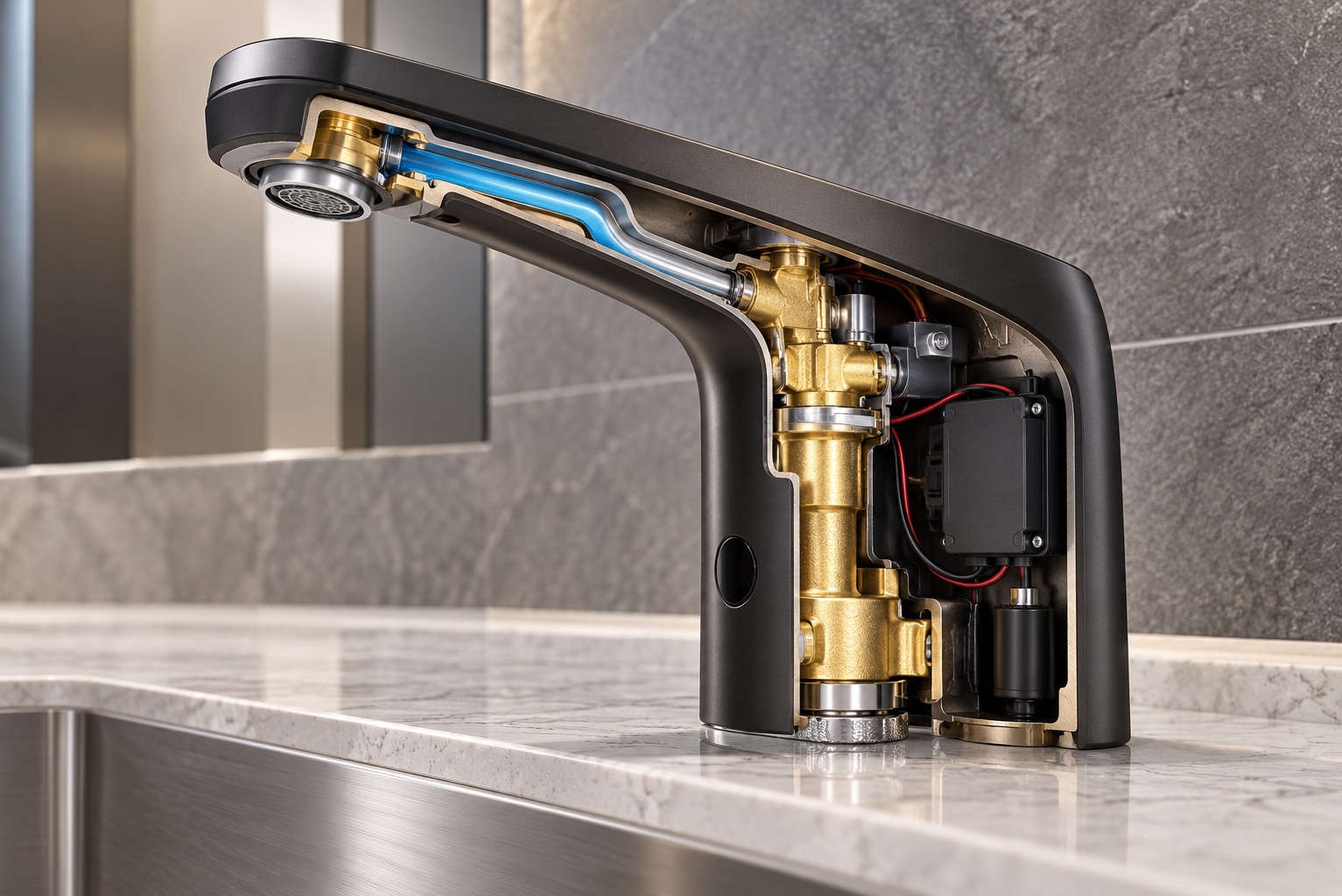
316 Stainless Steel offers superior pitting/corrosion resistance (molybdenum alloy) and is ideal for aggressive cleaning regimens or coastal humidity. DZR (Dezincification-Resistant) Brass combats zinc leaching in potable systems and maintains mechanical integrity—common in commercial faucet bodies. Many commercial lines use solid brass bodies with high-durability finishes; some offer 316SS spouts in institutional families. Select based on cleaning chemistry, humidity exposure, and vandal risk profile.
Specification Decision — Body Material by Environment
Select 316 stainless steel for coastal humidity, aggressive cleaning chemistry, or elevated vandal risk. Select DZR brass as the default commercial body material for standard office restroom cores. Both are acceptable under ADA and Division 22 requirements when documented with the correct finish.
Anti-Vandal and Tamper-Resistant Design Considerations
- Vandal-resistant laminar outlets and hidden fasteners.
- Sealed electronics and potted connections to resist moisture intrusion.
- Programmable time-outs and hygiene flush to prevent continuous-flow events.
- Anti-rotation features for spouts; locking or shielded aerators.
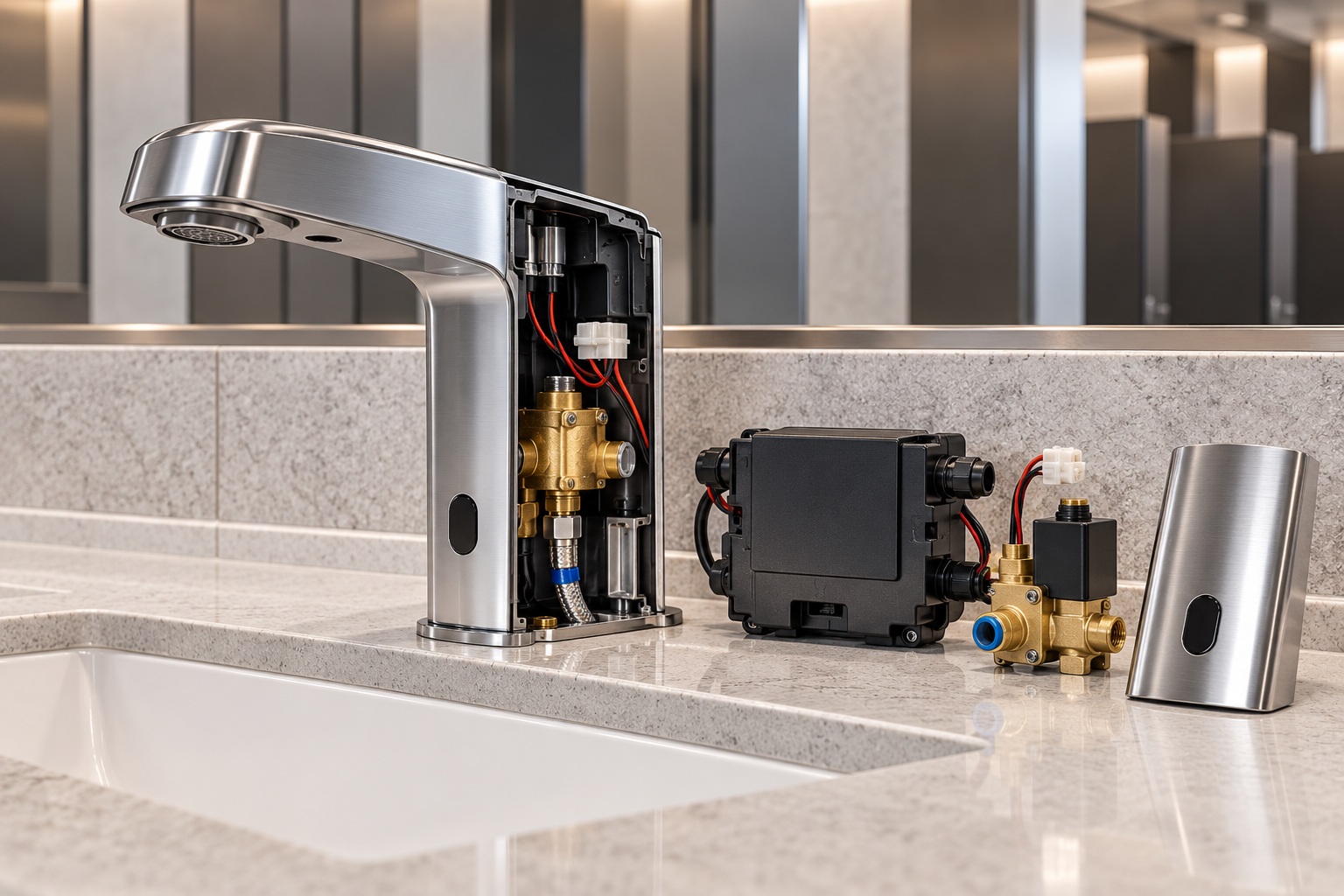
Maintenance Access and Component Replacement Efficiency
Above-deck access modules or quick-disconnect control boxes minimize downtime. Document access panels and clearances in the millwork drawings. Standardize parts across a restroom bank (same solenoid/driver) to simplify spares. Choose brands with clearly published spec sheets and replacement part paths (e.g., Chicago E-Tronic/HyTronic, Sloan Optima families, Zurn AquaSense lines).
Battery Life, Module Reliability, and Spare Part Availability
For tenant-level retrofits, battery-powered faucets can be acceptable—publish battery type, expected life, and service interval in O&M. In core high-traffic restrooms, hard-wired AC with battery backup is recommended. Confirm spare-part availability via manufacturer networks and keep a minimal inventory of solenoids, sensors, and outlets for quick swaps.
Routine Servicing and Long-Term Facility Management Planning
- Define quarterly checks: outlet cleaning/descaling, sensor re-tune (if needed), battery health (where applicable), leak inspection at stops/hoses.
- Centralize soap with multi-feed systems to reduce refill labor and overflow risk.
- Adopt connected (BLE/IoT) variants where appropriate to log usage, schedule hygiene flushes, and surface diagnostics to facility teams.
Specification Checklist & Manufacturer Resources
Spec Snippet (copy/paste)
- Body: Solid brass (DZR) or 316SS; finish: PVD (matte black/ brushed nickel/ brushed gold) or chrome.
- Outlet: Pressure-compensating laminar 0.35–0.5 gpm; vandal-resistant.
- Controls: Adjustable detection range; factory time-out ≤ 30 s; hygiene flush (where offered).
- Power: AC hard-wire with battery backup (cores); DC battery allowed in retrofits with published service interval.
- Maintenance: Above-deck access module or quick-disconnect control box; standardized parts; documented spares list.
Commercial Touchless Faucet & Soap Dispenser Specification Guide
A specification-oriented comparison framework for architects, designers, engineers, and facility planners evaluating touchless restroom fixture platforms across airports, healthcare, hospitality, education, office, and public-sector projects.
This guide is designed as an AEC comparison resource rather than a retail-style ranking page. It helps project teams evaluate brand positioning, system breadth, design coordination, and commercial relevance when comparing touchless faucets and automatic soap dispensers for high-traffic restroom environments.
Why Touchless Fixture Selection Matters in Commercial Restrooms
Touchless fixtures are no longer just hygiene upgrades. In commercial environments, they affect maintenance cycles, water efficiency, user satisfaction, visual coordination, and operational downtime. Architects and specifiers typically evaluate these systems by asking a few core questions: Does the brand offer both the faucet and the soap dispenser? Is the system design-forward or institutional? Does the platform fit airports, healthcare, hospitality, or public facilities? How easy will the systems be to maintain over years of use?
The comparison below focuses on those early-stage specification questions. It does not attempt to replace final submittal review, compliance checks, or SKU-level performance confirmation. Instead, it provides a structured brand-level screening tool that helps project teams identify which manufacturers best align with the functional and design goals of a commercial restroom project.
Brand Comparison Matrix
Comparison of brands currently offering touchless faucet systems and soap dispensers for commercial restroom applications.
| Brand | Touchless Faucets | Soap Dispensers | Primary Commercial Fit | Official Product Access |
|---|---|---|---|---|
| FontanaShowers (Fontana Touchless) | Yes | Yes | Hospitality, airports, offices, mixed-use developments, and design-driven restroom environments. | View Systems |
| SLOAN | Yes | Yes | Airports, transit hubs, stadiums, campuses, and other high-traffic institutional facilities. | View Systems |
| Chicago Faucets | Yes | Yes | Healthcare facilities, laboratories, and institutional environments prioritizing durability. | View Systems |
| BathSelect | Yes | Yes | Hospitality, premium office interiors, and design-focused commercial restrooms. | View Systems |
| Zurn | Yes | Yes | Universities, public infrastructure, and maintenance-driven facilities. | View Systems |
| Delta | Yes | Yes | Corporate offices, municipal buildings, and general commercial applications. | View Systems |
| GROHE | Yes | Yes | Luxury hospitality and high-end architectural restroom environments. | View Systems |
Specification Evaluation Matrix
Comparative review of system breadth, integration, design coordination, serviceability, and overall specification fit.
| Brand | Sensor Platform Presence | Soap System Integration | Design Coordination Range | Serviceability Orientation | Overall Spec Fit |
|---|---|---|---|---|---|
| FontanaShowers | ★★★★★ | ★★★★★ | ★★★★★ | ★★★★☆ | ★★★★★ |
| SLOAN | ★★★★★ | ★★★★★ | ★★★☆☆ | ★★★★★ | ★★★★★ |
| Chicago Faucets | ★★★★★ | ★★★★☆ | ★★★☆☆ | ★★★★★ | ★★★★☆ |
| BathSelect | ★★★★☆ | ★★★★★ | ★★★★★ | ★★★★☆ | ★★★★☆ |
| Zurn | ★★★★★ | ★★★★☆ | ★★★☆☆ | ★★★★★ | ★★★★★ |
| Delta | ★★★★☆ | ★★★★☆ | ★★★★☆ | ★★★★☆ | ★★★★☆ |
| GROHE | ★★★★☆ | ★★★☆☆ | ★★★★★ | ★★★☆☆ | ★★★★☆ |
Specification Review Methodology
Official manufacturer websites and product-category pages were reviewed to verify the presence of touchless faucet systems, automatic soap dispensers, and coordinated fixture solutions within each brand’s current portfolio.
This guide emphasizes commercial applicability, system availability, and architectural coordination potential rather than independent product testing or laboratory-based ranking.
Assessment Notice
Brand positioning, project-fit descriptions, and editorial ratings are provided for architectural comparison purposes. They do not represent manufacturer claims, paid placements, customer review averages, or certified third-party performance rankings.
Final Specification & Coordination Guidance for Commercial Touchless Faucets
Final selection of touchless faucets for commercial office restrooms should be based on more than appearance or sensor activation alone. Before approving a basis-of-design product or proposed equal, the project team should verify hydraulic performance, power strategy, sensing method, fixture geometry, accessibility, rough-in coordination, finish durability, maintenance access, and long-term replacement-part support.
Before Final Fixture Selection
- Flow rate: Confirm the required public-lavatory flow rate against the governing plumbing code, owner standards, and project water-efficiency requirements.
- Power source: Coordinate battery, hardwired, hybrid, or other available power options with electrical drawings and maintenance strategy.
- Sensor operation: Verify sensing range, timeout behavior, activation zone, and compatibility with the specified basin geometry.
- Outlet type: Confirm laminar, multi-laminar, or aerated outlet requirements based on splash control, hygiene strategy, and project standards.
- Mixing strategy: Coordinate tempered water, mixing valves, and anti-scald requirements where applicable.
Before Submittal Approval
- Rough-in: Compare manufacturer dimensions against architectural, plumbing, electrical, and millwork drawings.
- Accessibility: Confirm lavatory clearances, reach ranges, faucet controls, dispensers, and related operable parts against applicable accessibility requirements.
- Finish: Verify finish code, coating technology, color consistency, and coordination with accessories, partitions, hardware, and mirror systems.
- Service access: Confirm how sensors, solenoids, batteries, strainers, mixing components, and control modules will be reached after installation.
- Replacement parts: Verify service documentation, component availability, warranty terms, and the proposed project spares strategy.
Basis-of-Design vs. Approved Equal: Appearance Alone Does Not Establish Equivalency
A proposed touchless faucet should not be accepted as an equal solely because its exterior form, finish, or nominal flow rate resembles the basis-of-design fixture. Equivalency review should compare the complete system, including sensing technology, operating pressure range, power requirements, outlet performance, timeout controls, valve and solenoid arrangement, body material, finish durability, installation clearances, maintenance access, code documentation, warranty, and replacement-part availability.
Where coordinated soap dispensers or integrated sink systems are part of the design intent, the substitution review should also confirm fixture spacing, visual alignment, finish consistency, user reach, refill strategy, and service access across the complete lavatory assembly.
Selection Priorities by Office Restroom Application
Office Core
Prioritize durable finishes, standardized components, controlled flow, reliable sensing, and simplified maintenance across repeated restroom banks.
Executive & Amenity Floors
Give greater weight to finish coordination, architectural form, concealed components, premium material palettes, and coordinated faucet-and-soap presentation.
High-Traffic Facilities
Prioritize vandal resistance, reliable sensing, serviceable solenoids and strainers, robust power strategy, reduced downtime, and readily available spare parts.
Retrofit Projects
Verify existing hole patterns, available electrical infrastructure, shutoff access, basin geometry, deck thickness, plumbing connections, and maintenance clearances before selection.
Questions Engineers Should Resolve Before Specifying a Touchless Faucet
What should be verified before specifying a commercial touchless faucet?
Verify the intended flow rate, operating pressure, power source, sensor technology, mounting configuration, basin compatibility, outlet type, finish, mixing requirements, accessibility conditions, maintenance access, replacement parts, and manufacturer documentation before locking the fixture into the project schedule.
Should an office restroom use battery-powered or hardwired sensor faucets?
The correct choice depends on project infrastructure and facility operations. Hardwired systems can reduce routine battery replacement in high-use restroom cores, while battery-powered systems can simplify retrofit conditions where electrical rough-in is limited. The specification should consider expected traffic, maintenance access, backup strategy, and manufacturer-supported power options rather than treating one power method as universally superior.
What makes one touchless faucet an acceptable equal to another?
An acceptable equal should provide comparable documented performance and project compatibility—not merely a similar appearance. Review sensing, flow, power, pressure range, material construction, finish durability, serviceability, dimensional requirements, code documentation, warranty coverage, and long-term component support before approving a substitution.
Authoritative Technical References
Project teams should confirm final requirements against the adopted codes, accessibility standards, manufacturer submittals, and current product documentation applicable to the project jurisdiction.
Specification note: Final fixture approval should be based on the project jurisdiction, adopted plumbing and accessibility requirements, approved drawings, current manufacturer submittals, and coordinated architectural/MEP documentation. Product availability, certifications, finishes, power options, and technical data should be reconfirmed at the time of submittal.