
Commercial Restroom Design | Hygiene Technology
The Evolution of Hygiene Technology in Public Restrooms
Public restroom technology has evolved from manual fixtures to automated sensor-based systems. Automatic soap dispensers represent one of the most significant upgrades in restroom hygiene.
Today, touchless faucets, automatic flush valves, sensor hand dryers, and coordinated soap-dispensing systems can reduce the need to touch frequently used controls. For architects, MEP engineers, facility managers, and commercial restroom contractors, the challenge is not simply choosing automated products: it is specifying an accessible, serviceable, water-conscious restroom system that performs consistently under real operating conditions.
Key Technologies in Modern Restrooms
- infrared soap dispensers
- touchless faucets
- automatic flush valves
- sensor hand dryers
Manufacturers such as BathSelect, FontanaShowers, Grohe, and JunoShowers have played a major role in advancing these technologies. Product suitability should nevertheless be established using model-specific documentation, installation requirements, service support, and relevant project specifications.
For a detailed evaluation of automatic soap dispensers, visit: strengths and weaknesses of automatic soap dispensers.
Touchless Faucets: From Manual Operation to Sensor Control
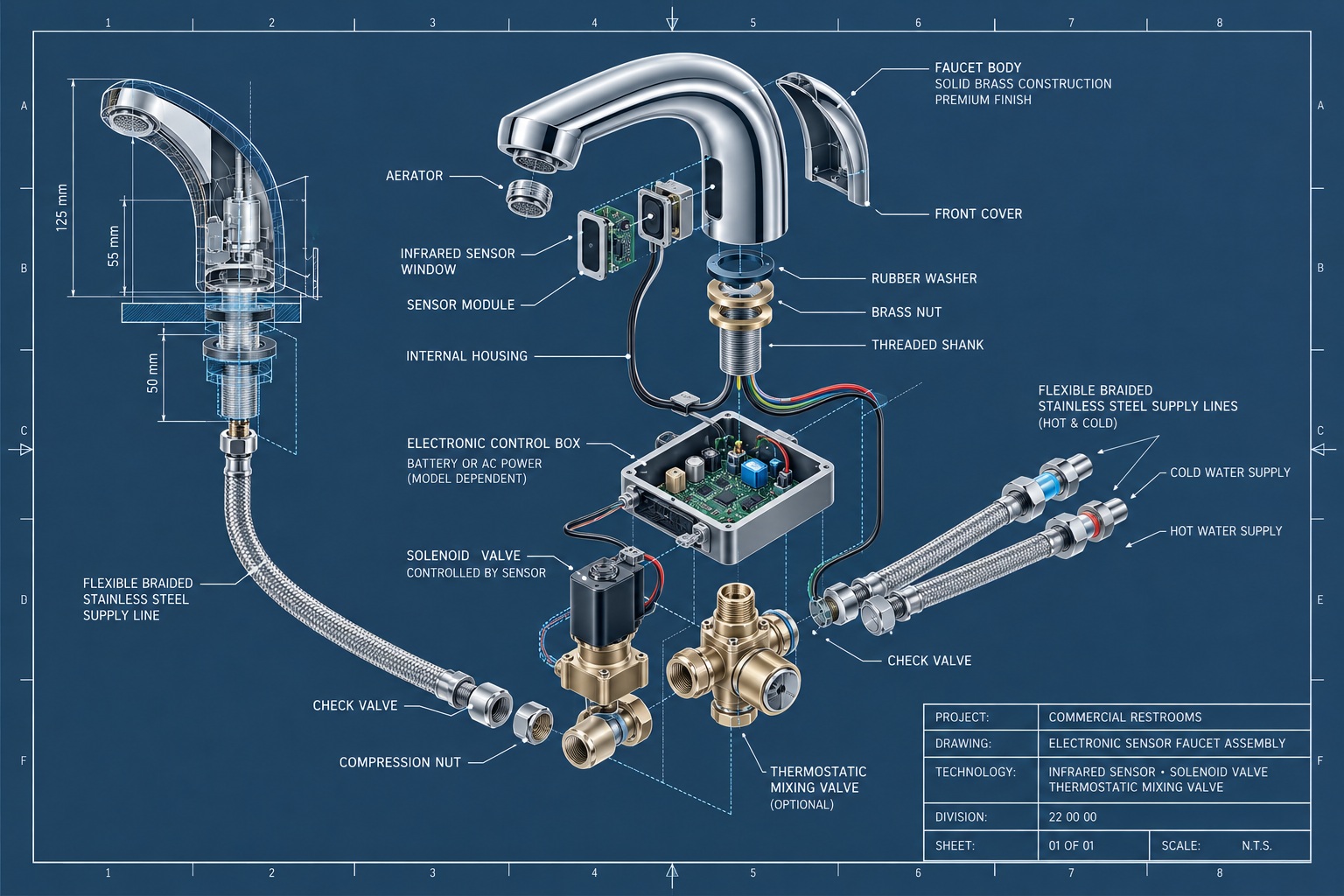
A conventional faucet requires contact with handles before and often after handwashing. A sensor-operated faucet instead uses a detection system to initiate flow when hands enter its sensing zone and to stop flow when the hands are removed or a programmed timeout is reached.
In high-traffic settings, designers should assess sensor range, false activations, power options, accessible reach, basin splash performance, and the ability to isolate or service the solenoid valve. Infrared sensing reduces contact with the control, but it does not eliminate the need for cleaning or a building water-management program.
The EPA WaterSense at Work faucet guidance notes that automatic sensors do not necessarily save water in every installation; actual savings depend on operating conditions and configuration.
Automatic Soap Dispensers and the Handwashing Sequence
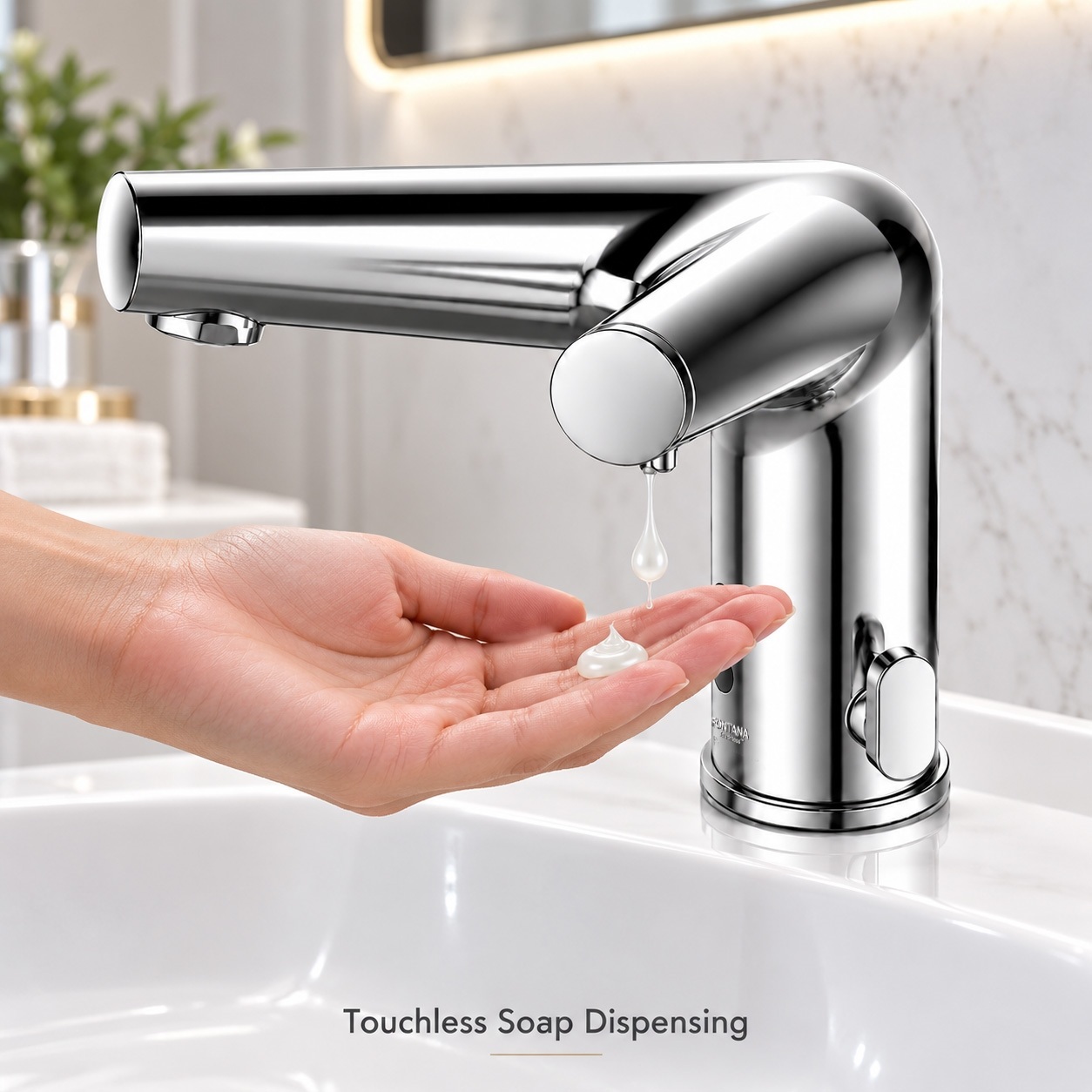
Automatic soap dispensers help users obtain soap without operating a shared pump. Their performance depends on compatible soap viscosity, reliable dosing, sensor placement, battery or mains power, and an accessible refill process.
Dispensers should be positioned so that users can move naturally from soap to water without reaching across other fixtures. The soap outlet, basin geometry, and expected hand position must work together to limit drips onto counters and floors.
Facilities teams should document refill intervals, approved consumables, nozzle cleaning, and response procedures for clogged or non-dispensing units. A touchless dispenser with an empty reservoir offers no practical hygiene benefit.
Automatic Flush Valves and Sensor Hand Dryers
Sensor-operated flush controls can reduce contact with toilet or urinal handles. However, occupancy detection, flush timing, water supply compatibility, and access for maintenance must be checked during specification and commissioning.
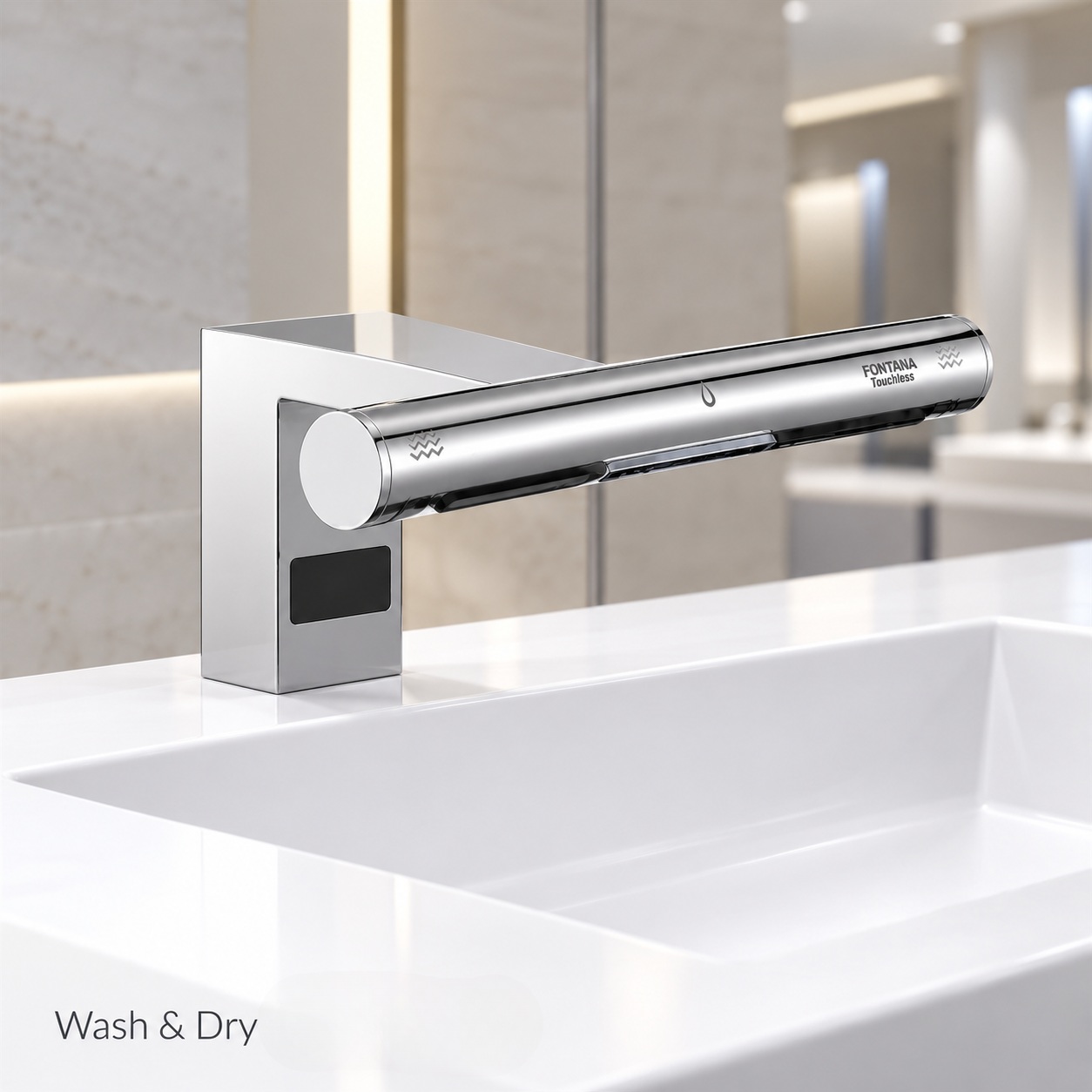
Sensor hand dryers reduce the need to touch a start button, while introducing other design questions: drying time, noise, electrical demand, air movement, cleaning, and accessibility. The appropriate hand-drying solution varies by facility type and operating policy.
For the complete restroom, the sequence from soap to washing to drying should be intuitive and should not create avoidable congestion near doors or accessible circulation routes.
Comparing the Four Core Hygiene Technologies
| Technology | Primary benefit | Key specification check | Maintenance priority |
|---|---|---|---|
| Infrared soap dispenser | No-touch soap delivery | Dosing and soap compatibility | Refill and nozzle cleaning |
| Touchless faucet | Hands-free water activation | Sensor, flow, basin, power | Sensor and valve inspection |
| Automatic flush valve | No-touch flushing | Fixture and supply compatibility | Calibration and leak checks |
| Sensor hand dryer | No-touch activation | Electrical, noise, placement | Surface and inlet cleaning |
Architectural Layout, Accessibility, and User Experience
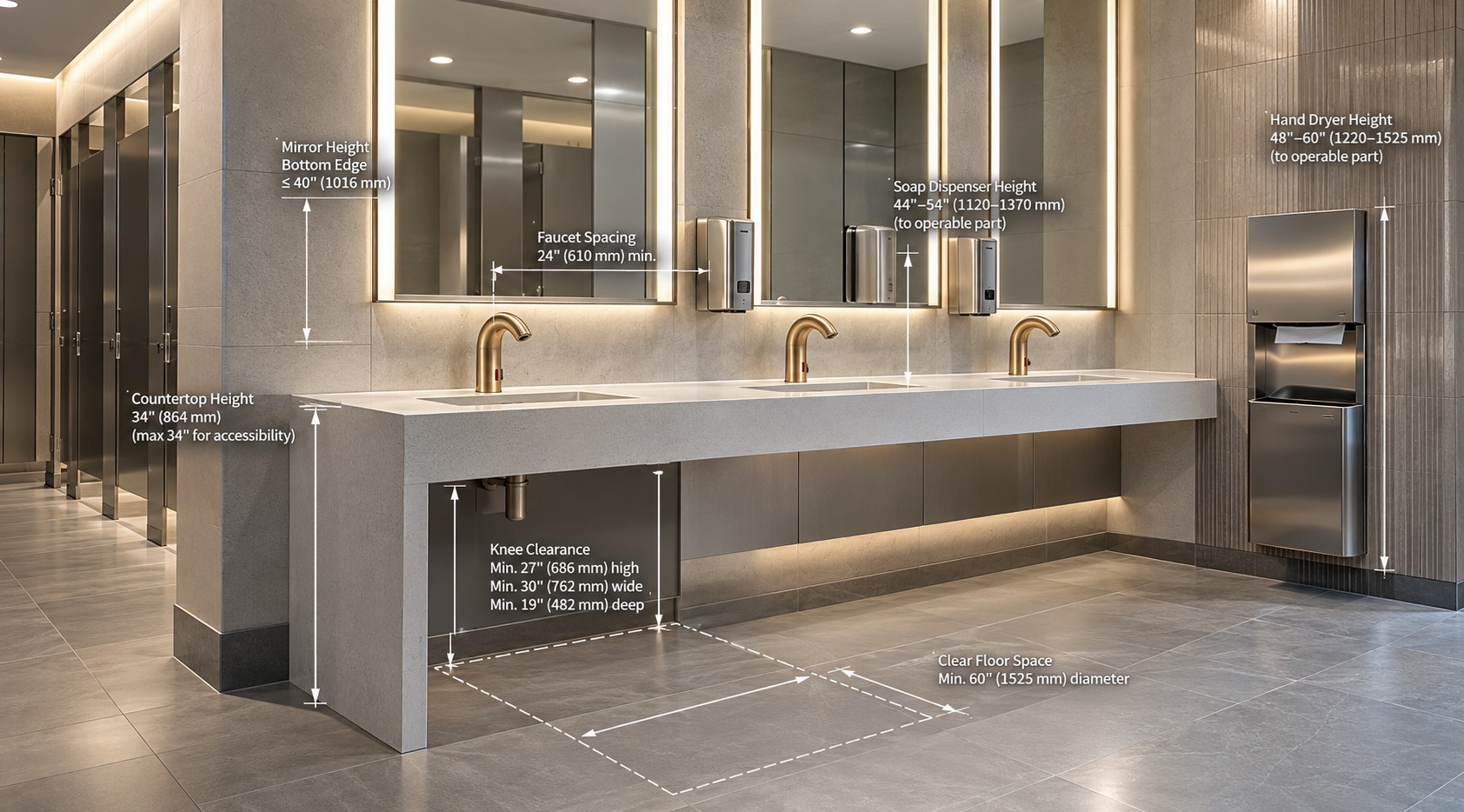
Technology should follow the user’s route through the restroom. Soap and faucet sensors must be usable without awkward hand positions, while dispenser heights, clearances, and controls should be evaluated against the accessibility requirements applicable to the project.
For hospitality, offices, schools, and transport facilities, fixture spacing should account for peak use, queue formation, splash zones, cleaning access, and the location of mirrors, waste receptacles, and hand-drying stations.
Architects should coordinate finished wall dimensions and mounting heights with MEP and interior design teams before shop drawings are approved. Attractive product photography is not a substitute for verified clearances or accessible installation details.
For technical guidance on accessible restroom layouts, consult the U.S. Access Board ADA Accessibility Standards .
MEP Coordination: Power, Plumbing, and Commissioning
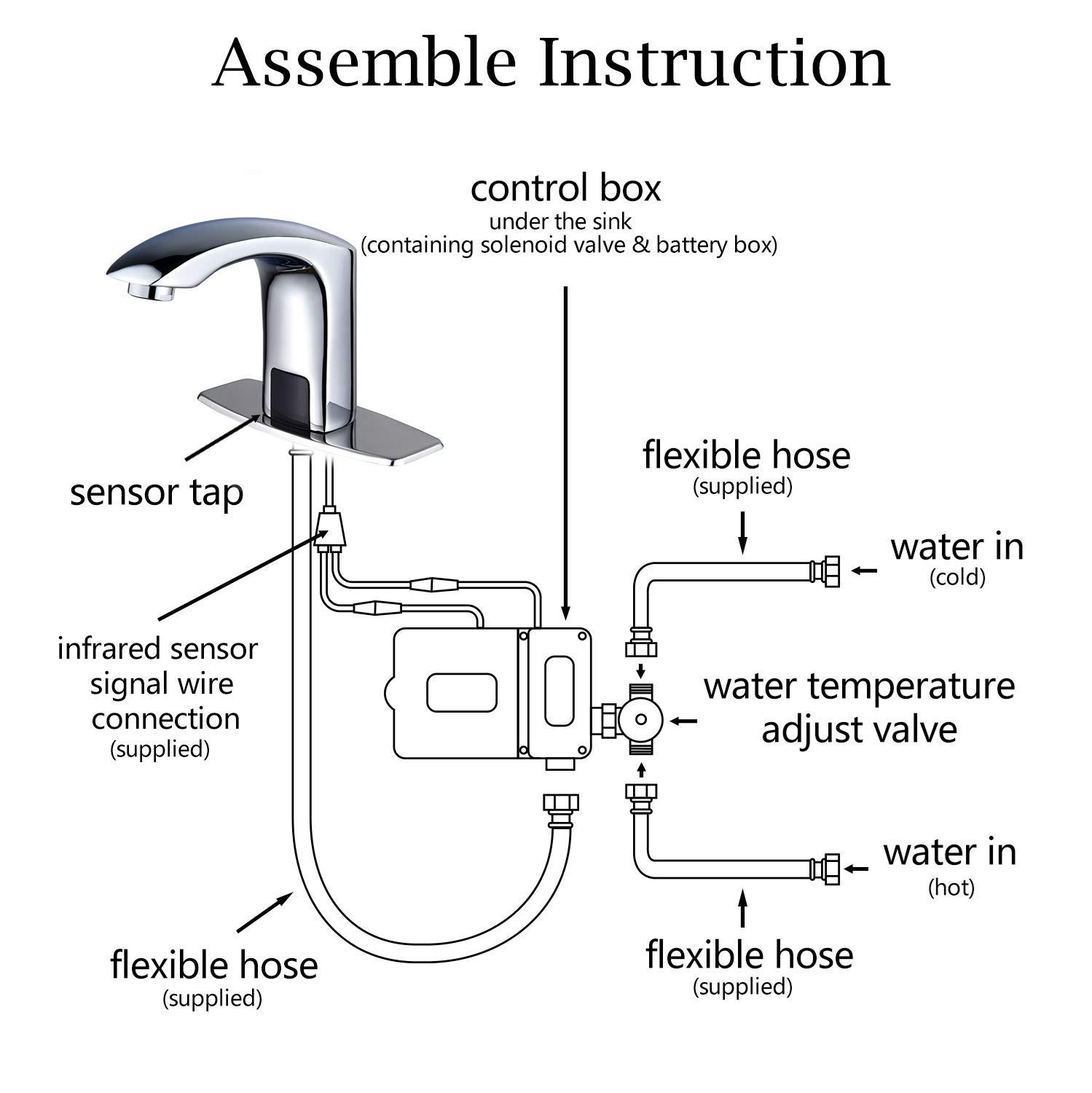
Automated fixtures introduce interfaces between plumbing and electrical systems. Teams should establish whether each product uses batteries, a low-voltage power supply, or a hardwired connection, and confirm the location of accessible service points.
For sensor faucets, review water pressure, temperature control, flow regulation, shutoff access, backflow protection where required, and compatibility between the sensor, controller, and solenoid. Sensor placement and reflective basin surfaces should be evaluated to reduce unwanted activations.
Commissioning should include activation testing, timeout verification, leak checks, cleaning-access review, and handover documentation. These steps support reliable performance after the contractor leaves the site.
Water Efficiency Without Overpromising
Automatic operation can limit unnecessary run time, but sensor technology alone does not guarantee lower water use. Flow rate, sensor sensitivity, shutoff timing, pressure, and user behavior determine actual results. Water-use targets should therefore be checked against applicable codes and measured during commissioning.
For U.S. public lavatories, EPA guidance identifies 0.5 gallons per minute or less as a water-efficient flow rate. The EPA explains the distinction between public and private lavatory faucets: public lavatory faucets are not currently eligible for the WaterSense label, so project teams should not claim that every commercial sensor faucet is WaterSense certified.
Where local regulations differ, follow the governing jurisdiction and the approved project specifications rather than relying on a generic flow claim.
Cleaning, Maintenance, and Long-Term Reliability
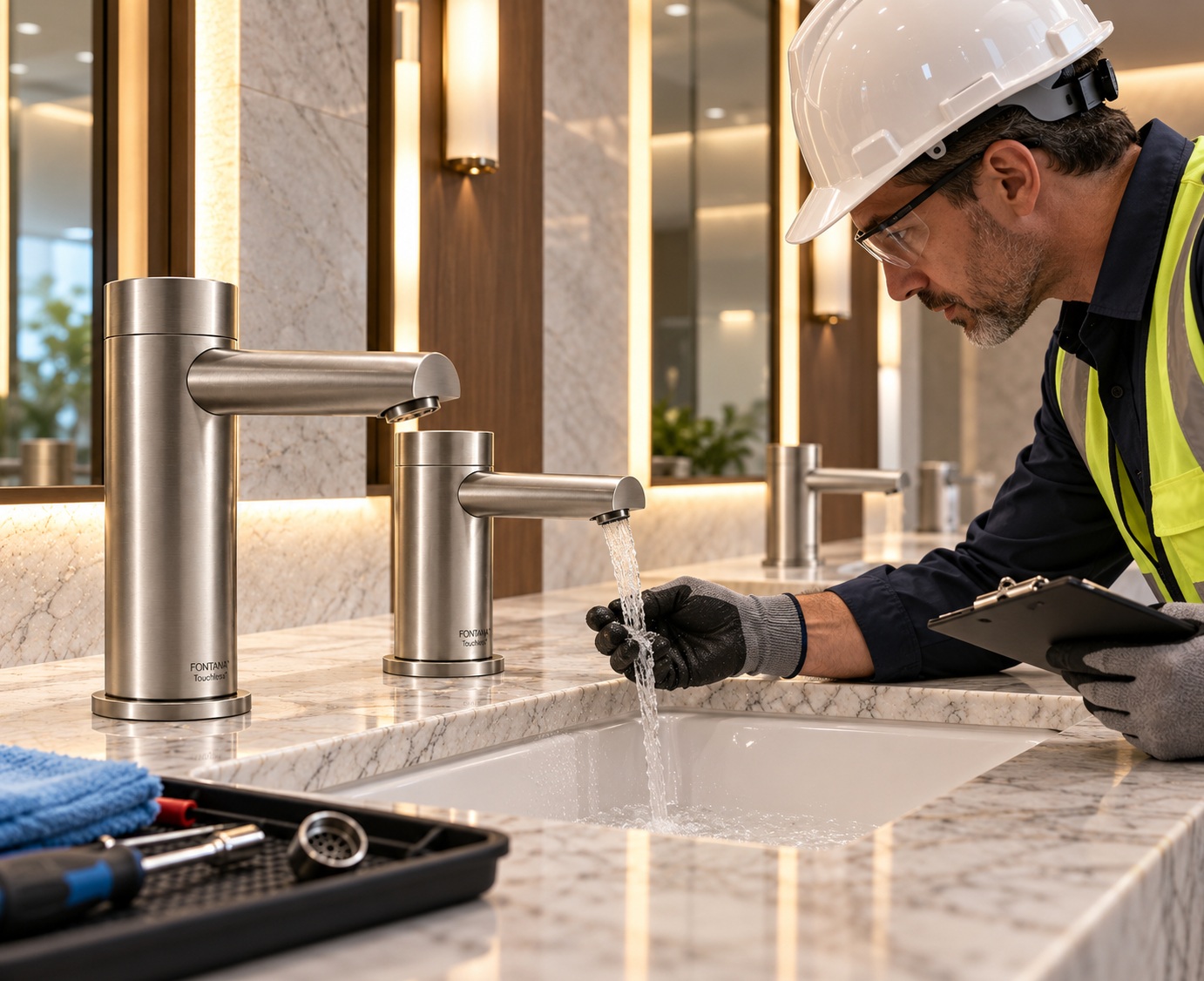
Hands-free controls can reduce contact with selected touchpoints, but they do not make a restroom self-cleaning or sterile. Surface disinfection, supply-water management, scheduled inspections, and prompt fault reporting remain essential.
Facility managers should keep a register of batteries, power supplies, sensors, valves, soap reservoirs, compatible consumables, and spare parts. Maintenance schedules should address blocked aerators, leaking valves, empty soap containers, and sensor misalignment.
In sensitive settings, including healthcare, plumbing and infection-prevention teams should evaluate water stagnation, aerosol considerations, and the facility’s water-management plan rather than assuming that automatic operation eliminates microbiological risk.
Specification Checklist for Architects and Facility Teams
- Function: Confirm sensing technology, activation range, timeout, and manual service procedures.
- Plumbing: Verify supply pressure, flow rate, temperature limits, valves, and access.
- Electrical: Document power type, wiring, battery replacement, and service isolation.
- Accessibility: Check mounting heights, clear floor space, and operability against applicable standards.
- Operations: Confirm cleaning products, soap compatibility, spare parts, and warranty support.
- Documentation: Obtain technical data sheets, installation instructions, commissioning records, and maintenance manuals.
The preferred product is not necessarily the most visually complex one. It is the fixture that fits the building’s usage pattern, compliance obligations, maintenance capacity, and total cost of ownership.
Frequently Asked Questions
Are touchless faucets more hygienic than manual faucets?
They reduce the need to touch faucet handles during handwashing, but hygiene outcomes also depend on cleaning, water quality, user behavior, and maintenance.
Do sensor faucets always save water?
No. Savings depend on flow rate, activation time, programming, and actual usage. Proper specification and commissioning are important.
What is the main advantage of automatic soap dispensers?
They allow soap dispensing without pressing a shared pump, provided the units are filled, calibrated, and maintained.
Can sensor fixtures be installed in existing restrooms?
Often yes, but retrofits require checks for mounting space, power, plumbing compatibility, accessibility, and service access.
Are all commercial touchless faucets WaterSense labeled?
No. EPA WaterSense faucet labeling currently applies to eligible private lavatory products, not public lavatory faucets.
Which professionals should coordinate hygiene technology?
Architects, interior designers, plumbing and electrical engineers, accessibility consultants, installers, and facility operations teams should review the system together.
Final Thoughts: Designing a Coordinated Hygiene System
The evolution of public restroom hygiene is best understood as a move toward coordinated, lower-contact systems rather than a collection of isolated electronic fixtures. Infrared soap dispensers, touchless faucets, automatic flush valves, and sensor hand dryers each address a different point in the user journey.
For successful commercial projects, specify technology alongside accessibility, water efficiency, maintenance access, and reliable building services. The result is a restroom that is easier to use, more straightforward to maintain, and better aligned with the expectations of occupants and facility operators.