
Commercial Faucet Valve Technology: Ceramic Disc vs. Solenoid vs. Metering vs. Gear-Driven Systems
The faucet body is only the visible shell. Inside, water may be controlled by a ceramic disc, magnetic solenoid, self-closing metering cartridge, or motor-driven ceramic valve. These architectures fail differently, respond differently to debris, and create very different maintenance requirements. This guide explains what architects, MEP engineers and facility managers should specify before procurement.
Four Commercial Water-Control Architectures
Hard ceramic surfaces rotate or slide to control water mechanically with low friction and strong wear resistance.
An electrical signal opens or closes the waterway, making this architecture common in touchless sensor faucets.
A mechanical actuator opens the valve temporarily; the cartridge then closes automatically after a timed cycle.
A small motor and gear system moves a ceramic cartridge electronically without a conventional solenoid.
How the Valve Types Differ
| Factor | Ceramic Disc | Solenoid | Metering | Gear-Driven |
|---|---|---|---|---|
| Electronic power | Not inherently | Yes | No | Yes |
| Automatic operation | Depends on actuator | Excellent | Timed mechanical | Excellent |
| Debris sensitivity | Generally good | Filtration important | Cartridge dependent | Designed for improved tolerance |
| Common service item | Cartridge | Solenoid + strainer | Metering cartridge | Gear/cartridge assembly |
| Best fit | Manual/mixed systems | Touchless | Timed public use | New-generation touchless |
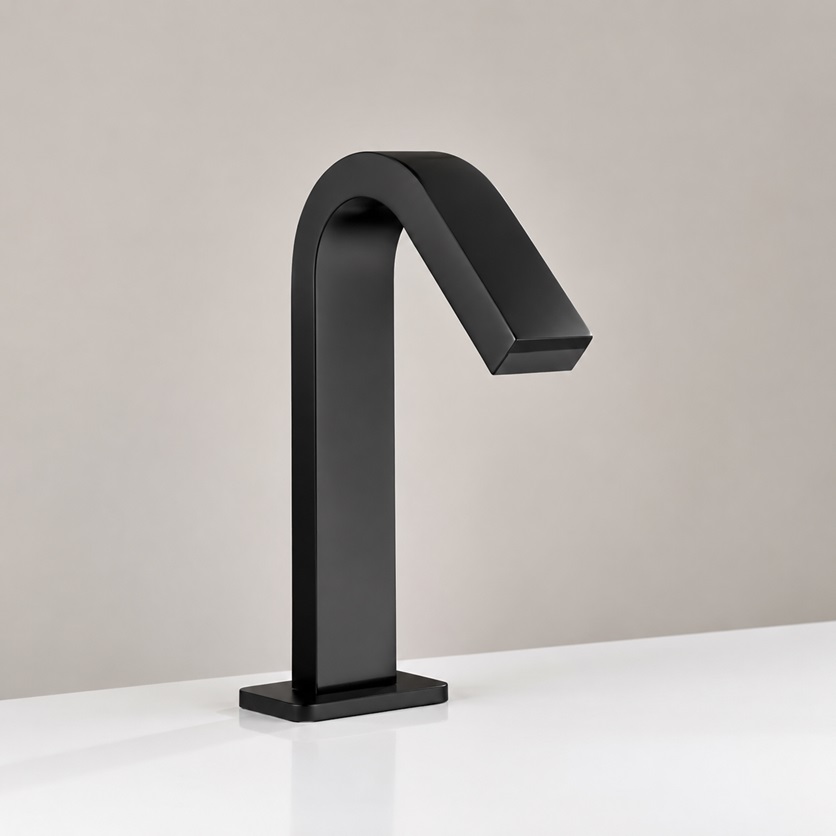
Fontana Commercial Matte Black Touchless Automatic Sensor Hands Free Faucet
The Fontana Commercial Matte Black Touchless Automatic Sensor Faucet is a straightforward example of electronic solenoid control. The sensor detects the user, the control circuit energizes the valve, and water stops when the sensing condition ends.
This architecture is familiar to commercial technicians and highly effective, but its reliability depends on clean water, stable power and protection from debris.
Fast electronic operation using familiar commercial solenoid architecture.
Keep filtration accessible and diagnose sensor, power and solenoid separately.
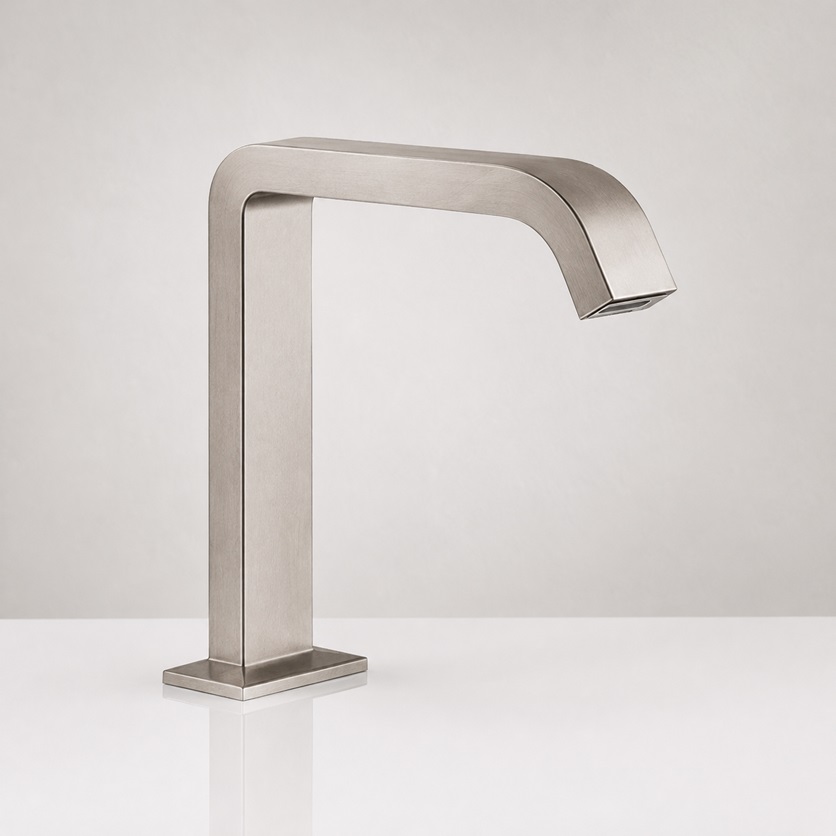
BathSelect Hands Free Commercial Automatic Bathroom Sink Faucet — Brushed Nickel
BathSelect shows why real faucets can contain more than one valve technology. The selected model lists a drip-free ceramic-disc cartridge while its electronic water-control package uses a 6-volt magnet-latching solenoid.
A cleanable 50-mesh strainer protects the solenoid from supply debris. That layered architecture demonstrates why maintenance teams need a component diagram rather than one generic “valve” replacement part.
Ceramic control surfaces paired with electronically triggered commercial water control.
Identify whether a complaint originates in cartridge, solenoid, sensor or filtration.
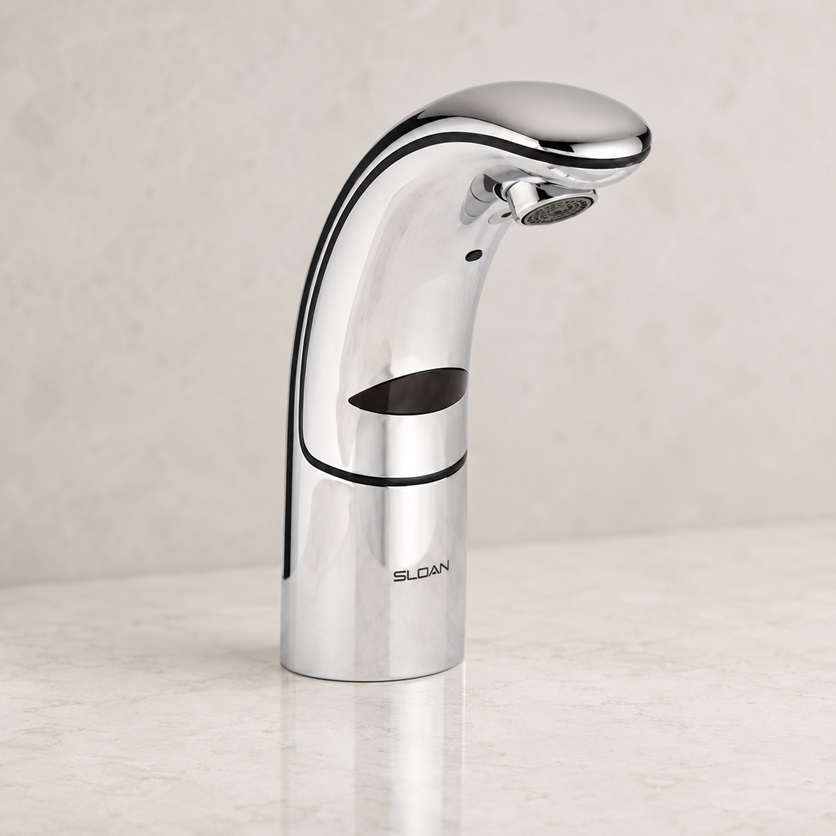
Sloan Optima® EAF-150 Commercial Sensor Faucet
Sloan’s EAF-150 uses a magnetic solenoid valve coordinated with automatic self-adapting infrared sensing. A supply strainer protects the valve, while low-battery indication helps separate power problems from hydraulic faults.
Mature electronic valve architecture with strong commercial service support.
Check the strainer and power source before replacing the solenoid.
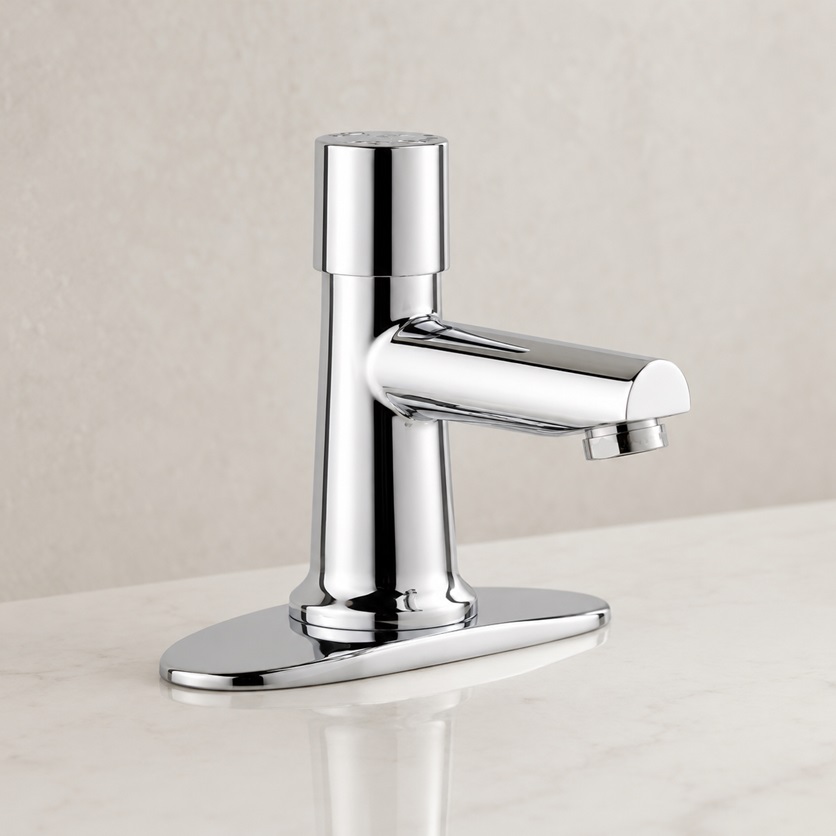
Chicago Faucets 3500 Series MVP® Metering Faucet
The Chicago Faucets 3500 Series uses a completely mechanical strategy. Its MVP self-closing metering cartridge opens when the user pushes the actuator and then automatically closes after an adjustable cycle of approximately 2–25 seconds.
There is no sensor, battery or solenoid. That makes metering attractive where automatic shutoff is needed without electronic maintenance.
Automatic water limitation using mechanical cartridge timing alone.
Service centers on cartridge wear and cycle-time adjustment rather than electronics.
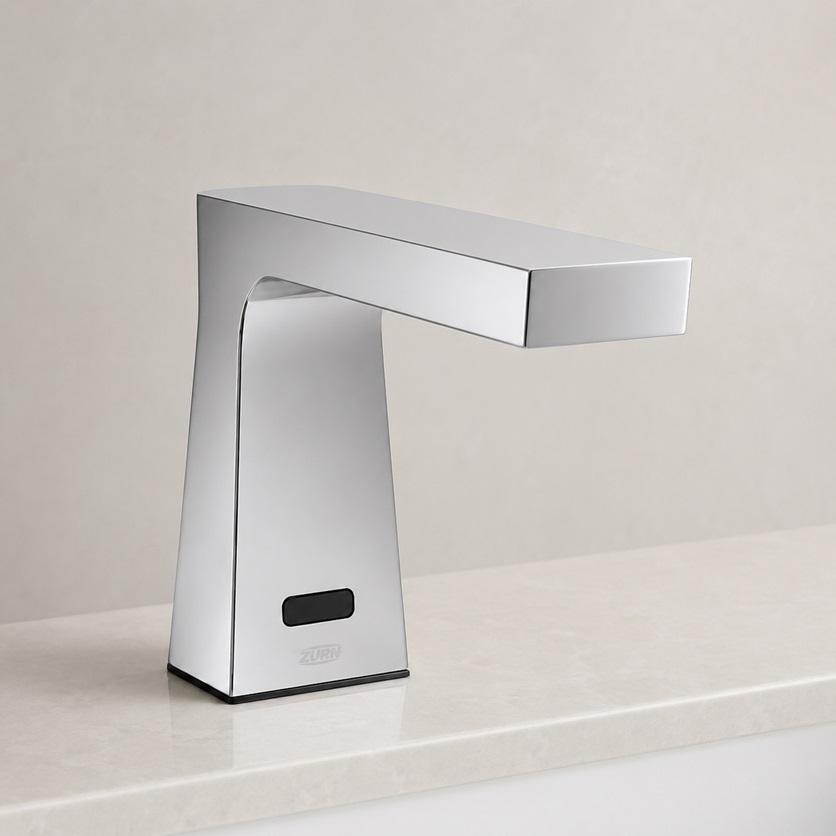
Zurn Camaya Series® ZG6953 Gear-Driven Ceramic Cartridge Sensor Faucet
Zurn represents the newest architecture in this comparison. Its EZ Gear system uses a motor and gear assembly to operate a ceramic cartridge, eliminating the conventional solenoid entirely.
Zurn states that the system is less susceptible to debris and buildup and is intended to outlast and outperform conventional solenoids. Bluetooth programming adds adjustable sensing, timeout and flushing functions.
Electronic touchless operation without a conventional solenoid water-control mechanism.
Technicians need gear/cartridge-specific parts and service knowledge.
What Usually Goes Wrong?
| Valve Type | Typical Service Concern | First Diagnostic Step |
|---|---|---|
| Ceramic disc | Wear, debris or cartridge leakage | Inspect cartridge and supply cleanliness. |
| Solenoid | No flow, continuous flow or restricted movement | Check power, strainer and valve actuation. |
| Metering | Incorrect runtime or failure to close | Inspect and adjust/replace metering cartridge. |
| Gear-driven | Motor, gearing or cartridge fault | Follow model-specific electronic diagnostic procedure. |
Filtration Can Matter More Than Valve Brand
Construction debris, mineral particles and pipe scale can interfere with narrow electronic valve waterways. That is why commercial sensor faucets frequently incorporate inlet strainers ahead of the solenoid.
BathSelect and Sloan both document filtration upstream of their solenoid systems, while Zurn’s gear-driven architecture is specifically promoted as less susceptible to debris and buildup.
Which Valve Architecture Fits the Facility?
| Project Priority | Review Direction |
|---|---|
| Lowest electronic complexity | Ceramic/manual or mechanical metering |
| Touch-free operation | Solenoid or gear-driven electronic valve |
| Automatic shutoff without batteries | Mechanical metering cartridge |
| Established commercial service ecosystem | Solenoid architecture |
| Reduce conventional solenoid dependence | Gear-driven ceramic |
Do Not Write “Electronic Valve” and Stop There
Better solenoid specification: “Magnet-latching commercial solenoid valve with upstream serviceable strainer and replaceable valve assembly.”
Better metering specification: “Mechanical self-closing metering cartridge with field-adjustable cycle duration.”
Better gear-driven specification: “Motor-operated gear-driven ceramic cartridge; no conventional solenoid; service cartridge replaceable.”
Commercial Faucet Brands Related to Valve Engineering
Commercial Faucet Valve Technology FAQ
Is a ceramic cartridge the same as a solenoid?
No. A ceramic cartridge mechanically controls the waterway, while a solenoid uses electrical energy to actuate a valve.
Why do sensor faucets use solenoids?
Solenoids can open and close rapidly from a low-voltage electronic command generated by the sensor controller.
What is a metering cartridge?
It is a self-closing mechanical valve that delivers water for a limited period after user activation.
Do metering faucets require batteries?
Mechanical metering faucets such as Chicago Faucets’ 3500 Series do not.
Why is Zurn eliminating the solenoid?
Its gear-driven ceramic system is designed to improve debris tolerance and simplify conventional electronic-valve maintenance.
What should facilities keep as spare parts?
The exact valve/cartridge, upstream filter, power component and manufacturer-specific service tools should be identified before handover.
Professional Sources
American Society of Plumbing Engineers
Commercial plumbing engineering and fixture specification resources.
International Code Council
Model plumbing and building-code resources affecting commercial faucet installations.
NSF/ANSI 61
Health-effects requirements for drinking-water system components.
NSF/ANSI/CAN 372
Lead-content requirements relevant to potable-water faucet components.
U.S. EPA — Bathroom Faucet Efficiency
Commercial/public-lavatory efficiency guidance.
Specify How the Faucet Controls Water—not Just How It Looks
Ceramic cartridges remain excellent for mechanically simple faucet control. Metering cartridges provide automatic shutoff without electronics. Solenoids remain the established workhorse of commercial touchless faucets, while newer gear-driven ceramic systems provide an alternative where debris tolerance and elimination of conventional solenoid service are priorities. The best architecture is the one the facility can reliably maintain for the life of the building.
Review Fontana Commercial Solenoid Sensor Faucet →Commercial Faucet Valve Technology
Commercial bathroom faucet performance depends on the water-control system behind the fixture as much as the visible spout and sensor. Solenoid valves, ceramic cartridges, metering mechanisms, actuators, filters, strainers, power supplies, mixing arrangements and shutoff controls can affect response, flow stability, debris tolerance and long-term serviceability. Architects, plumbing engineers, MEP teams, contractors and facility managers should evaluate valve technology alongside water efficiency, maintenance access and lifecycle requirements.
Valve Architecture
Identify whether water is controlled by a solenoid, ceramic cartridge or disc, metering assembly, mechanical actuator or combined electronic and mechanical system. Valve architecture affects response, service requirements, power needs and compatible replacement parts.
Waterway Protection
Debris, mineral scale and pressure conditions can affect commercial valve performance. In-line filters, strainers and outlet aerators should be coordinated with water quality and accessible for service to help prevent recurring flow restrictions.
Diagnostics & Service
Effective troubleshooting separates sensor and power issues from flow restrictions and valve problems. Control boxes, isolation points, strainers, solenoids and cartridges should remain accessible after the sink, countertop and surrounding construction are complete.
Commercial Faucet Valve Architecture Comparison
| Valve / Control Type | How It Controls Water | Commercial Strength | Service Consideration | Specification Note |
|---|---|---|---|---|
| Electronic Solenoid | An energized or latching valve opens and closes in response to the sensor and control system. | Fast touchless operation, consistent shutoff and compatibility with commercial sensor systems. | Debris, actuator or coil issues, moisture, wiring, power loss or slow valve response. | Coordinate power type, pressure range, filter or strainer protection, service access and replacement-valve availability. |
| Ceramic Disc / Cartridge | Precision ceramic sealing surfaces regulate or isolate the waterway. | Reliable sealing, smooth operation and resistance to repeated mechanical wear. | Debris, mineral scale, cartridge wear, improper seating or incompatible replacement parts. | Verify the exact cartridge type, mixing configuration, service access and compatible replacement parts. |
| Metering | A timed hydraulic or mechanical mechanism delivers water for a limited period after activation. | Controlled run time and automatic shutoff without continuous user control. | Timing changes, debris, seal or spring wear and pressure sensitivity depending on the design. | Verify run-time requirements, available adjustment, operating pressure range and maintenance access. |
| Gear-Driven / Motorized | A motor and gear assembly operates the water-control element electronically. | Controlled electronic actuation where supported by the selected model. | Motor or gear wear, obstruction, power issues and model-specific component replacement. | Use where documented for the selected model and verify power, operating cycle, shutoff logic and service procedures. |
Valve-Specific Commercial Faucet Review Evidence

Fontana Commercial Touchless Automatic Sensor Faucet
Long-Term Reliability
“The internal solenoid and ceramic cartridge ensure smooth water delivery over extended periods.”
Bravat Commercial Automatic Electrical Sensor Faucet
Reduced Shutoff Delays
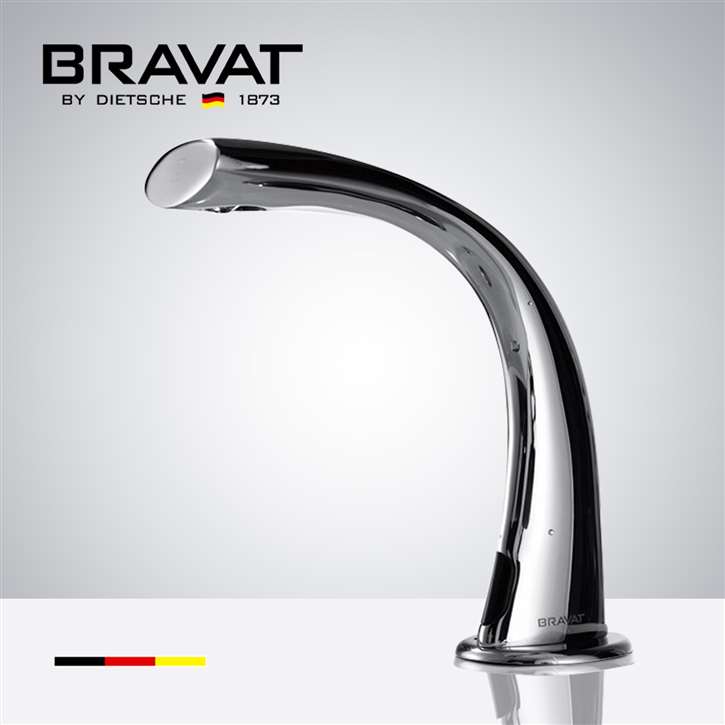
“Operational consistency has remained considerably stronger than previous commercial sensor fixtures maintained in comparable high-use environments.”

Fontana Porto Viro Grey Deck-Mounted Touchless Faucet
Reliable Solenoid Design
“The solenoid valve assembly operates quietly and consistently across extended duty cycles.”

Fontana Varzo Matte White Touchless Bathroom Faucet
Reliable Electronic Valve
“Solenoid performance remained stable with no pressure drop or leakage.”

Fontana Riviera Series Champagne Single Hole Automatic Smart Sensor Faucet
Controlled Water Delivery
“The ceramic cartridge showed no leakage during testing.”

Fontana Chrome Commercial Touchless Faucet
Commercial Water-Control Platform
“It is a single-hole faucet with a vandal-resistant aerator.”
Debris, Filtration & Waterway Protection Matrix
| Condition | Effect on Valve System | Design / Maintenance Response | Commissioning Check |
|---|---|---|---|
| Construction Debris | Can obstruct solenoid seats, strainers, cartridge seals or aerators. | Flush water supplies before final connection and maintain access to strainers, filters and isolation valves. | Confirm stable flow after final system flushing. |
| Hard-Water Scale | May restrict flow paths, affect metering operation or increase valve-closing resistance. | Consider water quality and follow model-specific cleaning or descaling procedures. | Check flow, shutoff response and outlet stream pattern. |
| Pressure Variation | Can affect flow, timing and valve response in pressure-sensitive systems. | Verify the specified operating-pressure range and any required pressure-regulating or flow-control devices. | Confirm stable operation under representative building-demand conditions. |
| Filter / Strainer Restriction | Can reduce flow and may be mistaken for a valve problem. | Keep filters and strainers accessible and include inspection and cleaning in service procedures. | Check supply conditions and outlet flow before replacing valve components. |
Valve Failure Modes & Diagnostic Sequence
| Symptom | First Checks | Valve / Waterway Checks | Next Service Step |
|---|---|---|---|
| No Water | Verify water supply, isolation valve, power or battery condition and sensor activation. | Check the inlet strainer or filter, control connections and solenoid operation. | Test or replace the model-specific valve or control component only after supply and power conditions are confirmed. |
| Water Will Not Stop | Check sensor obstruction, reflective interference and applicable control settings. | Inspect the solenoid seat for debris, sticking or damaged seals. | Isolate the fixture and follow the model-specific service procedure for valve inspection or replacement. |
| Low / Uneven Flow | Verify building water pressure and inspect the outlet or aerator. | Inspect the strainer, filter and internal waterway for restriction before replacing valve components. | Check pressure regulation, mineral scale and cartridge or solenoid restriction. |
| Delayed Shutoff | Check shutoff settings, sensor activation conditions and power stability. | Inspect valve-closing response and check for debris contamination. | For recurring delays, inspect or replace valve and control components according to model-specific service guidance. |
| Drip After Closure | Confirm that the outlet is not draining residual water after normal shutoff. | Inspect ceramic sealing surfaces or the solenoid seat for debris and wear. | Clean, reseat or replace the compatible cartridge or valve assembly according to model-specific service guidance. |
Specifier & Contractor Coordination Matrix
| Project Role | Valve-Technology Decision | Required Documentation | Coordination Priority |
|---|---|---|---|
| Architect / Interior Designer | Confirm faucet family, mounting type and service-access requirements associated with millwork, basin or wall construction. | Product schedule, finish, mounting details, rough-in requirements and maintenance-access provisions. | Maintain required service clearances through final cabinetry, countertop and basin coordination. |
| Plumbing / MEP Engineer | Coordinate valve architecture, operating pressure, target flow, mixing method, filtration, power and shutoff requirements. | Current specification sheet, installation instructions, BIM or submittal data and applicable power or control information. | Confirm that the installed valve and power configuration match the approved project requirements. |
| Plumbing Contractor | Flush supply lines, install strainers or filters correctly, maintain service access and verify valve response and shutoff. | Installation and maintenance documentation plus final sensor or valve settings where adjustable. | Record the exact SKU, valve or control location and applicable field-adjusted settings. |
| Facility Management | Maintain compatible solenoids, cartridges, filters, aerators and power components according to installed SKUs. | Asset records, maintenance history, compatible-parts information and troubleshooting procedures. | Track recurring valve issues and service requirements to support future fixture standardization. |