
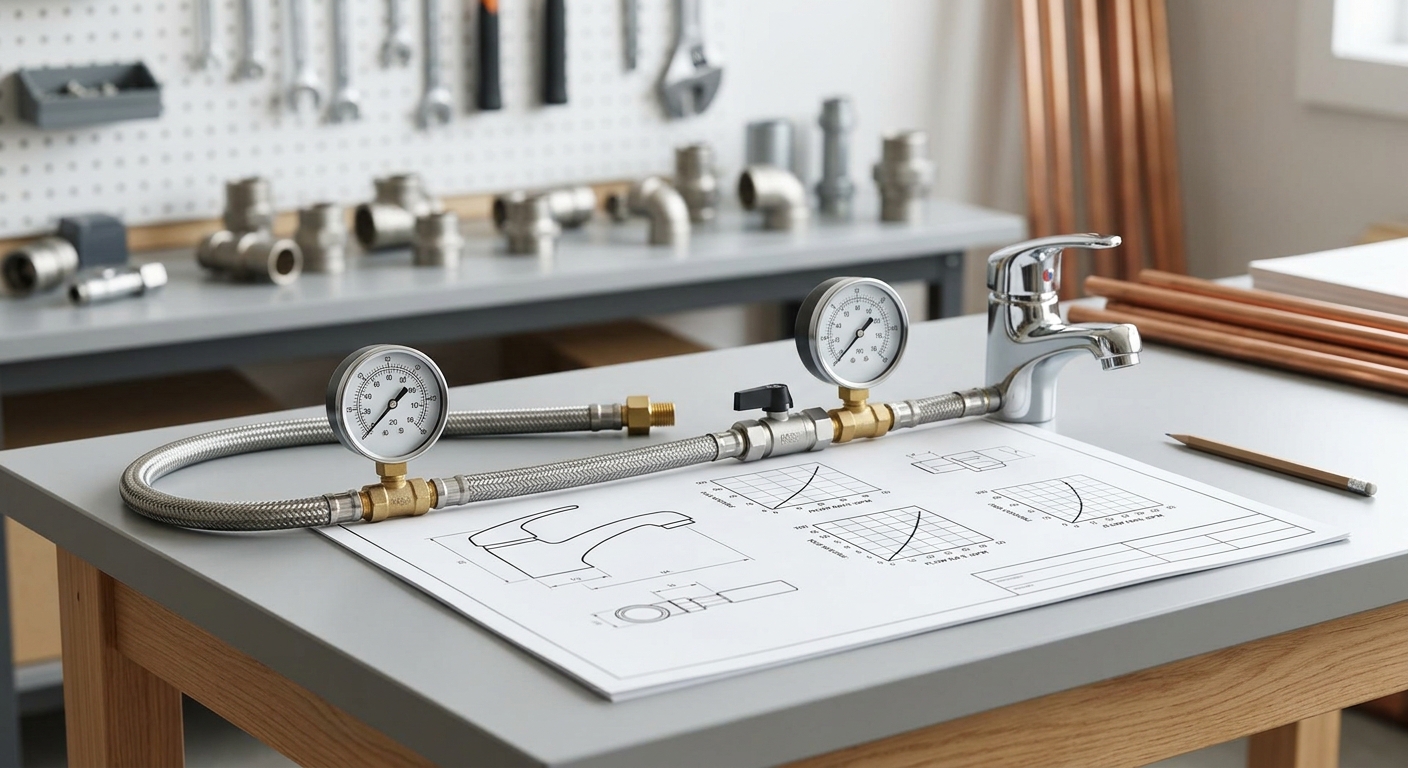
Your faucet fails inspection because the spec sheet’s static pressure rating and its dynamic pressure rating are two different numbers, and inspectors test under flow, not at rest. A cut sheet that says “rated to 100 psi” is describing static pressure, the pressure sitting in the line with no fixture open. The number that determines whether the mixing valve holds its balance and whether the handle meets ADA force limits is the dynamic pressure, measured while water is moving. If your submittal only lists static psi, you’ve documented the wrong condition and given the inspector nothing to check your ASSE 1016 compliance against.
Static vs Dynamic Pressure Defined
Static pressure is what a gauge reads at a closed outlet, with the system pressurized but not flowing. Municipal supply typically delivers 80 to 100 psi static at the meter, sometimes higher in low-elevation zones or buildings fed directly off a street main without a reducing valve. Dynamic pressure is what remains once water is moving through pipe, fittings, and the faucet’s internal cartridge or valve body. Friction loss, fixture demand, and simultaneous draw all pull that number down. For most commercial lavatory faucets, dynamic pressure at the point of use runs 20 to 80 psi, and it’s this range, not the static number, that the fixture’s internal components are actually rated and tested against.
This distinction matters because a faucet body can be pressure-rated for 100 psi static without ever being tested for how its pressure-balancing cartridge performs at 25 psi dynamic under partial simultaneous use, which is the condition most likely to trip an ASSE 1016 failure during commissioning.
Why Spec Sheets List Both Numbers
Manufacturers list static pressure because it’s a manufacturing and shipping spec, it tells you the fixture won’t rupture, blow a seal, or deform under standing line pressure. They list dynamic pressure, when they list it at all, because it’s a performance spec that determines whether the valve does its job while water is running. A sheet that gives you only the static number has told you the faucet survives your building’s pressure. It hasn’t told you whether the faucet performs at the pressure your building actually delivers to that fixture during use, which is always lower and often substantially lower on upper floors or at the end of a long branch line.
When you’re comparing cut sheets across manufacturers, treat any listing that reports a single PSI figure without specifying static or dynamic as incomplete. Ask for the dynamic range, and if the answer is “it meets ASSE 1016,” ask them to show you the test pressure range that certification was run against, because ASSE 1016 test protocols specify a pressure window, not a single value.
ASSE 1016 and Pressure Balance Rules
ASSE 1016 governs individual pressure-balancing and thermostatic mixing valves, and it requires the valve to maintain outlet temperature within a set range when supply pressure fluctuates, including scenarios where one line drops due to simultaneous fixture use elsewhere in the building, like a toilet flushing on the same branch. The standard tests valves across a defined dynamic pressure range, not at a single static figure, specifically because real buildings don’t hold static pressure once multiple fixtures draw at once.
A faucet can carry an ASSE 1016 listing and still fail field verification if the installed dynamic pressure falls outside the range the valve was certified against. This happens most often in two situations: buildings with a pressure-reducing valve set too aggressively, pushing dynamic pressure below 20 psi at distant fixtures, and buildings with no PRV at all, where static pressure near 100 psi doesn’t drop enough under flow to stay inside the tested window. Either way, the fixture install can be entirely correct and still fail if nobody checked the as-built dynamic pressure against the valve’s certified range before signing off on the submittal.
ADA 5 lbf Force at Low Flow
ADA operable-parts requirements cap the force needed to operate a faucet control at 5 pounds of force, regardless of pressure. This is where low dynamic pressure creates a second failure mode that has nothing to do with ASSE 1016. Some faucet mechanisms, particularly single-lever mixing valves and certain metering faucets, require more actuation force to overcome internal spring resistance when line pressure is low, because the cartridge is compensating for reduced flow. A faucet that operates within 5 lbf at 60 psi dynamic can exceed that threshold at 20 psi, especially on units where the pressure-balancing spool adds mechanical resistance proportional to the pressure differential it’s correcting for.
Inspectors testing ADA compliance during final walkthrough use a force gauge at the actual installed condition, not at a lab-rated ideal pressure. If your building’s dynamic pressure runs low at the fixture, that’s the pressure the handle gets tested at, and that’s the number that has to clear 5 lbf.
Documenting Pressure for Inspectors
The paper trail that gets a commercial faucet through inspection without a callback includes more than the fixture cut sheet. Building teams that pass on the first walkthrough typically have the following on hand:
- Static pressure reading at the building main or nearest test port, dated and logged
- Dynamic pressure reading at the specific fixture location, taken under simultaneous-use conditions if the branch serves multiple fixtures
- The faucet manufacturer’s ASSE 1016 certification sheet showing the tested dynamic pressure range
- A note confirming the installed dynamic pressure falls inside that certified range
- ADA force test results at the as-installed condition, not manufacturer’s rated force
- Confirmation of 0.5 gpm flow rate at the lavatory, per current federal fixture requirements for public-use faucets
Without the dynamic pressure reading tied to the specific fixture location, you’re asking the inspector to take the static number on faith and extrapolate compliance, and most won’t.
Common Spec Sheet Misreads
The most frequent error is treating a single PSI figure on a cut sheet as universal, when it’s almost always the static rating used for shipping and pressure-vessel purposes. The second most frequent error is assuming ASSE 1016 certification means the valve works at any pressure in the building, when the certification applies only within the tested dynamic range, commonly 20 to 80 psi but always worth confirming against the specific model’s documentation. The third is reading flow rate and pressure as interchangeable, when 0.5 gpm at the lavatory is a flow restriction independent of the pressure question, and a faucet can meet the flow cap while still failing dynamic pressure or ADA force requirements.
| Spec sheet term | What it tells you | What it doesn’t tell you |
|---|---|---|
| Static pressure rating | Fixture survives standing line pressure | Whether it performs under flow |
| Dynamic pressure range | Conditions the valve was tested and certified under | Your building’s actual pressure at that location |
| ASSE 1016 listing | Valve maintains temperature within its tested range | Compliance outside that range |
| 0.5 gpm flow rate | Flow is code-compliant at the lavatory | Whether ADA force or pressure balance also pass |
Finish selection doesn’t change any of this math, but it’s worth noting when you’re pulling cut sheets for submittal that matte and dark finishes are sold across the same valve platforms as polished ones, so a spec written around black basin faucets should carry identical dynamic pressure and ASSE 1016 documentation as the standard finish version of the same body.
Before you schedule final inspection, pull the dynamic pressure reading at each fixture location, not just at the main, and match it against the ASSE 1016 certified range on the actual model installed. If the building doesn’t have a documented dynamic reading on file, get one before the walkthrough rather than during it. On any project where the PRV setting was adjusted after fixture selection, recheck the low end of the dynamic range against both ASSE 1016 and the 5 lbf ADA threshold, because that’s the adjustment most likely to move a compliant fixture out of range without anyone updating the paperwork.