
Commercial Bathroom Faucet Maintenance Planning: Batteries, Aerators, Strainers, Valves & Spare Parts
A commercial faucet specification is incomplete if it explains how the faucet operates but not how the facility will maintain it. Batteries expire, strainers collect debris, outlets accumulate scale, solenoids and cartridges eventually require service, and poorly planned access can turn a five-minute repair into a restroom shutdown. This guide shows facility managers, architects and MEP engineers how to plan faucet maintenance before procurement.
The Cheapest Faucet to Buy May Not Be the Cheapest Faucet to Own
For a building with 150 lavatory faucets, even a minor recurring service task becomes a facility-wide labor issue. A ten-minute maintenance difference per faucet represents 25 labor hours across that fixture population.
How often will batteries require replacement, and can the facility standardize one battery type?
Can strainers, aerators and flow controls be cleaned without removing the faucet?
Can technicians distinguish sensor, power and valve failures without replacing multiple components?
What Actually Requires Attention?
| Component | Typical Problem | Maintenance Action |
|---|---|---|
| Battery | Low voltage / faucet stops operating | Replace as a scheduled group or when diagnostics indicate. |
| Strainer | Debris restricts flow or valve operation | Isolate supply, remove and clean screen. |
| Aerator / Outlet | Scale, debris, distorted stream | Clean or replace using manufacturer tool. |
| Solenoid | No flow or continuous flow | Diagnose power and filtration before replacement. |
| Cartridge | Leakage or incomplete shutoff | Replace cartridge or valve module. |
| Sensor | False activation / no detection | Clean lens and verify range, power and basin reflection. |
| Supply Hose | Leakage or deterioration | Inspect during scheduled restroom maintenance. |
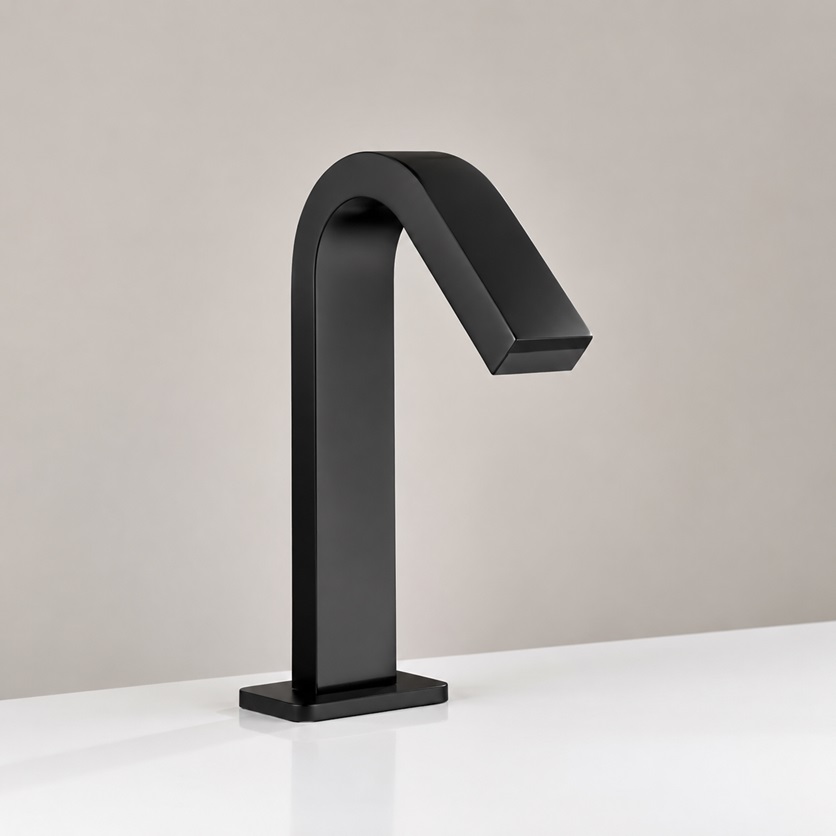
Fontana Commercial Matte Black Touchless Automatic Sensor Hands Free Faucet
The Fontana Commercial Matte Black Touchless Automatic Sensor Faucet represents a conventional commercial electronic architecture where the facility should treat the sensor, power supply, solenoid and hydraulic pathway as separate diagnostic zones.
When a faucet stops operating, replacing the solenoid immediately is poor maintenance practice. Technicians should first confirm supply isolation, power condition, sensor operation and whether debris is restricting the water-control assembly.
Conventional commercial electronic architecture is familiar to service technicians.
Keep compatible valve/power components identified by exact faucet model.
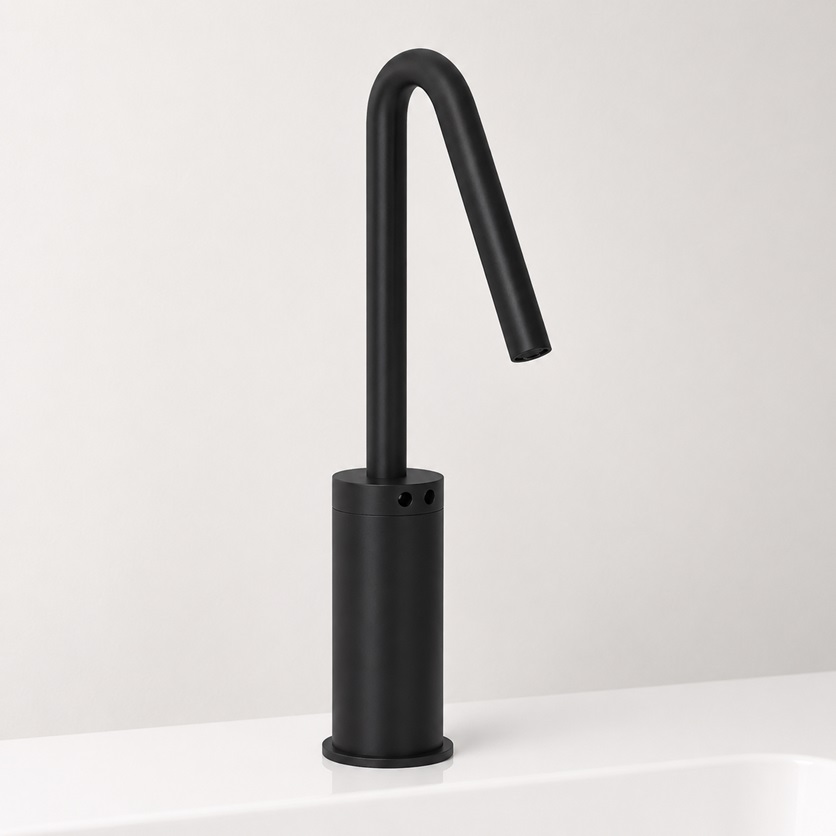
BathSelect Matte Black Hands Free Commercial Sensor Faucet
BathSelect provides unusually useful maintenance information on this commercial platform. The faucet includes diagnostic indication for power-up, low battery and solenoid function, plus a built-in strainer designed to stop debris before it reaches the solenoid.
BathSelect states approximately five years of battery service under its published assumption of 8,000 cycles per month and adequate water pressure. Actual field life will vary with traffic, battery quality and operating conditions.
Diagnostic codes help separate power problems from solenoid faults.
Standardize quality AA alkaline batteries and maintain replacement valve components.

Sloan BASYS® EFX-250 Battery-Powered Commercial Sensor Faucet
Sloan BASYS demonstrates how maintenance can be engineered into the fixture itself. The EFX-250 provides one-tool service, an integral supply shutoff, an above-deck serviceable strainer and individual diagnostic indicators for battery life, solenoid condition and power-up mode.
That architecture reduces one of the most frustrating commercial-restroom maintenance tasks: crawling underneath a crowded lavatory simply to clean a filter.
Above-deck diagnostics, strainer access and integral isolation simplify service.
Four-AA battery standardization makes facility-wide inventory straightforward.
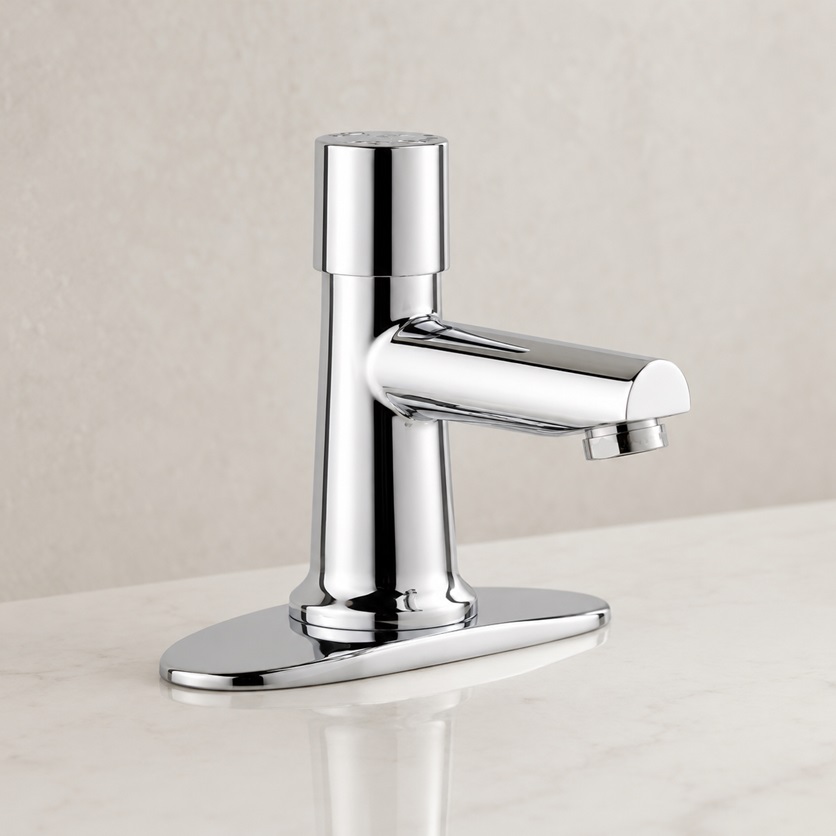
Chicago Faucets E-Tronic® 40 Commercial Touchless Faucet
Chicago Faucets represents the institutional approach to maintenance: specify commercial components with published replacement-part architecture instead of treating the faucet as a disposable assembly.
For large properties, the value of this strategy becomes significant. A technician should be able to identify the failed component, isolate the fixture, replace the required part and return the station to service without replacing the entire faucet.
Institutional product architecture supports component-level service planning.
Keep the exact outlet and electronic valve components associated with installed models.
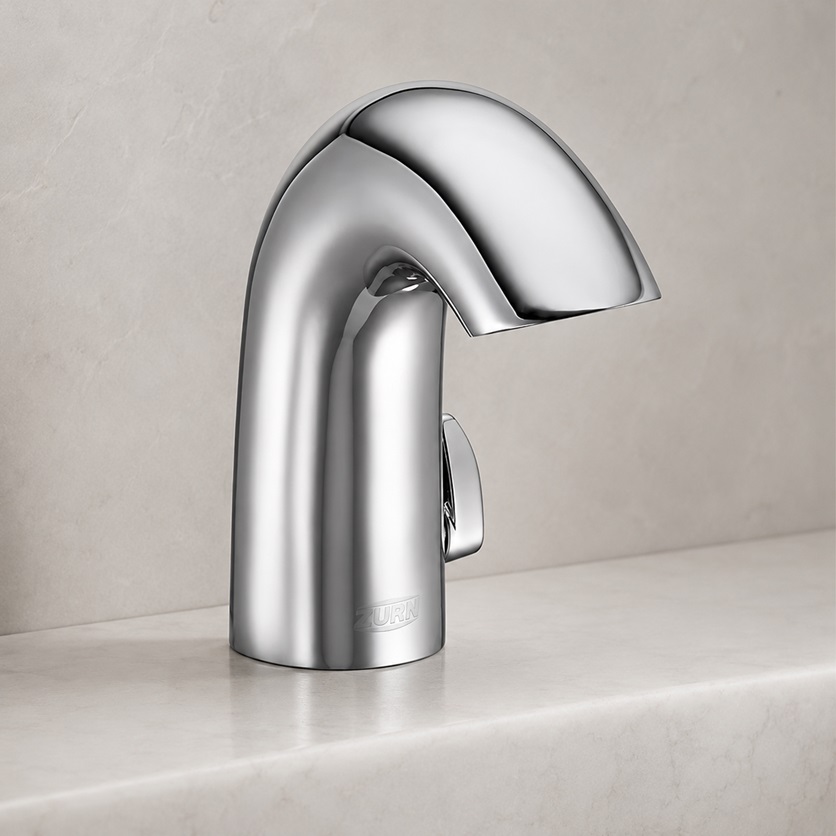
Zurn Aqua-FIT® Serio Series® Commercial Battery Sensor Faucet
Zurn’s Aqua-FIT platform illustrates another lifecycle advantage: a manufacturer-supported repair-parts ecosystem. Zurn publishes replacement components for faucet filtration, electronics and power architecture rather than requiring wholesale fixture replacement for routine failures.
For facilities with dozens or hundreds of identical faucets, this makes model standardization strategically valuable.
Documented replacement-part ecosystem supports component-level repair.
Maintain a small controlled inventory of the highest-failure service parts.
Do Not Replace Batteries One Faucet at a Time Forever
Reactive battery replacement sounds economical because batteries are changed only after depletion. In a large facility, however, repeated individual service calls can cost more in labor than the batteries themselves.
Facilities should evaluate group replacement. If 80 identical faucets were installed at the same time and battery history shows predictable life, changing batteries by restroom, floor or building zone can reduce repeated dispatches.
The Small Filter That Can Shut Down the Faucet
A sensor faucet can have perfect electronics and still produce weak or zero flow when its inlet strainer becomes clogged with construction debris, pipe scale or sediment.
For this reason, accessible filtration deserves explicit attention during specification. Sloan’s BASYS EFX-250, for example, makes its supply strainer serviceable from above deck, while BathSelect specifies a built-in cleanable strainer upstream of the solenoid.
Flow Complaints Often Start at the Outlet
Before replacing an electronic valve because occupants report “low pressure,” inspect the outlet. Mineral scale and debris can distort a laminar or multi-laminar stream and dramatically reduce perceived performance.
| Symptom | Check First |
|---|---|
| Uneven stream | Outlet/aerator contamination |
| Reduced flow | Outlet + inlet strainer |
| No water | Isolation valve + power + strainer + solenoid |
| Water will not stop | Sensor obstruction + valve/solenoid |
| Intermittent activation | Battery condition + sensor lens + sensing range |
What Should a Large Facility Keep on the Shelf?
High Priority
✓ Batteries
✓ Aerators / flow controls
✓ Strainers
✓ Solenoid or valve modules
✓ Cartridge assemblies
Useful Spares
✓ Supply hoses
✓ Sensor/electronic modules
✓ Power adapters
✓ O-rings and seals
✓ Manufacturer service keys
Documentation
✓ Exact model number
✓ Installation manual
✓ Wiring diagram
✓ Parts diagram
✓ Warranty information
One Faucet Family Can Be Easier to Maintain Than Ten
A property with ten different faucet platforms may need ten aerators, several battery types, multiple solenoids and different service tools.
Standardizing a proven faucet family across multiple restroom types can reduce spare-parts inventory, technician training and diagnostic time.
Example Preventive Maintenance Framework
| Interval | Recommended Review |
|---|---|
| Routine cleaning | Inspect sensor lens, stream quality, leaks and physical damage. |
| Quarterly | Review abnormal activation, flow reduction and high-use fixtures. |
| Semiannual | Inspect strainers in facilities with sediment or water-quality concerns. |
| Annual | Audit battery age, outlet condition, hoses and service-part inventory. |
| Manufacturer interval | Follow model-specific battery, cartridge and preventive-maintenance instructions. |
Intervals above are planning examples, not manufacturer-prescribed requirements. Actual frequency should reflect traffic, water quality and manufacturer documentation.
Five Checks Before Replacing the Faucet
| 1. Water | Is the fixture isolation valve open and is supply pressure available? |
| 2. Outlet | Is the aerator or laminar outlet blocked? |
| 3. Strainer | Is debris restricting flow upstream of the valve? |
| 4. Power & Sensor | Are batteries/power supply and sensor operation normal? |
| 5. Valve | Only after upstream checks should the solenoid/cartridge become the primary suspect. |
Commercial Faucet Brands Related to Lifecycle Maintenance
Commercial Faucet Maintenance FAQ
How long should sensor-faucet batteries last?
There is no universal number. Battery life depends on faucet electronics, battery chemistry, activation frequency and operating conditions. Use the exact manufacturer’s published estimate for lifecycle budgeting.
Should facilities replace all faucet batteries together?
For large standardized installations, zone-based preventive replacement can reduce repeated labor compared with purely reactive individual replacement.
Why does a sensor faucet suddenly have low flow?
Check the outlet and inlet strainer before assuming an electronic failure. Scale and supply debris are common hydraulic causes.
Should we stock complete replacement faucets?
Keeping a few complete fixtures can be useful, but high-volume facilities should also stock common component-level service parts.
Is above-deck servicing important?
Yes. It can materially reduce technician time where access below the sink is obstructed by traps, cabinetry or accessibility panels.
Should every faucet have an isolation valve?
Serviceable isolation allows one fixture to be repaired without unnecessarily interrupting other restroom fixtures.
What information should be recorded at handover?
Model, finish, flow rate, power type, battery type, valve/solenoid, outlet, strainer, replacement-part numbers, warranty and maintenance documentation.
Professional Sources
American Society of Plumbing Engineers
Professional plumbing engineering and commercial fixture resources.
International Facility Management Association
Facility-management resources relevant to preventive maintenance and lifecycle planning.
U.S. EPA — Bathroom Faucet Efficiency
Current water-efficiency guidance for bathroom and public-lavatory faucets.
NSF/ANSI/CAN 61
Health-effects requirements for components and materials contacting drinking water.
International Code Council
Model building and plumbing-code resources for commercial installations.
Design the Maintenance Program Before Buying the Faucet
The best commercial faucet is not simply the fixture with the longest feature list. It is the faucet a facility can diagnose quickly, isolate safely, clean easily and repair with readily available components. Accessible strainers, standardized batteries, diagnostic indicators, replaceable valves and documented spare parts can produce more lifecycle value than a lower initial purchase price.
Review Fontana Commercial Touchless Faucet →Commercial Bathroom Faucet Maintenance Planning — Review Evidence for Batteries, Filters, Solenoids, Service Access & Long-Term Operations
Commercial faucet maintenance planning begins before installation. Facility teams should understand how each faucet is powered, where control and valve components are located, whether filters and aerators are accessible, how low-power conditions are identified, what troubleshooting procedures apply to low flow or intermittent activation, and which spare parts should be standardized across the facility. The selected reviews highlight maintenance reduction, service access, custodial workload, long-term high-traffic operation and recurring facility-service requirements.
Prevent Failures
Track battery condition, sensor cleanliness, aerator/strainer condition, mounting stability and unusual shutoff or flow behavior before a fixture fails in service.
Shorten Service Time
Preserve access to batteries, transformers, filters, strainers, solenoids, control modules and isolation points so technicians can diagnose one station without disrupting an entire restroom bank.
Standardize Operations
Record exact SKUs, power types and compatible replacement parts. Standardized fixture families can simplify stocking, training, troubleshooting and preventive service across large facilities.
Selected Commercial Faucet Maintenance Review Evidence

Fontana Commercial Touchless Sensor Faucet For Restroom
Beautiful design and finish
We used these faucets in a large corporate campus renovation. The no-contact operation improved restroom hygiene and reduced maintenance calls by over 40%. It’s an excellent value addition to any modern facility upgrade.
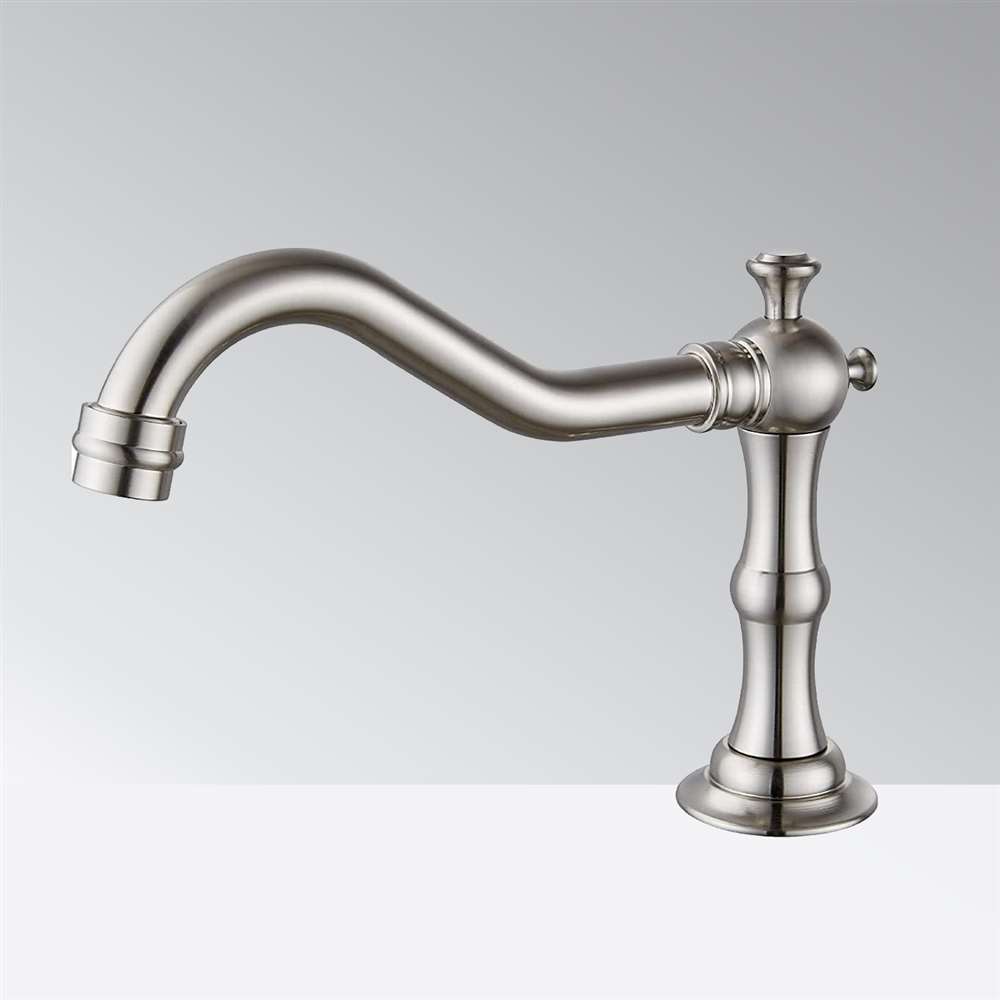
Fontana Brushed Nickel Commercial Bathroom Touchless Faucet
Commercial Grade Reliability
This faucet was selected for a healthcare outpatient facility where reliability and hygiene were essential. The calibrated sensor range helps prevent false activations while supporting accessible use. Brass construction, efficient flow control and straightforward component access support durability, water conservation and long-term maintenance.

FontanaFluidis Champagne Automatic Touch Free Bathroom Faucet
Durable Commercial Fixture
The Fluidis Champagne Touchless Faucet has performed well across multiple high-traffic restroom installations. The brass body and internal components show excellent resistance to wear, and the sensor module continues to function without drift over time. Maintenance teams reported easy access to service components, reducing downtime. This faucet meets long-term performance expectations for commercial and institutional environments.

Fontana Chatue Commercial Automatic Touchless Sensor Faucet
Reduced Maintenance Issues
Maintenance requests related to faucet leaks and manual handle wear dropped significantly after this sensor faucet was added during a tenant improvement project. Sensor timing feels well calibrated, especially during busy morning traffic when restrooms receive constant use. The chrome surface has remained easy to wipe down, and there has been very little buildup around the base compared to older fixtures. Around 8 months later, everything still feels secure and operating normally.

Solo Commercial Automatic Touchless Sensor Faucet
Easier Facility Upkeep
Maintenance staff noticed a difference almost immediately after these automatic faucets were added throughout a multi-floor office renovation. Daily cleaning became quicker because the sink counters stayed drier and required less attention during heavy traffic periods. The faucet itself feels solid without becoming bulky, and the chrome finish continues to clean up well during routine maintenance. Tenant response has also been favorable regarding the convenience of the touchless operation.

Fontana Matte Black Automatic Touchless Sensor Faucet
Expensive but its worth it!
Given heavy usage, typically expected in airpot restrooms, durability will was a factor. I am extremely happy with the construction of these faucets. They have stood up to peak times, and so far, maintenance has been very minimal. Just the auto shut-off alone seems to reduce a lot of water waste and significantly brings down the operational cost..
Commercial Faucet Preventive-Maintenance Matrix
| Maintenance Area | What to Inspect / Service | Common Symptom | Facility Planning Action |
|---|---|---|---|
| Battery / Power | Battery type and count, low-battery indicator, contacts, AC transformer, dual-power fallback and accessible power compartment. | Intermittent sensing, slow valve response or no activation. | Record the exact battery specification by SKU, stock approved replacements and follow model-specific replacement guidance. |
| Aerator / Outlet | Mineral scale, debris, stream pattern and outlet condition. | Low flow, irregular stream or increased splash. | Clean or replace the approved aerator based on water quality and observed condition rather than a universal service interval. |
| Strainer / In-Line Filter | Debris accumulation upstream of the valve or outlet. | Low or uneven flow despite adequate building pressure. | Isolate the water supply before service. Document models with built-in or in-line filtration and stock compatible screens or filters where required. |
| Solenoid / Motor Valve | Opening and closing response, leakage, abnormal noise, debris exposure and electrical connections. | Water does not start, does not stop or shuts off inconsistently. | Keep the valve and control components accessible and record compatible replacement assemblies by model. |
| Sensor Window | Residue, scratches, obstruction, reflectivity and alignment. | False triggering, missed activation or repeated recalibration. | Clean using approved methods, then verify detection under actual lighting and basin conditions. |
| Mounting / Connections | Faucet mounting, hoses, fittings, isolation valves and control-box mounting. | Movement, leaks, vibration or difficult service access. | Include mounting and accessible connections in routine restroom inspections. |
| Finish / Cleaning | Approved cleaning products, residue around the faucet base and water spotting. | Finish deterioration or increased custodial workload. | Follow finish-specific care instructions and train cleaning teams on compatible cleaning products. |
| Spare Parts | Batteries, aerators, strainers, sensor/control modules, solenoid/valve assemblies and model-specific service components. | Extended downtime while waiting for replacement parts. | Maintain a critical-spares list by installed SKU and update it whenever the facility fixture standard changes. |
Facility Maintenance Planning Cadence
The intervals below are general maintenance planning categories. Actual service frequency should follow the selected model documentation, water quality, facility traffic, cleaning conditions and observed maintenance history.
| Planning Interval | Facility Check | Operational Goal |
|---|---|---|
| Routine Rounds | Confirm normal activation and shutoff, check for visible leaks, unusual runtime and obvious outlet or sensor contamination. | Identify service issues before they result in user complaints or fixture downtime. |
| Weekly / As Needed | Clean sensor windows and accessible outlets using approved methods, and confirm stable flow and automatic shutoff. | Prevent residue and buildup from affecting sensing or water delivery. |
| Monthly / As Needed | Review battery or power status, mounting stability, aerator condition, recurring faults and critical spare-parts availability. | Support preventive maintenance and reduce unexpected service interruptions. |
| Quarterly Review | Review recurring failures, downtime, repair time, sensor or valve issues and replacement-parts usage by restroom or SKU. | Identify recurring fixture problems, site conditions and maintenance requirements. |
| Annual Lifecycle Review | Review fixture inventory, maintenance labor, replacement parts, power issues, cleaning exposure, documentation and standardization opportunities. | Use facility maintenance history to support future replacement, procurement and specification decisions. |
Commercial Faucet Troubleshooting Sequence
| Symptom | First Checks | Next Service Checks |
|---|---|---|
| No Water | Check power or battery condition, isolation valve, sensor obstruction and water supply. | Check the strainer or filter, control connections and solenoid or valve operation. |
| Low / Irregular Flow | Check the aerator or outlet for buildup, verify supply pressure and inspect for visible debris. | Inspect the in-line filter or strainer, valve restriction, mineral scale and supply conditions. |
| Water Will Not Stop | Check sensor-window cleanliness, reflective interference and possible obstruction. | Inspect the solenoid or valve for debris, verify electrical connections and follow the model-specific reset procedure. |
| Intermittent Activation | Check battery or power stability, sensor cleanliness and changes in lighting or reflective conditions. | Verify sensor settings, wiring and connectors, and inspect for recurring component issues. |
| Recurring Failure | Review service history by SKU, location and restroom conditions. | Identify the recurring cause and evaluate replacement parts, service requirements or fixture standardization. |