
Commercial Restroom Uptime & Redundancy Calculator: How Many Backup Faucets, Soap Dispensers, Pumps & MultiFeed Zones Are Needed?
A high-traffic restroom should not stop functioning because one faucet, automatic soap dispenser, pump or central supply component requires service. Airports, stadiums, hospitals, universities, convention centers, corporate buildings and other major facilities can improve restroom resilience by designing spare fixture capacity, maintainable touchless equipment, service zones and appropriate redundancy into the project from the beginning. This guide explains operational availability, N+1 planning, spare wash positions, central soap failure domains, MultiFeed zoning and the effect of equipment outages on peak restroom throughput.

Availability and Redundancy Are Different
Operating Time ÷ Total Scheduled Time × 100
What Does N+1 Mean?
In redundancy planning, N represents the minimum capacity required to perform the intended function.
Interactive Restroom Uptime & Redundancy Calculator
Use this as a preliminary capacity-planning tool. It does not establish code fixture counts or manufacturer system limits.
How Many Spare Wash Positions Should a Project Consider?
| Required Operational Positions | N | N+1 | N+2 | Approx. Reserve at N+2 |
|---|---|---|---|---|
| 6 | 6 | 7 | 8 | 33% |
| 12 | 12 | 13 | 14 | 17% |
| 24 | 24 | 25 | 26 | 8.3% |
| 48 | 48 | 49 | 50 | 4.2% |
As fixture banks become larger, one or two extra positions represent a smaller percentage of the total project.
What Happens When Faucets Go Offline?
Assume 30 seconds of average occupancy per wash position.
| Installed Positions | Offline | Operational | Theoretical Throughput | Loss vs Full Operation |
|---|---|---|---|---|
| 24 | 0 | 24 | 48/min | — |
| 24 | 1 | 23 | 46/min | -2/min |
| 24 | 2 | 22 | 44/min | -4/min |
| 24 | 4 | 20 | 40/min | -8/min |
| 24 | 6 | 18 | 36/min | -12/min |
If peak arrivals are 45 users per minute, the 24-position bank can theoretically stay ahead of demand while all fixtures operate.
With two positions offline, capacity falls to approximately 44 users per minute and a queue can begin growing.

N+2 Example: Why Two Additional Positions Can Matter
Assume the project requires 24 operational wash positions during the design peak.
Soap Dispenser Failure Is Also a Capacity Failure
A sink with water but no conveniently available soap is not providing the intended complete handwashing service.
Current Fontana automatic-soap troubleshooting guidance specifically calls for checking power, sensor condition, soap buildup, pump priming, reservoir, pickup tube and nozzle during diagnosis.
Automatic Soap Dispenser Reset & Service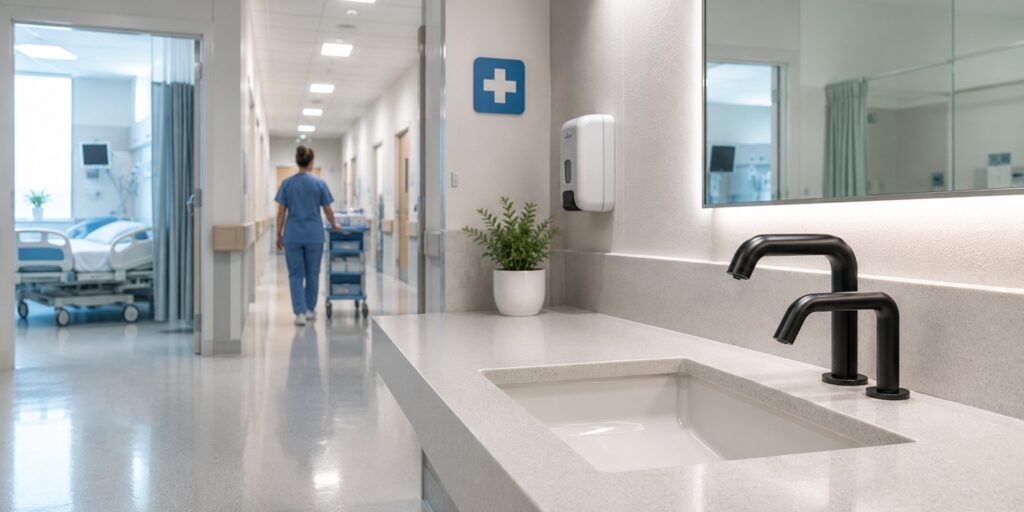
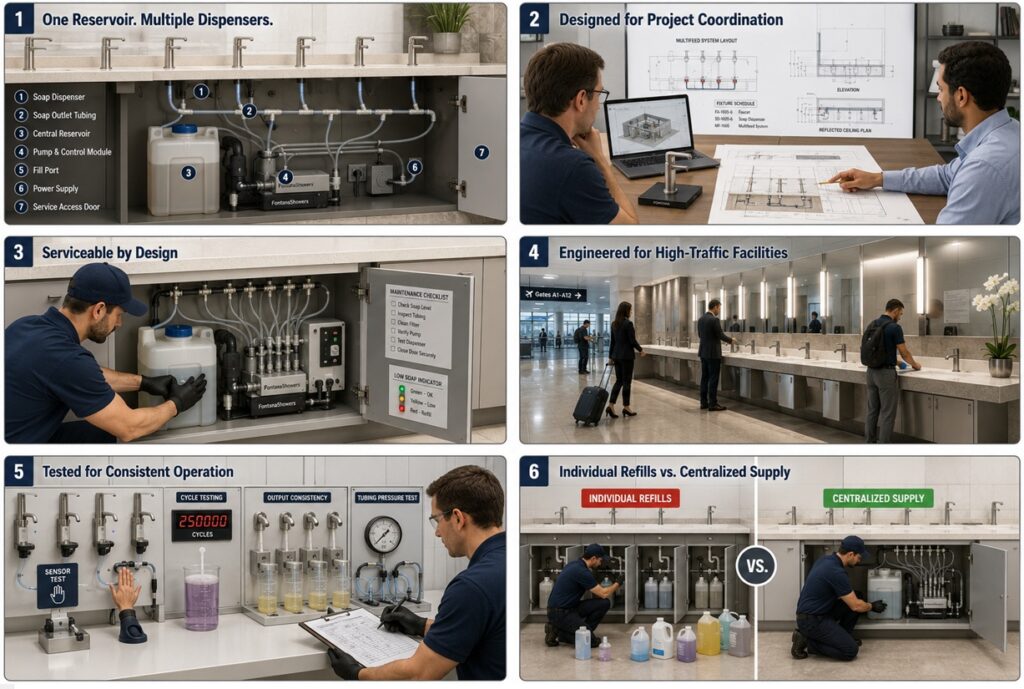
Serviceability Is Part of Uptime
Two dispensers can have the same failure frequency but very different operational availability if one can be restored in ten minutes while the other requires a lengthy service visit.
MTBF ÷ (MTBF + MTTR)
Where:
The formula is a standard reliability concept used here as a facility-planning framework. Actual product MTBF and MTTR values should come from manufacturer data or the facility’s own operating records.
Current Fontana Serviceability Examples
Fontana currently provides BIM files, specification sheets, installation instructions and dedicated repair/maintenance resources on many commercial touchless products.
The current Fontana Milan commercial dispenser goes further and describes:
Central Soap Systems Change the Failure Domain
Individual soap reservoirs isolate many faults locally.
Centralized soap distribution can substantially reduce refill activity, but shared pumps, reservoirs, manifolds and distribution lines mean system-level components can influence several dispensing positions.
Why MultiFeed Zoning Matters
Consider a facility with 24 automatic soap dispensing positions.
| Architecture Concept | Zones | Dispensers / Zone | Potential Positions Within One Zone |
|---|---|---|---|
| One Large Shared Zone | 1 | 24 | 24 |
| Two Zones | 2 | 12 | 12 |
| Four Zones | 4 | 6 | 6 |
| Six Zones | 6 | 4 | 4 |
Actual reservoir capacity, pump configuration, manifold capacity, tubing distance and maximum connected outlet quantity must follow the exact manufacturer-approved MultiFeed configuration.
Fontana MultiFeed™ Engineering12 vs 24 vs 48 Wash Positions: Redundancy Strategy
| Project Scale | Local Fixture Redundancy | Central Soap Strategy | Operational Priority |
|---|---|---|---|
| 12 Positions | Evaluate 1–2 reserve positions where peak demand justifies them. | Individual or central feed can both be viable. | Balance simplicity and service labor. |
| 24 Positions | N+1 or N+2 capacity deserves evaluation. | Multiple service zones can reduce failure domains. | Preserve peak throughput during service. |
| 48 Positions | Plan reserve capacity across multiple restroom banks. | Zoned central systems become increasingly relevant. | Prevent one maintenance event affecting a major portion of the facility. |
Power Architecture Is Another Reliability Layer
Current Fontana touchless faucet-and-soap systems include commercial products documenting AC/DC, hardwired or four-AA battery configurations.
Installed Redundancy vs Spare-Parts Redundancy
There are two different ways to prepare for a failure.
A strong facility strategy may use both.
100-Fixture Portfolio: Spare Inventory Becomes Strategic
For one restroom, a complete spare-parts inventory may be unnecessary. For 100 or 500 standardized touchless fixtures, it can materially change restoration time.
Number of Components Replaced ÷ Installed Components × 100
Facilities can use actual operating history to determine whether stocking one, two or several replacement components is economically justified.
Downtime Cost Is More Than the Repair Invoice
What Does 99% Availability Mean?
Availability percentages sound impressive until converted to annual downtime.
| Availability | Approx. Downtime / Year* |
|---|---|
| 95% | ≈438 hours |
| 98% | ≈175 hours |
| 99% | ≈87.6 hours |
| 99.5% | ≈43.8 hours |
| 99.9% | ≈8.8 hours |
| 99.99% | ≈52.6 minutes |
*Mathematical annualization assuming 8,760 scheduled hours per year.
Measure Reliability Instead of Assuming It
EPA WaterSense recommends that commercial facility owners use planning, metering, leak detection and maintenance practices to control water, energy and operating costs.
A similar asset-management approach can be applied to touchless restroom equipment.
What Architects & MEP Engineers Should Specify
Build Maintainability Into the Bid Documents
Fontana’s current specification guidance emphasizes coordinated architectural, MEP and construction documents for commercial touchless faucet and soap systems.
| Document | Reliability Information to Include |
|---|---|
| Architectural Plan | Fixture count, accessible stations, reserve positions and service clearances. |
| Plumbing Plan | Valves, piping, central soap reservoir and distribution routing. |
| Electrical Plan | Power supplies, transformers, AC/DC or battery architecture. |
| Equipment Schedule | Exact model, serviceable components and manufacturer documentation. |
| Commissioning Plan | Operational test of every faucet, dispenser and central-feed branch. |
| O&M Manual | Repair guides, replacement parts, soap compatibility and zone mapping. |
Redundancy Priority by Facility Type
| Facility | Why Redundancy Matters | Planning Priority |
|---|---|---|
| Airport | Long operating hours and irregular passenger surges. | High uptime + zoned maintenance |
| Stadium / Arena | Extreme short-duration peak demand. | Spare fixture throughput + rapid recovery |
| Hospital Public Areas | Reliable handwashing availability and continuous operations. | Serviceable equipment + rapid replacement |
| University | Large distributed fixture fleets. | Standardization + spare parts |
| Convention Center | Event peaks and major restroom banks. | Zoned systems + capacity reserve |
| Office Tower | Multiple distributed floor restrooms. | Standardized components + efficient service |
| Luxury Hotel / Resort | Visible fixture failures affect premium guest experience. | Rapid restoration + discreet maintenance |
Commercial Restroom Uptime Worksheet
| Reliability Input | Project Value |
|---|---|
| Total installed wash positions | ________________ |
| Required active positions during design peak | ________________ |
| Fixture reserve | ________________ |
| Selected redundancy | N / N+1 / N+2 / Other |
| Automatic soap outlets | ________________ |
| Central soap zones | ________________ |
| Maximum outlets per approved zone | ________________ |
| Spare pump modules on site | ________________ |
| Spare sensors on site | ________________ |
| Spare power supplies | ________________ |
| Average repair time | ________ hours |
| Annual fixture downtime | ________ hours |
| Observed annual availability | ________ % |
| Commissioning completed | YES / NO |
| O&M / zone map delivered | YES / NO |
Verified Fontana Reliability & Commercial Project Resources
Current Fontana touchless-faucet families for airports, healthcare, hospitality, offices and public buildings.
Commercial Touchless FaucetsCentral reservoir, pump, manifold and distribution architecture for multi-dispenser commercial restroom projects.
MultiFeed EngineeringCurrent commercial platform documenting replaceable pump modules and accessible tubing.
Serviceable Pump SystemCurrent product page providing BIM, specifications, installation instructions, repair/maintenance documents and warranty resources.
Commercial SystemCurrent maintenance guidance covering power, sensors, pump priming, nozzle buildup and soap-path inspection.
Reset & MaintenanceFontana guidance for coordinating touchless faucets and soap dispensers in architectural, plumbing and MEP documents.
Specification GuideCommercial Automatic Soap Dispenser Research Series
Browse current Fontana automatic commercial soap-dispenser models and technical documentation.
Automatic Soap SystemsCurrent Fontana guidance focused on coordinated touchless systems, maintenance and high-traffic restroom operation.
Facility ManagementCurrent spec-focused Fontana faucet families for architecture, commercial duty, sustainability and smart-building applications.
Product FamiliesCommercial countertop and deck-mounted automatic dispenser category for coordinated lavatory layouts.
Deck-Mount SystemsIndependent Facility Operations References
Facility-management guidance covering planning, metering, maintenance, operating costs and commercial water performance.
Commercial BuildingsEPA guidance notes that equipment malfunctions and incorrect fixture installation can produce leaks and that monitoring can help identify abnormal operation.
Leak & Flow MonitoringCommercial Restroom Uptime & Redundancy FAQ
What does N+1 mean in a commercial restroom?
As a reliability-planning concept, N+1 means providing one additional unit of capacity beyond the minimum required operating capacity. It is not presented here as a universal plumbing-code requirement.
How many backup faucets should a commercial restroom have?
There is no universal number. Projects with severe peak traffic may evaluate one or more additional usable wash positions so localized fixture outages do not immediately reduce the planned peak capacity.
Should a 24-sink restroom install 26 positions?
If the design requires 24 operating stations during peak conditions, 26 installed positions would mathematically provide N+2 capacity against two local position outages. Whether that is warranted depends on project cost, space, code, traffic and operational requirements.
What is fixture availability?
Availability measures the percentage of scheduled time a fixture or system is capable of performing its intended function.
Does 99% availability mean very little downtime?
Ninety-nine percent availability mathematically corresponds to approximately 87.6 hours of downtime over 8,760 annual scheduled hours. The figure is a mathematical illustration and not a Fontana product guarantee.
Why does repair time matter?
Faster restoration reduces the duration that restroom capacity remains unavailable. Field-serviceable components and accessible equipment can therefore improve operational availability.
Should MultiFeed be divided into zones?
Larger centralized projects should evaluate manufacturer-approved service zones so that maintenance or failure of one shared component does not necessarily create an excessive failure domain.
Can one central soap pump serve 24 or 48 dispensers?
No assumption should be made from the fixture count alone. Maximum outlets, pump capacity, reservoir size, tubing length, manifold architecture and soap compatibility must be verified for the exact approved system.
Should facilities keep spare automatic soap dispenser pumps?
Large standardized fleets may benefit from stocking manufacturer-supported replacement pump modules when actual failure history, part lead time and downtime risk justify the inventory.
How should architects improve restroom uptime?
Coordinate reserve wash capacity, maintainable fixtures, accessible service locations, power architecture, central-soap zoning, commissioning and owner spare-parts information during design rather than leaving all reliability decisions to maintenance staff after construction.
Final Recommendation: Design for Failure Without Designing for Failure Everywhere
High-performance commercial restrooms should assume that individual components will eventually require service.
The goal is not to eliminate every possible failure. The goal is to prevent one ordinary failure from causing a disproportionate loss of restroom capacity.
That means keeping localized fixture failures local, keeping central soap systems serviceable and appropriately zoned, maintaining spare capacity during peak traffic and giving facility teams the documentation and components needed to restore failed equipment quickly.