
0.35 vs. 0.5 vs. 1.0 GPM Commercial Bathroom Faucets: Water Savings, Performance & User Experience
Lower flow does not automatically mean better commercial faucet performance. A successful specification balances water consumption with stream coverage, pressure compensation, splash control, basin geometry and the time users actually keep the faucet running. This engineering guide compares 0.35, 0.5 and 1.0 GPM commercial faucet strategies.
What Changes When GPM Changes?
Ultra-Low Flow
Maximum conservation for public handwashing applications. Best results depend heavily on multi-laminar or pressure-compensating outlet design.
Commercial Baseline
A balanced public-lavatory flow rate providing greater stream volume while remaining within EPA’s current efficiency recommendation.
Higher-Volume Stream
Provides stronger perceived water volume but uses twice the water of 0.5 GPM during equal runtime.
0.35 vs. 0.5 vs. 1.0 GPM
| Factor | 0.35 GPM | 0.5 GPM | 1.0 GPM |
|---|---|---|---|
| Water use | Lowest | 43% more than 0.35 | 2× 0.5 GPM |
| Perceived stream | Depends strongly on spray design | Balanced | Fuller |
| Splash risk | Usually lower velocity | Moderate | Greater basin coordination needed |
| High fixture counts | Maximum savings potential | Strong efficiency | Higher water demand |
| Public lavatory efficiency | Strong | Strong | Generally above EPA recommendation |
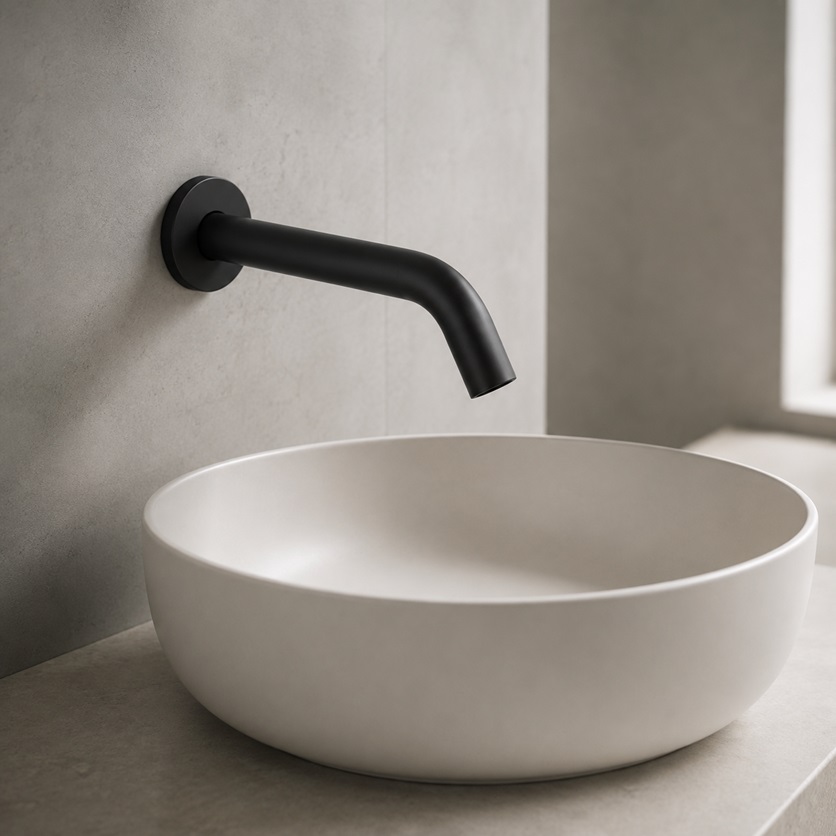
Fontana Brio Matte Black Wall-Mount Commercial Sensor Faucet
The Fontana Brio Wall-Mount Commercial Sensor Faucet is a strong example of designing the fixture around low-flow public-restroom performance. Fontana currently positions the platform with a regulated laminar stream in the 0.35–0.5 GPM range, intended to control splash while maintaining usable handwashing coverage.
The current specification sheet identifies a 0.5 GPM configuration, while the broader Brio commercial platform supports lower-flow project strategies.
Low-flow laminar delivery combined with architectural wall-mounted design.
State the required outlet flow explicitly in the project schedule.
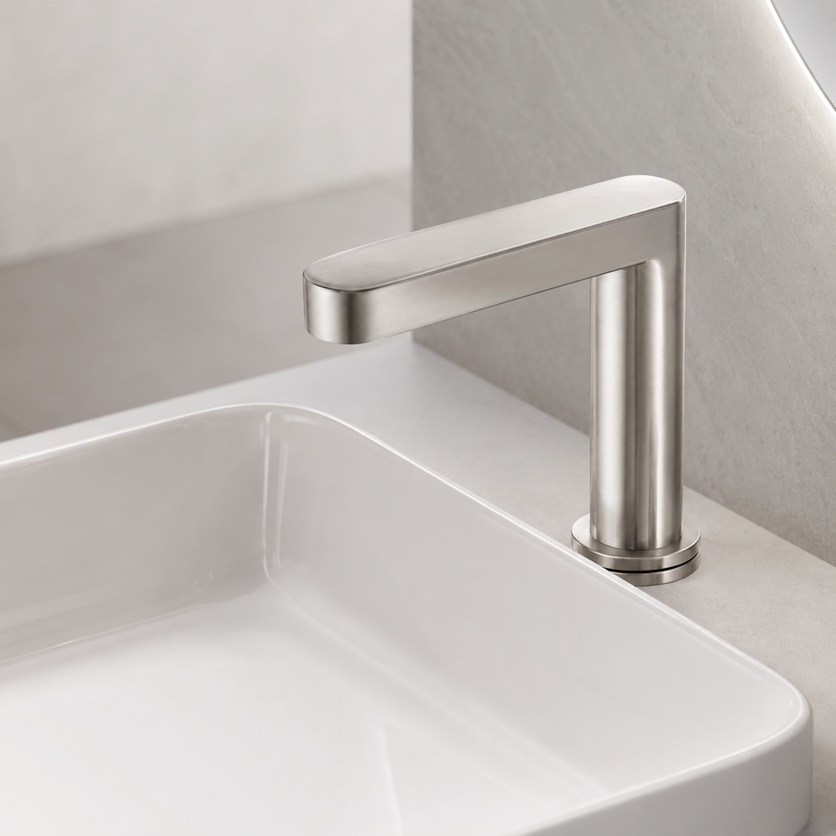
BathSelect Touchless Commercial Brushed Nickel Motion Sensor Faucet
BathSelect provides an especially useful flow-comparison platform because the same commercial faucet is offered with optional 0.5 and 1.0 GPM outlets.
That allows an owner to retain the same sensing, finish and maintenance architecture while changing the flow strategy according to application requirements.
Multiple outlet options permit project-specific water-performance selection.
Do not leave the aerator selection undefined on the purchase order.
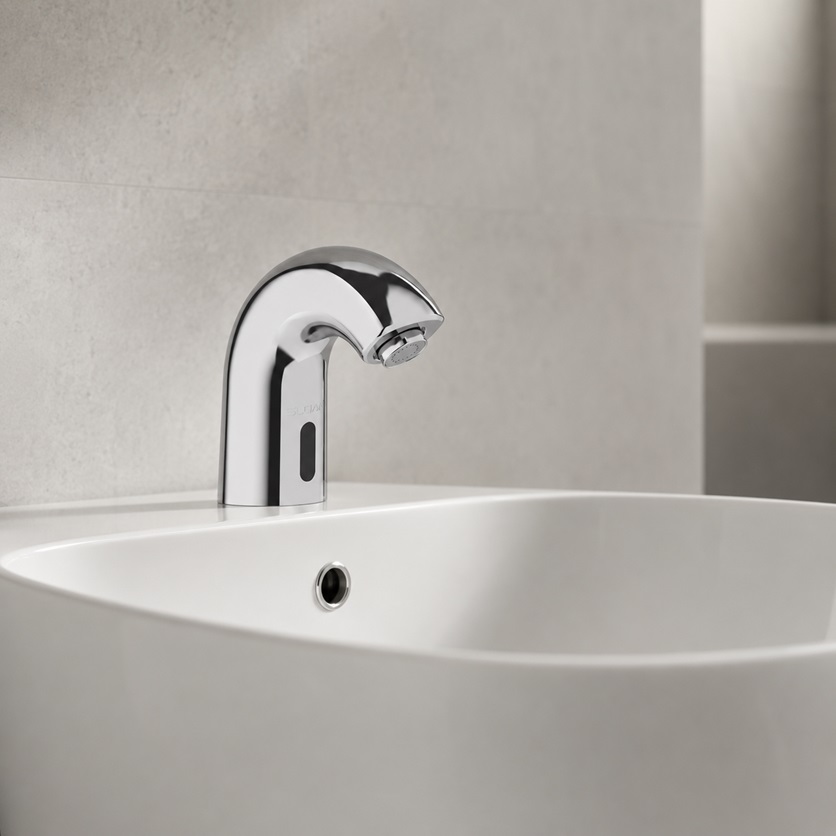
Sloan SF-2150 Commercial Sensor Faucet
Sloan’s SF-2150 makes the 0.35-vs-0.5 comparison particularly clear because both flow configurations are available within the same commercial platform.
Its 0.35 GPM option uses a multi-laminar spray specifically intended to distribute limited water more effectively across the user’s hands.
One faucet platform supports both ultra-low and standard commercial efficiency.
Mock up the 0.35 GPM spray when occupant perception is a major concern.
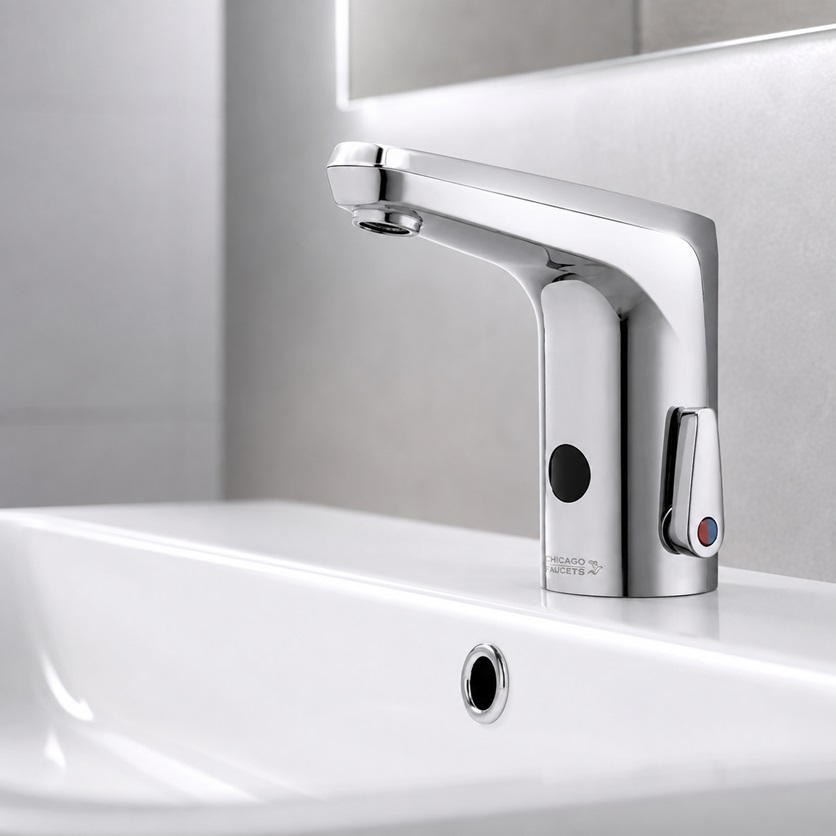
Chicago Faucets E-Tronic® 40 Commercial Touchless Faucet
Chicago Faucets provides a useful higher-flow comparison. This current E-Tronic 40 configuration uses a 1.0 GPM pressure-compensating non-aerating laminar outlet.
It illustrates why 1.0 GPM should be treated as an application-specific choice rather than the default for public commercial lavatories. The higher flow provides a fuller stream, but consumes twice the water of a 0.5 GPM faucet during equal runtime.
Fuller pressure-compensated laminar stream.
Confirm that 1.0 GPM complies with the intended facility and local requirements.
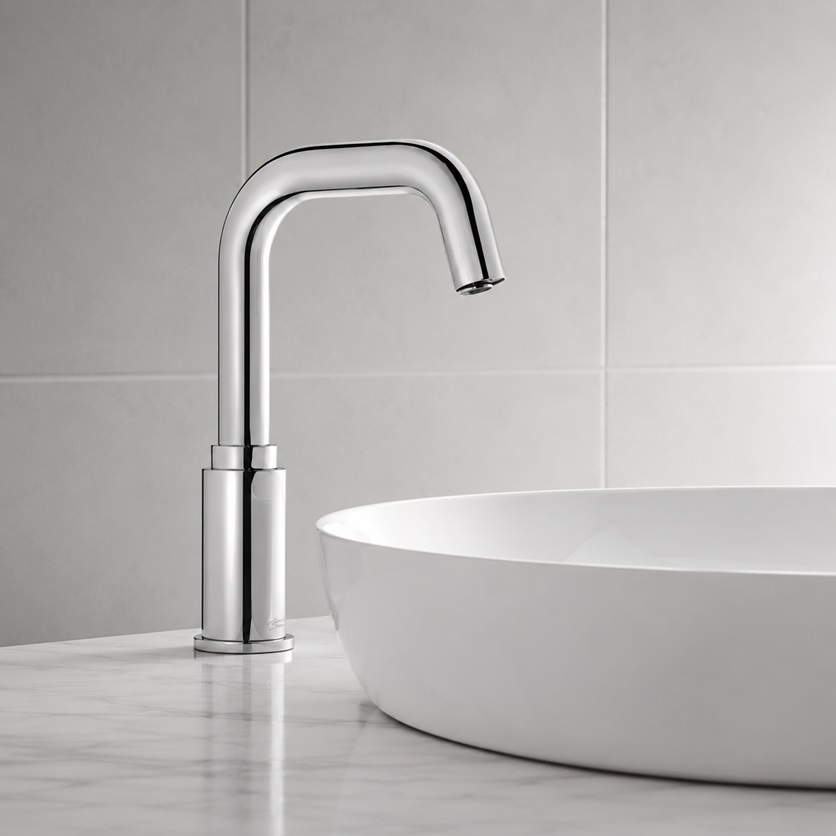
American Standard Serin® 0.35 GPM Commercial Touchless Faucet
Serin represents the dedicated ultra-low-flow approach. American Standard specifies a vandal-resistant 0.35 GPM pressure-compensating multi-laminar spray.
Rather than simply reducing the opening size, multi-laminar delivery distributes several controlled streams across the handwashing area to improve perceived coverage.
Purpose-designed 0.35 GPM pressure-compensating spray architecture.
Ultra-low flow should still be tested with actual basin geometry.
Small Differences Become Large at Building Scale
Assume 100 faucets each operate for a combined 60 minutes per day.
| Flow | Water / Day | Water / Year |
|---|---|---|
| 0.35 GPM | 2,100 gallons | 766,500 gallons |
| 0.50 GPM | 3,000 gallons | 1,095,000 gallons |
| 1.00 GPM | 6,000 gallons | 2,190,000 gallons |
Under that simplified operating scenario, moving from 1.0 to 0.5 GPM saves approximately 1.095 million gallons per year. Moving from 0.5 to 0.35 GPM saves another approximately 328,500 gallons.
Illustrative calculation only. Actual consumption depends on activation duration, traffic and operating schedule.
Why 0.35 GPM Can Feel Better Than Expected
GPM alone does not define perceived performance. Outlet engineering determines how effectively that water reaches the user’s hands.
A properly designed multi-laminar or controlled laminar outlet can distribute 0.35 GPM effectively, while a poorly directed 1.0 GPM stream may simply strike the basin wall and create splash.
Why Consistent Flow Across Floors Matters
Commercial buildings rarely maintain identical pressure at every faucet. A pressure-compensating outlet helps stabilize delivered flow as inlet pressure changes.
This becomes especially valuable in high-rise office towers, hospitals and large campuses where the fixture schedule may be repeated across many pressure zones.
Which Flow Rate Should You Specify?
| Project Condition | Recommended Review Direction |
|---|---|
| Large public restroom / very high fixture count | 0.35 GPM deserves strong consideration. |
| General commercial public lavatory | 0.5 GPM is the strongest baseline. |
| Aggressive LEED / water-reduction target | Evaluate 0.35 GPM. |
| User preference for fuller stream | 0.5 GPM generally provides a balanced compromise. |
| 1.0 GPM proposed in public restroom | Verify application and local requirements before approval. |
Commercial Faucet Brands Related to Flow Engineering
Commercial Faucet Flow-Rate FAQ
Does 0.35 GPM use 30% less water than 0.5 GPM?
Yes, when both faucets operate for the same duration.
Does 1.0 GPM use twice as much water as 0.5 GPM?
Yes, during equal runtime.
Is 0.35 GPM enough for handwashing?
It can be when paired with an engineered multi-laminar or pressure-compensating outlet and appropriate basin geometry.
What does pressure compensating mean?
The outlet is designed to stabilize flow despite changes in upstream water pressure.
Are public commercial faucets WaterSense labeled?
No. EPA currently has no WaterSense labeling criteria for public lavatory faucets.
What flow does EPA recommend for public lavatories?
EPA currently recommends 0.5 GPM or less for non-private public toilet facilities.
Professional Sources
U.S. EPA — Bathroom Faucet Efficiency
Current public-lavatory faucet efficiency and WaterSense eligibility guidance.
U.S. EPA — Ineligible WaterSense Products
Confirms the 0.5 GPM-or-less recommended efficiency criterion for public lavatories.
American Society of Plumbing Engineers
Professional commercial plumbing and water-efficiency engineering resources.
U.S. Green Building Council — LEED
Building-performance framework relevant to indoor potable-water reduction.
International Code Council
Model plumbing and building-code resources relevant to commercial faucet flow.
0.5 GPM Is the Baseline; 0.35 GPM Is the Optimization
For most non-private commercial lavatories, 0.5 GPM provides the strongest starting point because it balances current efficiency guidance with a comfortable stream. Projects with very large fixture counts or aggressive water-reduction goals should evaluate 0.35 GPM carefully. The strongest ultra-low-flow specifications combine the lower GPM with pressure compensation, engineered stream distribution and basin mock-up testing.
Review Fontana Brio Low-Flow Commercial Faucet →